
This is one of the most important archaeological finds in our history.
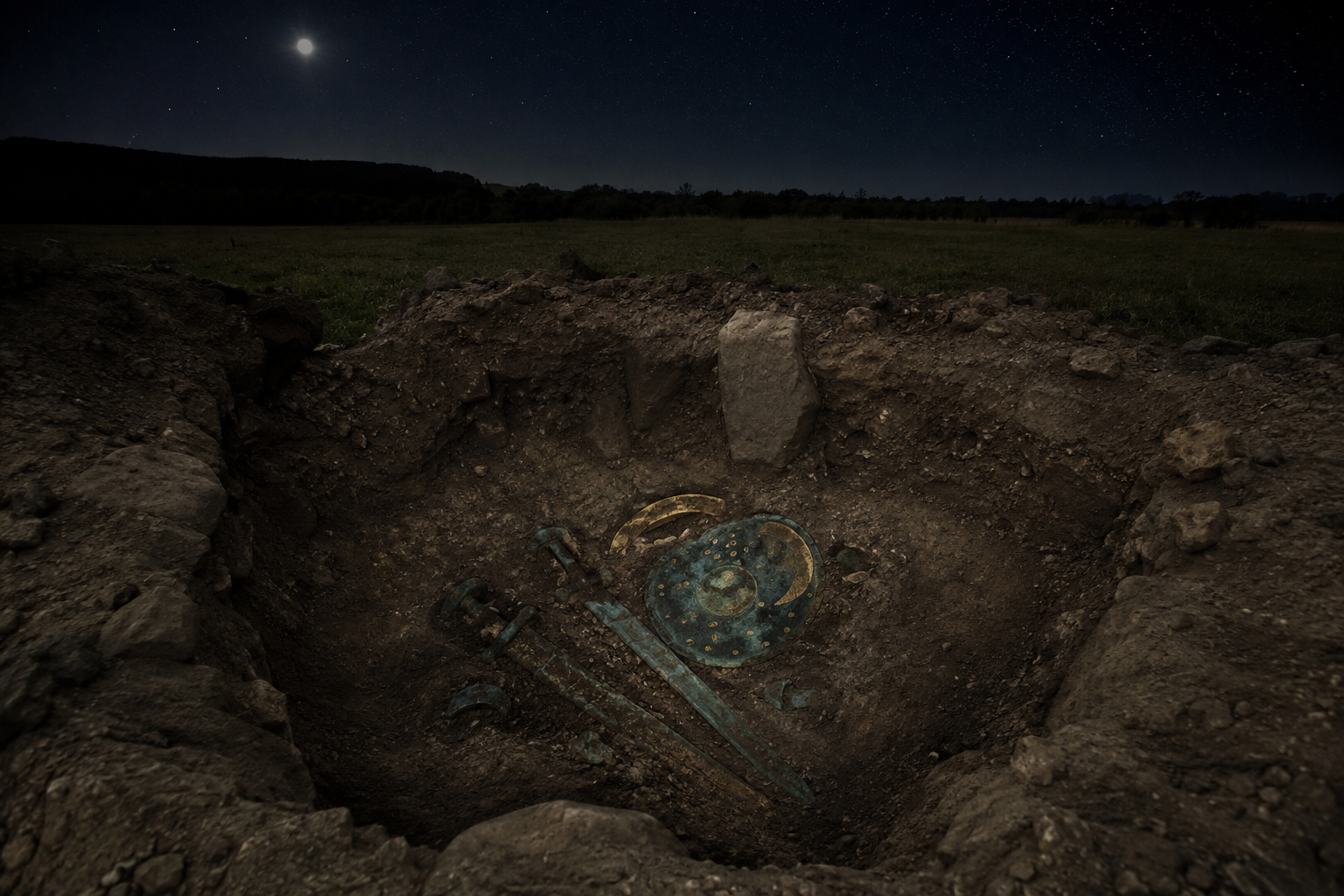
Illustration by Domi Verse X
It was buried with two swords and an axe, dug up illegally, and sold on the black market twice before anyone understood what they were holding.
This article contains affiliate links. If you buy through them, we may earn a small commission at no extra cost to you.
In the summer of 1999, two men climbed a wooded hill called Mittelberg, near the small German town of Nebra, with a metal detector. They had no permit to dig there. When the detector beeped, they found a bronze disc caked in dirt, and next to it, two bronze swords, two axes, a chisel, and pieces of broken arm rings, all buried together on purpose more than 3,000 years earlier. In the rush to dig it out, they tore some of the gold off the disc with a spade. If you want to look up at roughly the same night sky those Bronze Age people once tried to map, a beginner telescope is a cheap place to start.
They did not report the find. They sold it the very next day, for around 31,000 Deutsche Mark, to a dealer in Cologne. Over the next three years, the disc changed hands several times, moving further into the shadows, its price climbing toward the equivalent of about a million Deutsche Mark by 2001.
For years, almost nobody outside that black market knew the object existed. When archaeologists finally got their hands on it in 2002, they were looking at something that should not have survived, and that some of their own colleagues would spend the next two decades insisting was a fake.
This is the story of how that argument ended.
A Treasure That Almost Disappeared for Good
Word about the disc eventually reached Harald Meller, the state archaeologist for Saxony-Anhalt, the German region where it was found. Working with Swiss police, he arranged a sting operation in a hotel in Basel, Switzerland, in February 2002, and recovered the disc for 700,000 Deutsche Mark. The two men who originally dug it up were later convicted of a crime, and received a suspended sentence that was increased on appeal in 2003.
Think about how close this came to never happening. Illegally excavated artifacts are usually sold quietly to private collectors and never seen by scientists again. If that police sting had failed, or happened a year later, one of the most important objects from Bronze Age Europe might be sitting in someone's private display case today, with nobody outside that room ever knowing what it showed.
What Is Actually on the Disc
Once restorers cleaned it up, the disc turned out to be a bronze plate a little over a foot across, roughly the size of a vinyl record, and about as heavy as a bag of sugar. Hammered into its blue-green surface, in gold, are a full circle standing in for the sun or a full moon, a curved sliver for a crescent moon, and a tight cluster of small gold dots that most archaeologists read as the Pleiades star cluster, the same small clump of stars you can still pick out with your own eyes on a clear night.
The disc was not finished all at once. At some later point, whoever owned it added two gold arcs along its edges, one on each side. Those arcs mark the exact spots on the horizon where the sun rose and set on the two most extreme days of the year: the longest day of summer and the shortest day of winter. A separate curved gold shape, added later still, is usually read as a boat, tied to Bronze Age beliefs about the sun crossing the sky by day and traveling back at night by ship. In other words, this wasn't a one-time drawing. Someone kept coming back to this object and adding to it, the way a person today might keep updating a personal calendar.
A 3,600-Year-Old Question: Is It Even Real?
Enjoying this story?
Get a short teaser by email whenever we publish something new. No spam.
Dating the disc mattered enormously, because a Bronze Age sky map and a clever modern fake would look almost the same to the naked eye. Archaeologists leaned on the objects buried with it. The bronze swords, axes, and chisel in the same hoard match tools and weapons known from the Early Bronze Age Unetice culture, and birch bark still wedged into one sword's handle was radiocarbon dated to between roughly 1600 and 1560 BCE, meaning the disc is usually dated to around 1600 BCE, in that same window.
But because the disc had been dug up illegally, with no archaeologist present to record exactly how it was buried, doubt crept in almost immediately. Some experts argued the whole hoard could have been staged: dug up somewhere else entirely, then deliberately reburied at Nebra with genuine old weapons to make a much younger, possibly forged, disc look ancient to any buyer. If that were true, the disc could have been up to 1,000 years younger than claimed, and one of the most celebrated archaeological finds of the century would have been a very expensive hoax. For most of the 2000s and 2010s, that question was never fully settled.
A star wheel planisphere is a good way to see for yourself how much work went into matching a real object like this to the actual sky, if you want to try mapping a few constellations of your own.
The Proof That Finally Came
The answer arrived far later than most people expected. In November 2024, Meller and metallurgist Christian-Heinrich Wunderlich published a detailed study of the metal itself in the journal Scientific Reports. Under a microscope, the bronze showed the marks of at least 10 separate cycles of heating and hammering, each one requiring the metal to be heated past roughly 700 degrees Celsius before it could be worked again. That is an extraordinary amount of skilled labor for anyone to fake. On top of that, the exact mix of metals in the alloy matched copper from a specific Early Bronze Age mine in Austria, one that had already stopped operating by the time a later forger would have needed to source the metal.
Wunderlich put it plainly: it would be extremely unlikely that anyone faking the disc would have gone to that much trouble. Between the manufacturing process and the metal's origin, the case for a modern hoax fell apart. The disc really is what it looked like all along, a genuine Bronze Age object, made and reworked by real hands roughly 3,600 years ago.
What We Still Don't Know
The Nebra Sky Disc was formally added to UNESCO's Memory of the World Register in June 2013, described by researchers and the museum that now holds it as the world's oldest concrete depiction of astronomical phenomena currently known. It has lived in the State Museum of Prehistory in Halle, Germany since 2008, and it is not going anywhere.
What still divides researchers is not whether it is real, but what it was actually for. Some think it worked as a practical tool, a way to correct the Bronze Age calendar against the real solar year. Others think its main job was symbolic or religious, a portable object used to explain or perform ideas about the sky rather than calculate anything. Nobody has found an instruction manual buried next to it, and the people who made it left no writing behind to settle the argument. So the question sits exactly where it did the day it was pulled out of the ground in 1999: we know, now beyond real doubt, that someone mapped the sky 3,600 years ago. We still don't fully know why.
Sources
- State Museum of Prehistory, Halle: official Nebra Sky Disc page
- UNESCO Portal to the Heritage of Astronomy: Nebra Sky Disc entry
- Deutschlandmuseum: Nebra Sky Disc recovered, 23 February 2002
- Live Science: new study reveals how the ancient sky disc was made, squashing forgery claims (2024)
- Wunderlich & Meller, "Archaeometallurgical investigation of the Nebra Sky Disc," Scientific Reports (2024)