A Teaspoon That Weighs a Billion Tons
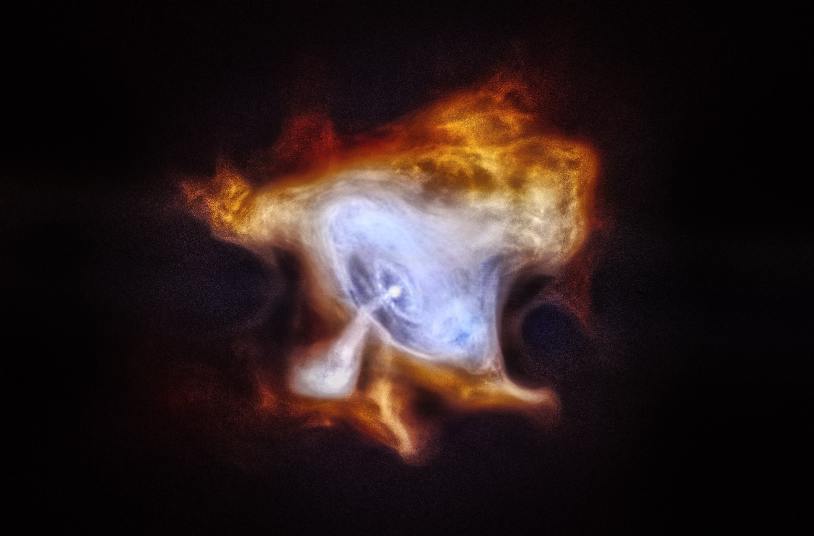
Credit: NASA/CXC/SAO
A neutron star packs so much mass into so little space that a single teaspoon of it could weigh about as much as every person on Earth combined.
This article contains affiliate links. If you buy through them, we may earn a small commission at no extra cost to you.
When a giant star, at least eight times the mass of the Sun, runs out of nuclear fuel, its core can collapse into something that pushes matter to its limit: a neutron star. It packs more mass than our entire Sun into a sphere only about 20 kilometers across, roughly the width of a city. A single teaspoon of that material would weigh somewhere around a billion tons.
Why matter can be squeezed this hard
Ordinary matter, including you, is mostly empty space. An atom's nucleus is tiny compared to the space its electrons occupy around it. When a dying star's core collapses, gravity becomes strong enough to overwhelm the forces that normally keep atoms from touching each other. Electrons get crushed into protons, turning them into neutrons, and the atom's empty space disappears. What is left is essentially one enormous atomic nucleus, held up not by chemistry but by a quantum mechanical effect called neutron degeneracy pressure: neutrons packed so tightly that a rule of physics, that no two identical particles can occupy the exact same state, is the only thing stopping total collapse.
That is why the density is so extreme. There is almost no empty space left to compress.
How anyone measures something nobody can touch
Nobody has sampled a neutron star, and nobody ever will: getting close enough would be lethal long before arrival, and no probe could survive the gravity or radiation. The numbers come from three independent methods that mostly agree with each other.
Astronomers measure a neutron star's mass by watching how it pulls on a companion star or, in the case of pulsars, timing the pulses of radio waves the neutron star sweeps out as it spins, sometimes hundreds of times per second, with the timing precise enough to reveal tiny gravitational effects. Its radius is measured more directly by missions like NASA's NICER telescope, mounted on the International Space Station, which watches how X-rays from hot spots on a pulsar's surface are bent by the star's own gravity. And in 2017, the LIGO and Virgo observatories detected gravitational waves from two neutron stars colliding, an event called GW170817, which gave physicists an entirely independent way to constrain how stiff or squeezable neutron star matter actually is.
Enjoying this story?
Get a short teaser by email whenever we publish something new. No spam.
What is still disputed
The mass and radius are reasonably well pinned down for several dozen known neutron stars. What is not settled is what the material is actually doing at the very center. Some physicists think the core is a soup of pure neutrons. Others think the pressure is high enough to break neutrons apart entirely into their component quarks, forming a state of matter never observed on Earth. The relationship between a neutron star's mass and its exact internal pressure at every depth, what physicists call its equation of state, is one of the biggest open questions in nuclear physics, and it is the reason estimates for something as basic as how much a teaspoon would weigh still come out as a wide range rather than one number.
Why it matters
Neutron stars are the densest objects in the universe that we can actually observe, short of a black hole itself. They let physicists test what happens to matter under conditions no particle accelerator on Earth can reproduce. The 2017 collision that produced GW170817 also confirmed that neutron star mergers forge heavy elements like gold and platinum, scattering them into space the way exploding stars scatter lighter elements. Some of the gold in the room around you may have been made in a collision like that.
So the teaspoon that weighs a billion tons is not just a striking number. It is a doorway into physics at the edge of what matter can do, tested by objects that no laboratory could ever build.