On August 30, NASA launches a telescope that sees one hundred times more space than Hubble
NASA
Same mirror as Hubble. One hundred times the view. And a question about the universe that it may finally settle.
This article contains affiliate links. If you buy through them, we may earn a small commission at no extra cost to you.
In a clean white room in Florida, a machine about the size of a small bus stands between two open halves of a rocket nose cone. The halves are propped on blue steel frames, curved like a shell waiting to close. Inside them the machine is wrapped in silver insulation, with folded solar panels the colour of dried blood. Once those halves swing shut, nobody will look at it directly again.
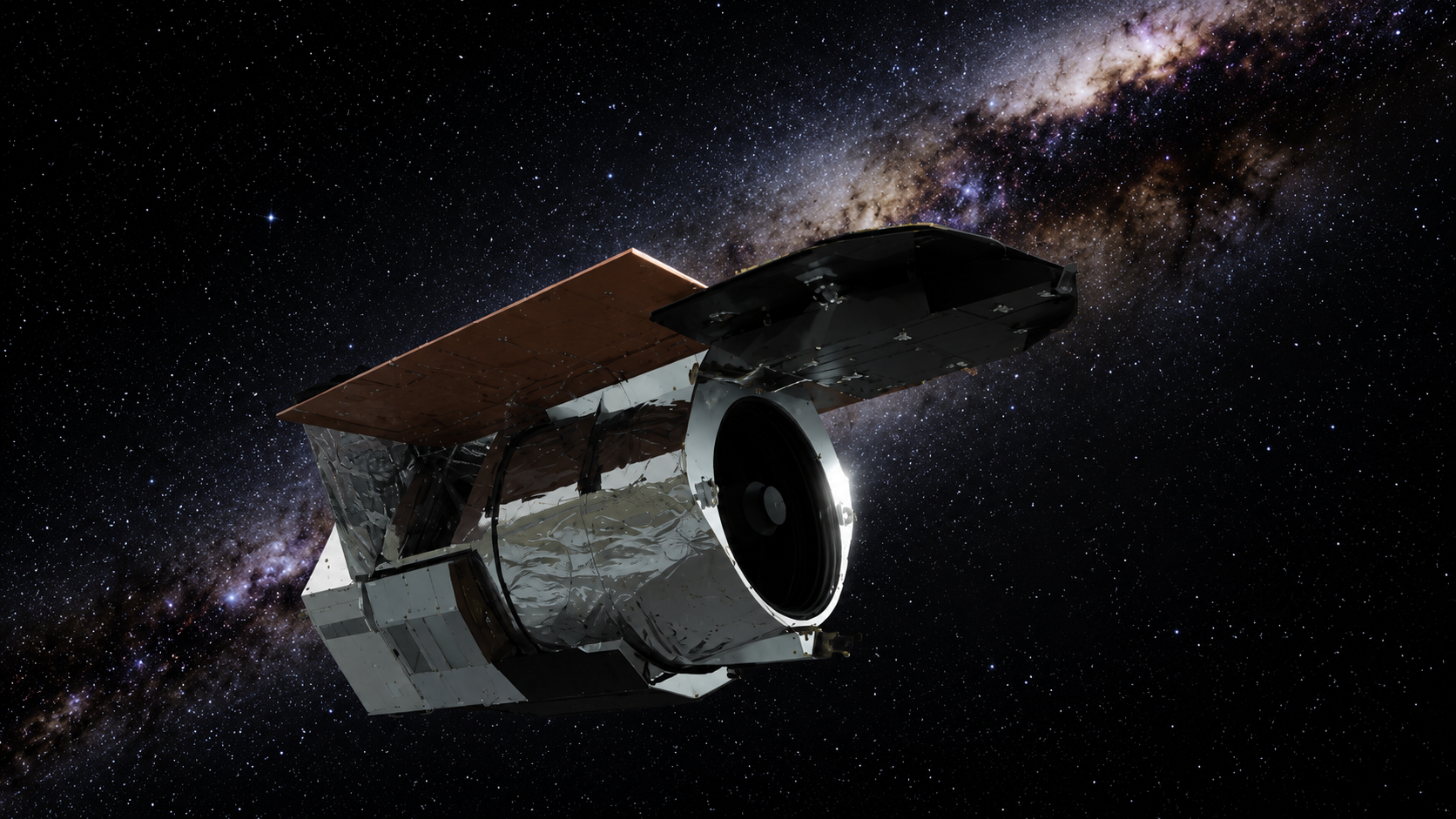
The machine is the Nancy Grace Roman Space Telescope. It cost about 4.3 billion dollars, and on Sunday, August 30, 2026, at 7:26 in the morning Eastern time, a SpaceX Falcon Heavy is scheduled to carry it off Launch Complex 39A at NASA's Kennedy Space Center. If the weather refuses, the backup attempt is the following morning. The flight itself lasts a little over half an hour before the telescope separates and starts its own journey. If you want something to do with the sky while you wait for the first images, a simple star wheel will show you what is overhead tonight without any batteries or apps.
The mirror is the boring part
Roman carries a primary mirror 2.4 metres across. That is exactly the same size as the mirror inside Hubble.
This is the first surprise. After more than three decades of progress, NASA did not build a bigger eye. It built the same size eye.
It did not need a bigger one. Roman has broadly the same sensitivity and the same sharpness of vision as Hubble. A single star looks about as crisp through one as through the other.
The difference is not the eye at all. It is how much of the universe lands on the sensor at once.
What "one hundred times more" actually means
Think about photographing a crowd in a stadium.
Hubble is a photographer with an extremely long lens. It can show you one face in that crowd in beautiful detail, down to the stubble and the reflection in the eye. But it shows you one face at a time. To cover the whole stand it has to take thousands of pictures and stitch them together afterwards.
Roman is a photographer standing in the same spot, with the same quality of detail, holding a camera that takes in a hundred faces per click.
NASA puts the number plainly: Roman's field of view is 100 times larger than Hubble's, and its Wide Field Instrument is a 288 megapixel camera covering 0.28 square degrees of the sky in one shot.
Nothing about the sharpness changed. What changed is the width. And that single design choice turns Roman into something Hubble could never be, which is a survey machine.
A century of work, done in a month
Here is the number that makes people stop.
Roman is planned to run a survey of the Milky Way that takes about one month. Julie McEnery, the project scientist, put the comparison in one sentence: "That one month of observations to survey our Milky Way galaxy would take about a century with Hubble."
Not a longer weekend. Not a few extra years. A century, compressed into a month.
That is what happens when you multiply the field of view by a hundred and keep the image quality the same. Astronomy stops being a matter of choosing one precious target and staring at it. It becomes a matter of photographing everything and sorting it out later. Over its mission Roman is expected to observe more than a billion galaxies. Amateur astronomers run a very small version of the same routine, and the thing that ruins it fastest is white light killing your dark adaptation, which is the entire reason a dim red astronomy light exists.
The thing it is actually hunting
Roman's headline job is not pretty pictures. It is a force.
In the late 1990s, two teams measuring exploding stars called Type Ia supernovae found something nobody had ordered. The universe is not simply expanding. The expansion is speeding up. Something is pushing space apart, and it is beating the combined gravity of every galaxy that has ever existed. The discovery won the Nobel Prize in Physics in 2011.
Enjoying this story?
Get a short teaser by email whenever we publish something new. No spam.
Nobody has ever seen this force directly. It has no confirmed particle and no accepted explanation. Physicists call it dark energy, which is an honest name, because "dark" here mostly means we cannot see it and do not understand it. On the usual estimates it accounts for roughly two thirds of everything in the universe, which makes it the largest single component of reality and also the largest blank space in the textbook.
Roman's method is the same one that found the problem in the first place. Type Ia supernovae explode with a fairly predictable brightness, so comparing how bright one should be with how bright it looks gives you its distance. Do that for thousands of them, at many different distances, and you can read the expansion history of the universe the way you read tree rings. Roman is designed to find and monitor thousands of them.
Why this particular launch is not routine
Here is the part that does not fit on a video card.
For most of the last twenty five years, dark energy has been treated as a constant. Same strength everywhere, same strength for all time, a fixed property of empty space. That assumption is built into the standard model of cosmology, and everything we say about how the universe ends rests on it.
That assumption has started to wobble.
In March 2025 the Dark Energy Spectroscopic Instrument released an analysis built on nearly 15 million galaxies and quasars, and when its data was combined with other cosmic measurements, the result leaned towards dark energy that changes over time rather than staying fixed. Depending on which datasets are combined, the preference sits somewhere between 2.8 and 4.2 sigma.
That is not a discovery, and the researchers say so themselves. Physics uses 5 sigma as its threshold, and as the DESI team noted, plenty of 3 sigma results in physics have quietly faded away. A 3 sigma event still has roughly a 0.3 percent chance of being a fluke, and the history of the field is littered with them.
So the situation right now is a genuine cliffhanger. There are real hints that the most fundamental assumption in cosmology is wrong, and not enough evidence to act on them.
Roman is the machine that settles it. Speaking before the launch, one cosmologist said Roman will "absolutely nail, whether the model's right or wrong". That is an unusually confident thing for a scientist to say about a spacecraft still sitting on the ground. It means this is not a mission sent up to add a decimal place. It is a mission sent up to decide something.
And what it may decide is not academic. Whether dark energy holds steady or fades is the difference between a universe that expands smoothly forever and a universe with a completely different ending.
The second job: planets found by bent light
While it does all that, Roman will also hunt planets, using a method most people have never heard of.
When one star drifts in front of a more distant star from our point of view, the nearer star's gravity bends and focuses the light behind it. The background star appears to brighten over days or weeks, then fade. This is gravitational microlensing.
If the nearer star has a planet, that planet adds its own small extra spike to the brightening. A blip inside a bump.
The value of this trick is that it reaches planets other methods cannot. Cold planets far from their star. Planets on the far side of the galaxy. Planets near the crowded galactic centre, a region that has been effectively off limits. In roughly three decades of searching, astronomers have confirmed around 6,300 planets outside our solar system. Roman is expected to add something in the order of 100,000 more, with some simulations running higher still. NASA expects more than 100,000 of those to come from transits, where a planet crosses in front of its star, on top of whatever microlensing turns up.
To catch a microlensing event you have to be watching millions of stars at once, constantly, because the signal lasts hours and never repeats. Which brings us back to the field of view. The same design choice that maps the galaxy in a month is what makes catching that blip possible at all.
What happens after Sunday
The halves of that nose cone close. The rocket flies. If everything works, Roman travels out to a quasi halo orbit around the second Sun Earth Lagrange point, a gravitational parking spot roughly 1.5 million kilometres from Earth, unfolds, cools down, and begins a primary mission planned to run five years, with hardware designed to support another five after that.
Then the data starts arriving, in quantities no team of humans can look at directly. The images will be sorted by software, and the overwhelming majority of what Roman sees will never be viewed by a person at all. For anyone who would rather start with the sky they can actually see, NightWatch is still the book most amateur astronomers hand to beginners.
Which leaves a question worth sitting with. We are about to open the widest eye we have ever built and point it at the largest unexplained thing in the universe. If the answer that comes back is that our model of the universe was wrong all along, we will have found it buried in a data set too big for anyone to read.
Sources
- Roman Space Telescope Frequently Asked Questions, NASA Science
- NASA's Nancy Grace Roman Space Telescope launches on an eye opening mission, NPR
- NASA is about to launch a space telescope that could change how we see the universe, KPBS
- What time will SpaceX launch NASA's Roman Space Telescope on Aug. 30?, Space.com
- New DESI results strengthen hints that dark energy may evolve, Fermilab News