A Telescope Found a Sign of Life on Another Planet. Then the Argument Started, and It Still Hasn't Ended.
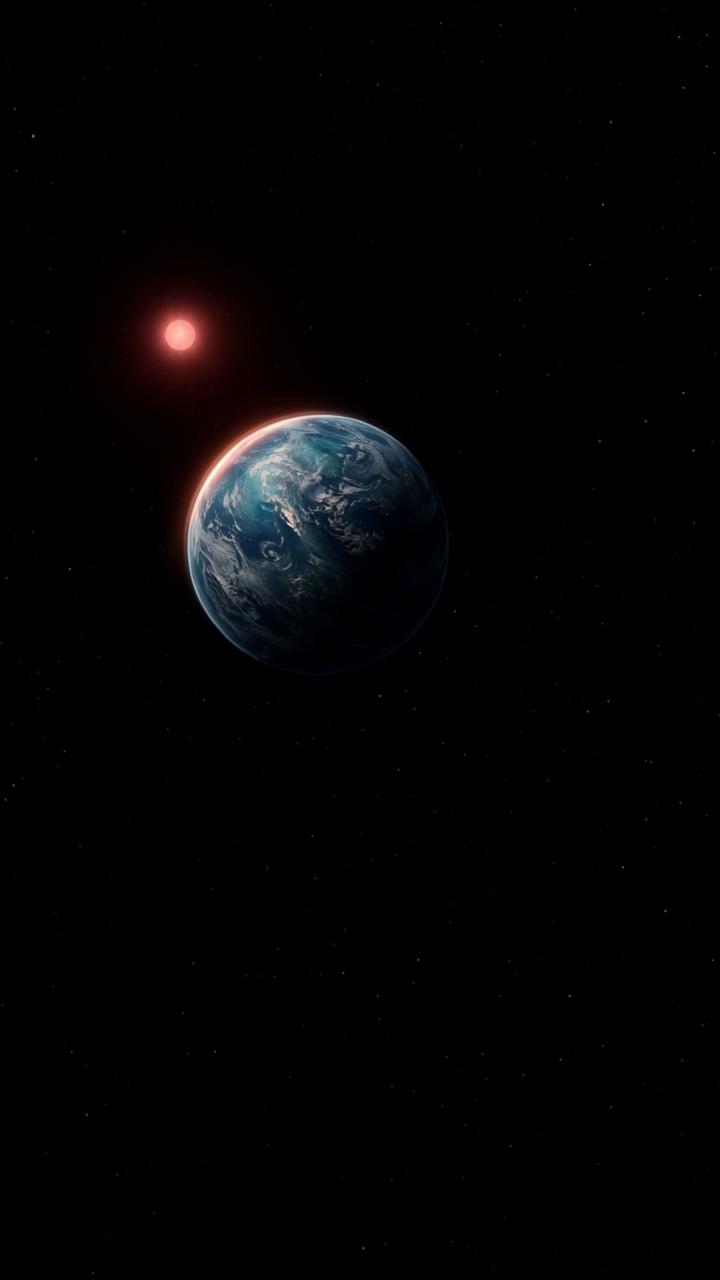
Illustration by Domi Verse X
A team at Cambridge found a gas that, on Earth, comes almost entirely from life, drifting in the atmosphere of a planet 124 light-years away. Within days, other scientists said the signal barely exists at all, and the argument still hasn't been settled.
This article contains affiliate links. If you buy through them, we may earn a small commission at no extra cost to you.
In 2025, a telescope pointed at a speck of light in the constellation Leo picked up a chemical signature that, on Earth, comes almost entirely from one source: living things. The planet is called K2-18b, and it is not a place anyone has seen up close. It is a shadow crossing in front of a dim red star, 124 light-years away, known only through the tiny dip it makes in starlight and the faint chemical fingerprint hidden inside that dip. One team says that fingerprint might be a sign of life. Several other teams say the fingerprint barely exists at all. Nobody has settled it, and that argument is still going on right now.
A Water World Under a Hydrogen Sky
K2-18b is about 2.6 times wider than Earth and roughly 8.6 times heavier, which puts it in a size category we do not have a single example of in our own solar system, somewhere between Earth and Neptune. It orbits its star every 33 days, close enough that it should be scorched, except its star is a small, cool red dwarf, dim enough that the planet still sits in the temperature range where liquid water could exist. In 2019, astronomers found water vapor in its atmosphere, one of the first such detections for any planet in a star's habitable zone. When the James Webb Space Telescope studied it more closely in 2023, it found methane and carbon dioxide but almost no ammonia, a pattern that fits a theory some astronomers call a Hycean world: a deep global ocean sealed under a thick blanket of hydrogen gas. Nobody has photographed that ocean and nobody can. Everything known about K2-18b comes from starlight filtered through its air, read out as a graph of exactly which colors are missing.
A Molecule Earth Makes Only One Way
The molecule at the center of the argument is called dimethyl sulfide, DMS for short. On Earth, it comes from ocean plankton and algae, and virtually all of it in our atmosphere traces back to marine life. That is what made it interesting to astronomers watching a possible ocean world. If DMS showed up in K2-18b's atmosphere in strong enough amounts, it would be one of the closest things to direct evidence of life beyond Earth that anyone has ever found. A planisphere like this one will show you roughly where in Leo to look, though the planet itself is far too faint and small for any backyard telescope to see.
The Claim That Made Headlines
In April 2025, a team at the University of Cambridge led by astrophysicist Nikku Madhusudhan announced their strongest results yet, describing them as the most compelling evidence so far for a possible biosignature outside the solar system. Reading a planet's atmosphere this way is a bit like identifying a spice by its smell through a wall from a hundred meters away. A handheld spectroscope lets you see the same basic idea up close: every substance splits light into its own pattern of colors, and astronomers are hunting for K2-18b's pattern buried inside noise from a star 124 light-years away. Using a different Webb instrument than earlier observations, the Cambridge team reported a DMS and DMDS signal at roughly three-sigma confidence, meaning there was about a 0.3 percent chance the pattern was random noise. That sounds convincing, but astronomers generally will not call something a confirmed detection until it reaches five-sigma confidence, a threshold so strict it corresponds to a chance of roughly one in a few million of it happening at random.
Almost as Fast, the Doubts Piled In
Enjoying this story?
Get a short teaser by email whenever we publish something new. No spam.
Within days, other researchers pushed back. Astronomer Jake Taylor at the University of Oxford ran an independent statistical check and found the data looked statistically consistent with a flat line, meaning no clear signal at all. A separate team led by Luis Welbanks at Arizona State University tested more than 90 different molecule combinations against the same observations and found that almost any of several other gases, including one called propyne, fit the data about as well as DMS did, sometimes better. A group at NASA's Jet Propulsion Laboratory, led by Renyu Hu, and including Madhusudhan himself as a co-author, reanalyzed the data and found only a much weaker, marginal signal, well under three-sigma confidence, far short of the original claim. Then, in August 2025, a separate team published a joint analysis in the journal Astronomy & Astrophysics that combined every available Webb instrument into one look at the planet's full observed spectrum, the most complete such analysis so far. They found no statistical support for DMS or DMDS at all, and estimated that roughly 25 more Webb observations of the planet crossing its star would be needed before the question could be settled either way.
Even If the Signal Is Real, It Might Not Mean Life
There is a second problem, separate from whether the signal is even there. In 2024, scientists studying dust from comet 67P, sampled by the European Space Agency's Rosetta mission, found dimethyl sulfide in it too, produced by ordinary chemistry with no biology involved. The same molecule has since turned up in interstellar gas clouds where nothing living has ever formed. Neither of those places has plankton. That does not prove K2-18b is lifeless. It means that even a confirmed DMS detection would no longer, on its own, prove the opposite.
Meanwhile, Astronomers Listened for Something Else Entirely
While the DMS argument was unfolding, a separate team pointed radio telescopes, the Very Large Array in New Mexico and MeerKAT in South Africa, directly at the K2-18b system, scanning frequencies from 544 megahertz up to 9.8 gigahertz for any signal that looked artificial rather than natural, the same basic listening principle behind a hobbyist's handheld radio scanner, just aimed at a target 124 light-years away instead of the local airwaves. The results, published in July 2026 in The Astronomical Journal, showed nothing: more than 20 million candidate signals were filtered out one by one, and none held up as a genuine transmission. That result says nothing about whether DMS is really there. It simply means that if anyone, or anything, is broadcasting from K2-18b on a radio frequency humans know how to listen for, they were not doing it loudly enough to hear.
An Argument That Is Still Live
Right now, nobody can honestly say whether K2-18b has life on it, an ocean at all, or neither. What is certain is that a small, cold-lit planet has pulled some of the most careful scientists in the world into a genuine, ongoing disagreement, playing out in public, one reanalysis at a time. The next round of Webb observations could add the missing evidence, or quietly explain the whole thing away. For now, the fingerprint in the starlight is still there, still argued over, and still unread.
Sources
- University of Cambridge: Strongest hints yet of biological activity outside the solar system
- arXiv: New Constraints on DMS and DMDS in the Atmosphere of K2-18 b from JWST MIRI
- Space.com: Doubts mount further over signs of alien life on exoplanet K2-18b
- Universe Today: How the Evidence for Alien Life on K2-18 b Evaporated
- Astronomy & Astrophysics: Insufficient evidence for DMS and DMDS in the atmosphere of K2-18 b
- Astronomy.com: Signs of life on K2-18 b revisited in new NASA study
- Astronomy.com: No signs of technology on exoplanet K2-18 b
- ScienceDaily: Are there aliens on exoplanet K2-18b? Scientists just scanned it for signals
- Astrobiology.com: Evidence for Abiotic Dimethyl Sulfide in Cometary Matter
- IOPscience: On the Abiotic Origin of Dimethyl Sulfide, discovery of DMS in the Interstellar Medium
- Wikipedia: K2-18b
- PBS NOVA: Water vapor found on an 'Earth-sized' exoplanet, 110 light-years from home