There is a room under Italy and it is believed to be full of books.
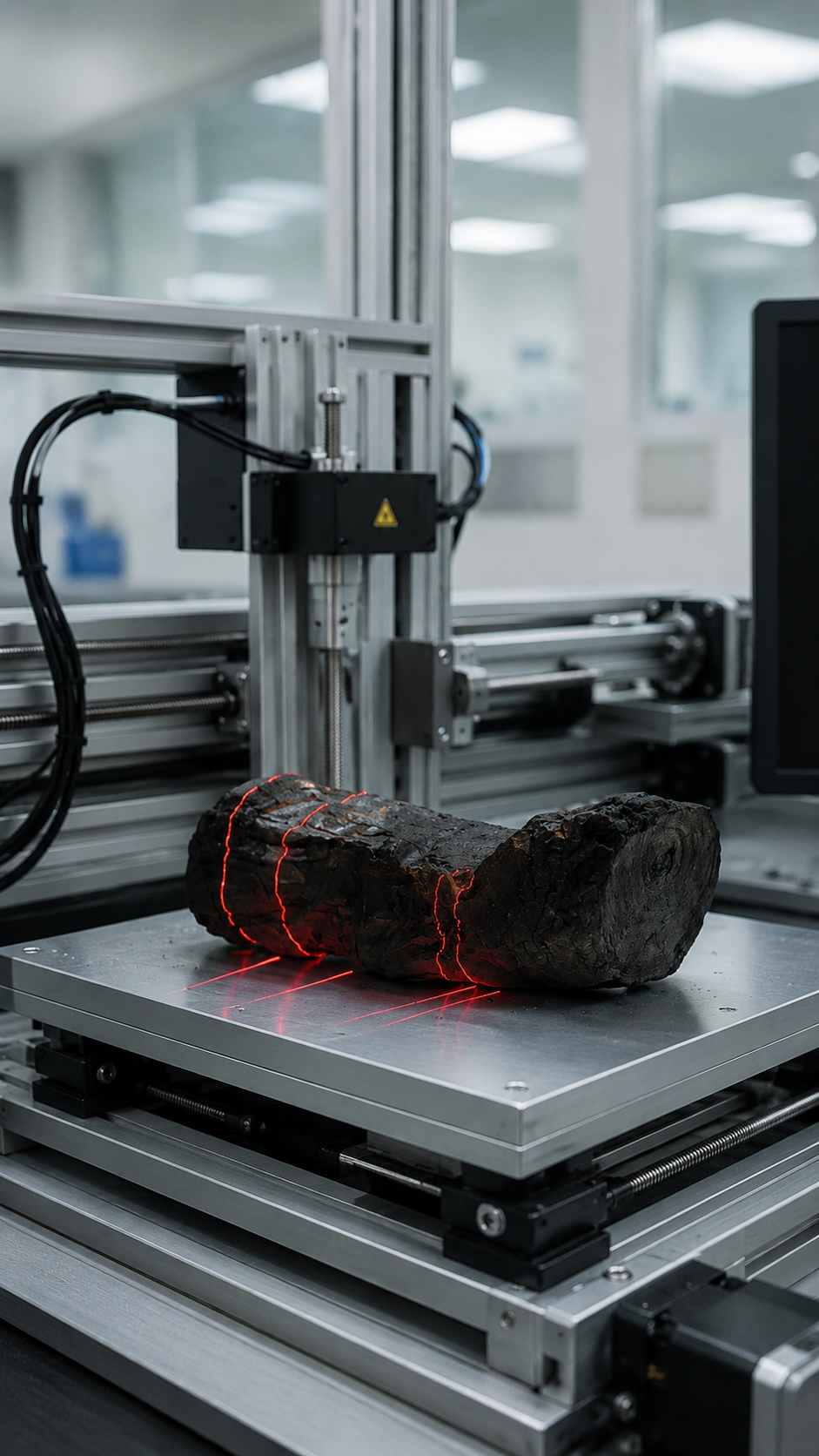
Illustration generated with AI for DomiVerseX
Eighteen hundred Roman books survived a volcano. Then people started trying to open them.
This article contains affiliate links. If you buy through them, we may earn a small commission at no extra cost to you.
In 1750 a farmer digging a well in the hills above Naples hit a marble floor about twenty metres down. He had struck the roof of a Roman house that Mount Vesuvius buried in the year 79, and everything under that point had to be reached the way he found it, in the dark, by lamplight.
The kings of Naples did not excavate it. They mined it. Engineers sank shafts and drove narrow tunnels through the hardened volcanic rock, hauling out statues and filling the tunnels in behind them. Those tunnels are still down there, and they look exactly like what they are, which is a mine cut straight through somebody's house.
In one room the tunnellers found what looked like lumps of firewood. Some were stacked on shelves. Some were on the floor. A few were thrown away before anyone worked out what they were.
The Only Library That Survived
They were books.
Between 1752 and 1754 that room and three other spots in the house gave up more than 1,800 rolls and fragments of papyrus, and some counts put the number closer to 2,000. The building has been called the Villa of the Papyri ever since. It may have belonged to Lucius Calpurnius Piso Caesoninus, who was Julius Caesar's father in law, though that is a strong guess rather than a settled fact.
Here is the part that is hard to take in. Every other library of the ancient world is gone. Alexandria is gone. The collections of Rome and Athens are gone. Almost everything we have of Greek and Roman writing survives because somebody copied it by hand, and then somebody copied that, over and over for a thousand years. This is the only intact library known from the classical world. It is still sitting where its owner left it.
It did not survive because anyone protected it. It survived because it was buried alive.
Why They Look Like Firewood
When Vesuvius erupted, the thing that killed Herculaneum was not lava. It was a pyroclastic flow, a wall of gas and ash moving fast and hot enough to cook everything it touched.
Inside a sealed room there was almost no oxygen, and without oxygen organic material does not burn away to ash. It carbonises. The papyrus turned to carbon and stopped there, and the ash then set around it like cement and held it for seventeen centuries. If you have never handled the material, a sheet of real papyrus explains a lot: it is plant fibre pressed into a mat, and it burns the way a dry reed does.
So the books were not destroyed. They were turned into charcoal with every letter still on them. Pick one up today and you are holding a black cracked cylinder that weighs almost nothing and looks like something you would put in a stove.
The ink is why they are so hard to read. It is mostly carbon, sitting on a page that is now also carbon, which is close to invisible on a normal scan and would defeat anything you could hold up to it. Later work found traces of lead in some of it, and that turned out to matter.
The Reading Is What Destroyed Them
This is where the story turns ugly.
For two and a half centuries the only way to read one of these was to open it, and every method of opening one damaged it.
In the 1750s an Italian monk named Antonio Piaggio built a machine that lifted the outer layer away with silk threads, a fraction of a millimetre at a time, while artists copied what appeared. It took four years to get through the first scroll. Hundreds of scrolls were pulled apart on that machine, and the record says it destroyed the beginning of every papyrus it touched.
Others were less careful. Camillo Paderni simply sliced rolls in half, copied the text he could see, and scraped the layer away to reach the next one. Hundreds of rolls were transcribed that way and destroyed in the process.
People also tried rose water, mercury and sulphur compounds. Humphry Davy, the chemist who invented the miner's safety lamp, went at them with chlorine gas in 1819 and 1820 and got 23 of them partly open.
Enjoying this story?
Get a short teaser by email whenever we publish something new. No spam.
By the middle of the twentieth century, 585 rolls had been fully unrolled and 209 partly unrolled. What came out of all that is real ancient literature, most of it by an Epicurean philosopher called Philodemus of Gadara, whose work accounts for 44 of the identified texts.
And every page of it cost a book.
Nobody agrees on exactly how many sealed scrolls are left. The published figures run from about 400 to more than 600, depending on who is counting and whether fragments count. What everyone agrees on is that nobody opens them any more.
The Books Are Being Read Right Now
In 2016 a team led by Brent Seales at the University of Kentucky read a burnt scroll from En-Gedi in Israel without unrolling it. They scanned it, found the individual layers inside the scan, flattened those layers in software, and put the ink back onto the flattened surface. The method is called virtual unwrapping, and the results were published in Science Advances.
Herculaneum was much harder, because the ink barely registers. The answer turned out to be machine learning: train a model to recognise the faint texture the ink leaves in the scan, then point it at data no human eye can interpret.
In March 2023 the project was thrown open as a public competition with prize money, the Vesuvius Challenge. That October a 21 year old student named Luke Farritor found the first word inside a sealed scroll. It was porphyras, Greek for purple. In February 2024 a 700,000 dollar grand prize went to a team that recovered about five percent of one scroll, and the text was a previously unknown work by Philodemus about music, food and pleasure.
Then came 2026. Using synchrotron scans from Diamond Light Source in Britain and the ESRF in France, three sealed scrolls gave up their contents at once. PHerc. 1667 became the first Herculaneum scroll ever virtually unwrapped and read from end to end, nearly a metre and a half of text across around twenty columns, by an author nobody has identified. PHerc. 172, held at the Bodleian Library in Oxford, produced more than seventy columns and turned out to be Philodemus writing On Vices. A third was identified as book eight of Philodemus On Gods, which tells us that work ran to at least eight books.
"Today, after years of interdisciplinary work combining advanced imaging, artificial intelligence, academic research and an innovation contest, we are finally able to read them," Seales said.
Nobody had to touch a single one of them.
The Part Nobody Is Digging Up
Now go back to the house.
Most of the Villa of the Papyri has never been excavated. One assessment put roughly 2,800 square metres of it still underground. Work in the 1990s found two further levels of the villa that nobody had explored, and some scholars believe those levels could hold hundreds or even thousands more scrolls.
There is a specific suspicion attached to them. The library that was found is a Greek library, dominated by one philosopher, which is what a specialist's working collection looks like. A Roman house of that size would normally have had a Latin library as well, and it may still be down there on a floor nobody has reached. The published site guides, including the standard account of the buried city, are describing a fraction of what is there.
That is the real prize. Not more Philodemus, but Latin literature that no medieval monk ever copied, and that therefore no living person has read.
It is not being dug. The Italian authorities have put conservation of what is already exposed ahead of opening new ground, which is a defensible call given how fast unprotected Roman material falls apart once air reaches it. Private money has been offered. A feasibility study has been discussed for years without being finished. And there is a practical problem that has not changed since the Bourbons stopped tunnelling in 1765, which is that there is an inhabited town directly on top.
So the situation is this. We finally have a way to read these books that does not destroy them. It works, it has been proven on a whole scroll, and it can be pointed at anything. The largest untouched collection of them is under a residential neighbourhood, and nobody is going to get it.
The scrolls have waited one thousand nine hundred and forty seven years.
Nobody has said how much longer they get.
Sources
- Herculaneum papyri, Wikipedia
- Villa of the Papyri, Wikipedia
- Smithsonian Magazine: Buried by the Ash of Vesuvius, These Scrolls Are Being Read for the First Time in Millennia
- The Past: Reading the Herculaneum Scrolls
- Vesuvius Challenge
- Diamond Light Source: New secrets revealed from the Herculaneum scrolls, 2026
- ESRF: The day the Herculaneum scrolls began speaking again
- University of Kentucky Digital Restoration Initiative
- From damage to discovery via virtual unwrapping: Reading the scroll from En-Gedi, Science Advances, 2016