Egypt Has Lost Three Cities to the Sea, and the Last One Is Still Standing
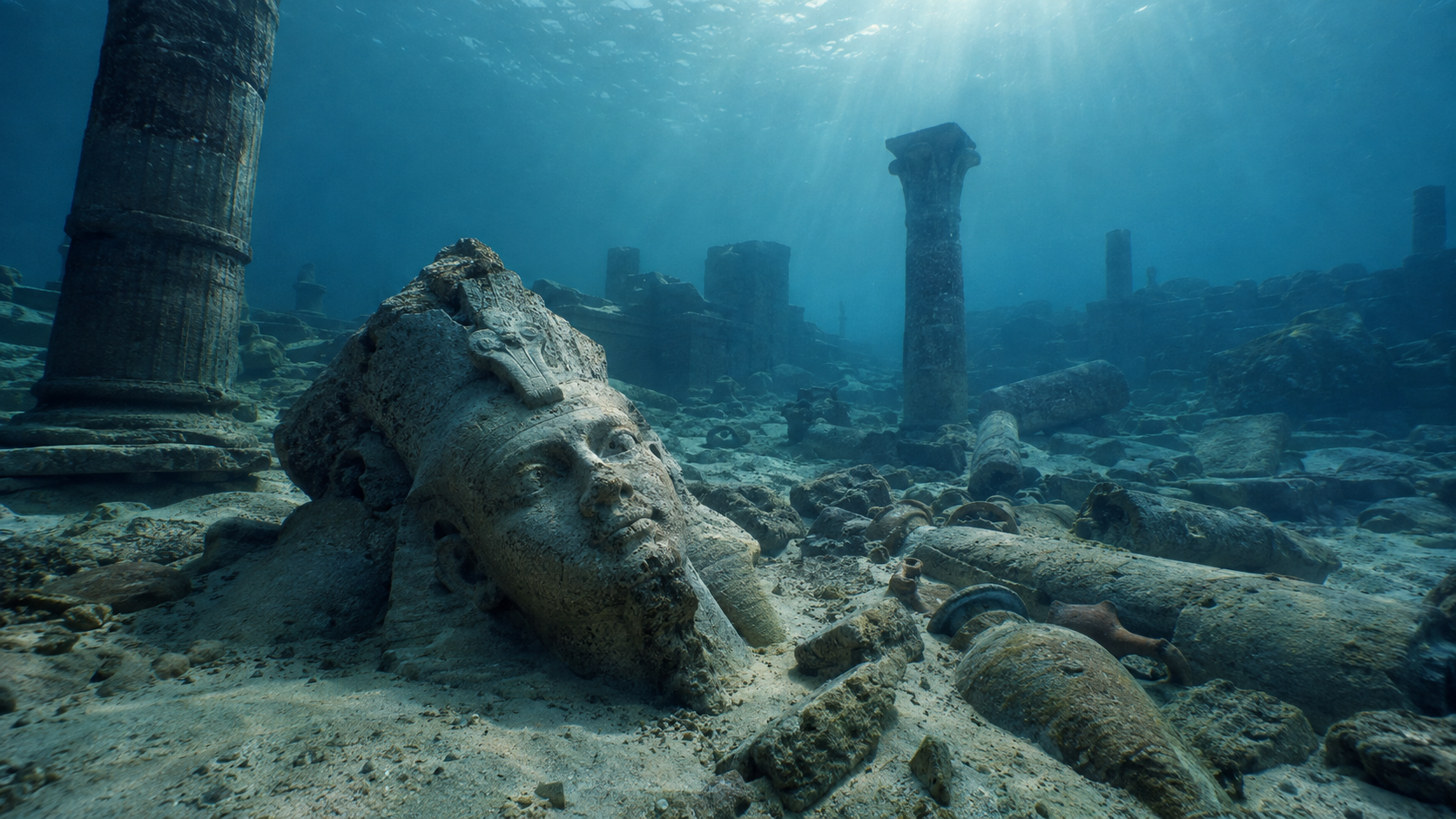
Illustration by Domi Verse X
Two of them are completely underwater. The third is the one you have heard of, and most of it is still above water.
This article contains affiliate links. If you buy through them, we may earn a small commission at no extra cost to you.
Along a single stretch of Egyptian coastline, about twenty miles end to end, there are three ancient cities lying on the seabed. Two of them went down completely. The third is the one you have heard of, and most of it is still above water, which is the part that should worry you.
Start in Abu Qir Bay, about four miles off the coast. The water there is shallow, roughly six metres, and it is murky green and full of drifting silt, so the beam of a light carried down into it dies after a few feet. In 2000, after a five year search, a French team led by Franck Goddio was pulling survey gear across this bay when the instruments began returning shapes that were too straight to be seabed. Walls. Column bases. A slab of granite the size of a small car.
The Port That Was Egypt's Front Door
What they had found was Thonis-Heracleion, and before Alexander the Great founded Alexandria in 331 BC, this was where Egypt met the rest of the world.
Ships arriving from the Greek world came through here to be taxed and inspected. The city was founded around the seventh century BC and was at its busiest between the sixth and fourth centuries. At the centre stood the temple of Amun-Gereb, which according to Goddio's team was not only a place of worship but a place of politics, where pharaohs came to have their right to rule confirmed.
Ancient writers had mentioned the place. Herodotus described a town at the mouth of the Nile where Paris and Helen were stopped on their way to Troy, watched over by a man named Thonis. Other Greek sources wrote about somewhere called Heracleion. For centuries scholars assumed these were two different towns, somewhere on dry land, buried under the delta fields where you could trace them on a map.
They were the same place, and it was not on land at all. The proof came up out of the water with everything else: a slab of black granodiorite carrying a decree of Nectanebo I, and the decree names the city the stone was meant to stand in. It says Thonis. It was found in Heracleion. One stone ended an argument that had run for generations.
Seventy Ships and a God Face Down in the Mud
The inventory is what stops people.
Around seventy vessels have been recorded on that seabed, which the excavation team describes as the largest deposit of ancient ships found anywhere in the world. Hundreds of stone and lead anchors lie among them. One wreck turned out to be a boat type called a baris, which Herodotus described in careful detail and which no archaeologist had ever found, until this one was excavated between 2009 and 2011 and matched his description almost line for line.
There are gold coins and bronze coins from the reign of Ptolemy II, small enough that you would want something to look at them closely. There is jewellery, there are sarcophagi for sacred animals, and there are Greek weapons. The centrepiece is a figure of Hapy, the god of the Nile flood, carved from granite and standing 5.4 metres tall, which is a shade under eighteen feet. He is holding an offering table. He spent most of two thousand years lying face down in the mud.
And the site is barely touched. Goddio's own published estimate is that around five percent of the city has been excavated. The other ninety five percent is still there.
The City of Miracles, Two Kilometres Away
Now move east along the same coast.
Canopus sits about two kilometres east of the modern port of Abu Qir, and it is also underwater. It was old when Thonis-Heracleion was busy. The earliest surviving reference to it is in a poem by Solon in the sixth century BC, and the name comes from a legend about the helmsman of Menelaus, who was said to have died there of a viper bite.
Canopus was not a trading town. According to Goddio's published site notes it was a place people travelled to in order to be healed. Its sanctuaries of Osiris and Serapis drew pilgrims who came hoping to be cured. Later the same ground held a Christian monastery famous for the relics of Saint John and Saint Cyril, so the healing traffic simply changed religion and kept coming.
The strangest object from Canopus is the Naos of the Decades, a black granite shrine dedicated to the god Shu and carved under Nectanebo I, the same pharaoh whose stele settled the argument about Thonis. Its surface carries a calendar of 36 decans, the ten day periods Egyptians tracked by small groups of stars. The shrine was put back together across nearly two centuries by three different sets of hands: French explorers took its top section to the Louvre in 1817, Prince Omar Toussoun recovered a piece in 1940, and Goddio's divers found further fragments in 2001. There is also a marble head of Serapis, a statue that may be Arsinoe II, granite columns, and coins from the Byzantine and Islamic periods, which tells you people were still living there long after the pharaohs were gone. Toussoun had already pulled objects out of these waters in 1933, but it took another sixty years and proper diving equipment before anyone mapped the place properly.
Cleopatra's Harbour Is Down There Too
Here is the third one, and this is the part almost nobody knows.
Modern Alexandria has a district that is already on the seabed. The royal quarter of the ancient city, the Portus Magnus, sank in the eastern harbour, and it covers roughly 400 hectares. Franck Goddio's institute has been surveying it since 1992 together with Egypt's Supreme Council of Antiquities, and everything in the next paragraph comes from their published site reports.
Enjoying this story?
Get a short teaser by email whenever we publish something new. No spam.
Down there is the island of Antirhodos, with a temple to Isis on it. There is the Poseidium peninsula. These are the places where Julius Caesar stayed, where Mark Antony had his retreat, and where Cleopatra lived. Divers have recovered a pleasure boat from the royal harbour, statues of priests, sphinxes, a torso of Hermes, and a granite head that has been attributed to Caesarion, the son of Cleopatra and Caesar.
So the honest version of the count is this. Two entire cities, Thonis-Heracleion and Canopus, are completely submerged. The third is not a whole city underwater but the royal heart of one, and the rest of Alexandria is standing on the shore above it. If you swim out from a modern Egyptian beach, with your phone sealed in a pouch back on the boat, you are swimming over Cleopatra's front garden.
Why Three Cities Went Down
This is the part the photographs never explain, and it is the reason all of this matters today.
Cities do not usually sink. Coastlines move, sea levels creep up over centuries, towns get abandoned and buried under sand. What happened here was different and much faster. The ground gave way.
The Nile delta is not rock. It is clay and fine sand, dropped by the river over thousands of years, and it is saturated with water the whole way down. Soil like that can do something that sounds impossible until you have seen footage of it. Under a sudden shock, an earthquake or a heavy flood load, the water pressure between the grains rises until the grains stop touching each other. At that moment the ground stops behaving like a solid and starts behaving like a thick liquid. Anything heavy standing on it sinks straight in. Engineers call it liquefaction, and it is why buildings sometimes tip over completely intact during earthquakes instead of falling down.
These three sites were full of heavy things. Stone temples, granite colossi, stone quays. The research at Thonis-Heracleion points to a destructive event in the second century BC, an earthquake or a tsunami or both, and then a further collapse of the central island around 101 BC, probably after a severe flood, when the ground let go and took the buildings with it. Liquefaction is documented specifically at Thonis-Heracleion. For Alexandria, Goddio's team describes the loss of the Portus Magnus more broadly, as a combination of earthquakes and tidal waves, and for Canopus the published account says only that the sea took it back. The three sites share the ground, not a single proven mechanism. Sea level was rising through all of it. Alexandria had already taken the trade. What remained kept slipping, and by the eighth century AD the sea had closed over the lot.
None of these cities drowned because the sea rose up to meet them. They were dropped into the sea by the ground they were standing on. It is worth reading the excavation accounts to see how consistent that pattern is across all three sites.
The Fourth Time Is Happening Now
Now look at the coastline the divers surface into.
Modern Alexandria sits on the same delta, on the same waterlogged ground, and it is in trouble. A study published in the journal Earth's Future on 12 February 2025 by Essam Heggy of the University of Southern California and Ibrahim Saleh of Alexandria University mapped building collapses across the city from 2001 to 2021. Historically the city lost roughly one building a year. The study's figure for recent years is as many as forty. Two hundred and eighty buildings came down over the study period, the authors identify around seven thousand more at risk, and in some stretches the shoreline is retreating by twenty four to thirty six metres a year.
It is not the same event as 101 BC, and it should not be sold as one. But it is the same weakness. Seawater is pushing inland underground, lifting the water table, softening the soil under foundations that were never designed for it, and rusting the steel inside the concrete. The ground under a delta city is only ever as reliable as the water in it.
No scientist is saying Alexandria will end up on the seabed. What they are saying is measurable and already happening, and the city has a piece of itself down there to compare against. That is a rare thing for a place to have: a worked example of what its own ground can do, sitting in the harbour, with tourists snorkelling over it.
What Happens to What Is Left
In August 2025 Egypt ran its first recovery operation of sunken antiquities in Abu Qir Bay in twenty five years. Cranes lifted objects clear of the water while divers watched from the surface. Reports listed a partial sphinx carrying the cartouche of Ramesses II, a headless granite figure from the Ptolemaic period, the lower half of a Roman marble statue, limestone structures, stone anchors and the remains of a merchant ship. Some of the pieces had been located back in 2023. The Tourism and Antiquities Minister Sherif Fathi attended, and stressed that most of the material stays exactly where it is.
Some of it you can already go and see. Alexandria's National Museum opened an exhibition called Secrets of the Sunken City with 86 objects raised from Canopus and Thonis-Heracleion, and two Ptolemaic royal statues around five metres tall now stand in the grand hall of the Grand Egyptian Museum in Giza.
Egypt has talked for roughly two decades about building an underwater museum off Alexandria so that people could see the ruins in place rather than in a display case. It has been designed and promoted. As of the most recent reporting available, it has not been built.
So the situation, right now, is this. Two sunken cities and the royal quarter of a third are lying in shallow water within a few miles of each other. Ninety five percent of the largest one has never been excavated. The coast they belonged to is losing ground every year, and the living city on that coast is losing buildings.
Whatever is still down there in the silt has been waiting twelve centuries.
Nobody has said how much longer it gets.
Sources
- Franck Goddio, Thonis-Heracleion
- Franck Goddio, Canopus
- Franck Goddio, sunken Alexandria and the Portus Magnus
- Wikipedia: Heracleion (Thonis-Heracleion)
- British Museum, Sunken Cities exhibition press release, 2016
- Heggy, E. and Saleh, I. (2025). Building collapse and coastal erosion in Alexandria. *Earth's Future*, 12 February 2025.
- Live Science: Alexandria is crumbling into the sea at an unprecedented rate
- Egyptian Ministry of Tourism and Antiquities: underwater cultural heritage activities and the Secrets of the Sunken City exhibition
- AllAfrica, 21 August 2025: first recovery operation of sunken antiquities in 25 years
- Greek Reporter, 22 August 2025: statues resurface from sunken city off Alexandria
- Hilti Foundation: Franck Goddio's maritime archaeology journey
- Smithsonian Magazine: an underwater museum in Egypt
- Wikipedia: Naos of the Decades
- Wikipedia: Prince Omar Toussoun