A Lost Human Species Was Just Found in a Cave in China
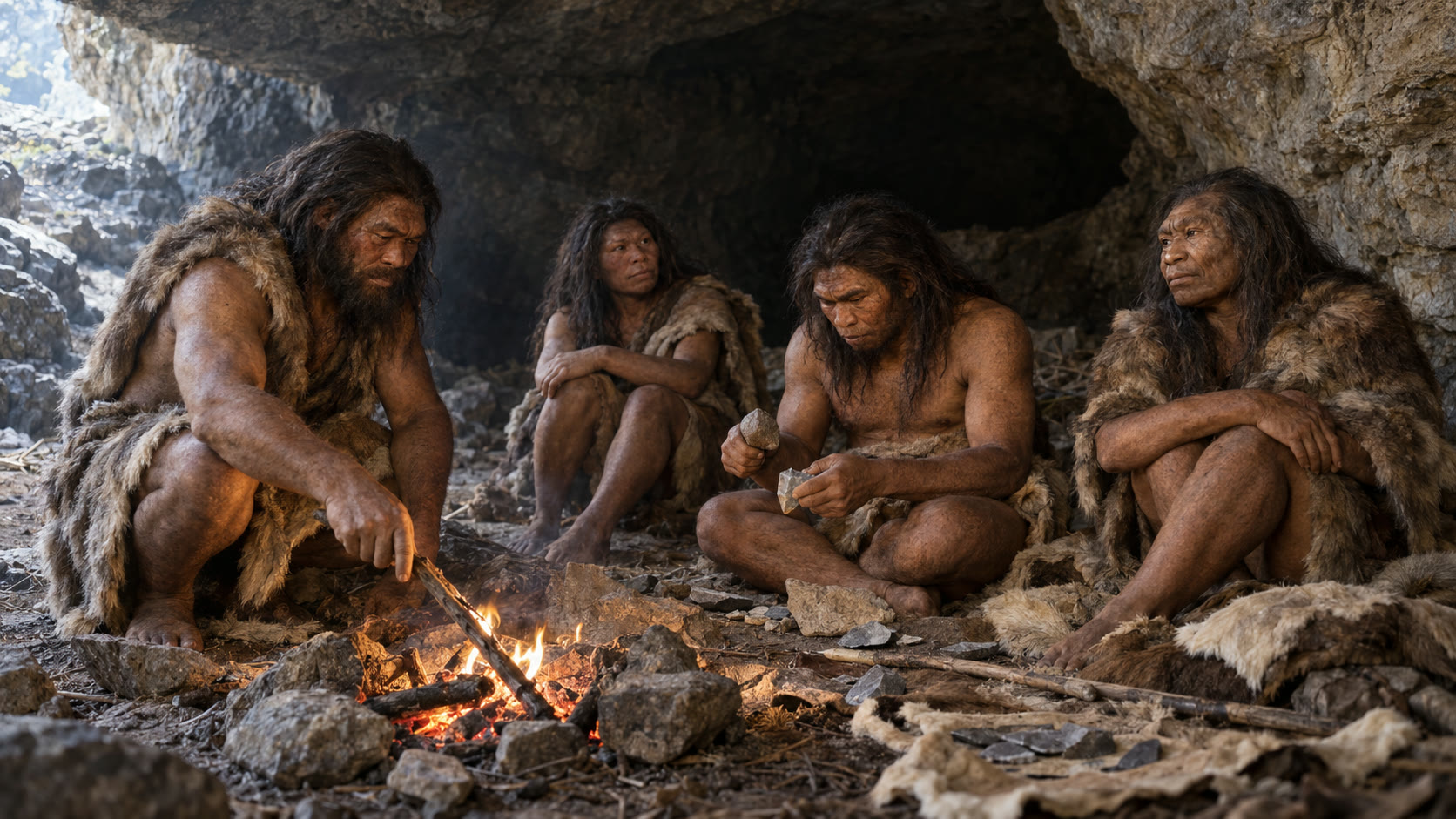
Illustration generated with AI for DomiVerseX
Denisovans were identified in 2010 from a finger bone and a genome. A cave in Yunnan has finally given them bodies, tools, and a forest to live in.
This article contains affiliate links. If you buy through them, we may earn a small commission at no extra cost to you.
For fifteen years, one of the strangest gaps in human evolution has involved a group of ancient humans that scientists knew almost nothing about physically.
They are called the Denisovans.
Unlike Neanderthals, whose bones have turned up at hundreds of sites across Europe and Asia, Denisovans were identified from almost nothing. One fragment of a finger. A few teeth. Yet genetics showed they were not some tiny group tucked away in one valley. They spread across huge parts of Asia, met other kinds of humans, and left traces that survive in people alive right now.
Now a cave in southwestern China has given scientists the clearest picture yet of how these people actually lived.
Researchers working at Bianfu Cave in Yunnan Province have identified Denisovan remains alongside a large archaeological record: stone tools, butchered animal bones, and evidence that bone itself was used as a tool. The findings appeared in two studies published in Nature on September 9, 2026.
A Population Discovered Through Chemistry, Not Bones
The Denisovan story started in Siberia.
In 2010, researchers reported genetic evidence taken from a small finger bone found in Denisova Cave in the Altai Mountains. The DNA described a population that was neither modern human nor Neanderthal.
That is an odd way to discover a kind of human. Normally you find a skeleton and then argue about what it is. Here, scientists had a population before they had a body.
More evidence trickled in over the following years: a jawbone from the Tibetan Plateau, a jaw from the Taiwan Strait, a nearly complete skull from Harbin in northeastern China. But the physical record stayed thin. Researchers could measure Denisovan ancient DNA inside living people while holding only a handful of actual Denisovan bones.
Bianfu Cave changes the arithmetic.
Seven Fossils Out of Sixty Thousand Fragments
Bianfu Cave sits in Yunnan Province, in the southwest corner of China. It was found in 2019, exposed in the sloping wall of an abandoned quarry.
The scale of the sorting job is the part worth pausing on. Researchers screened more than 60,000 bone fragments. Picture a warehouse floor covered in broken pieces, almost all of them animal, and you need the few that are human. Morphology narrowed it to 22 candidates. A protein-based method called ZooMS then confirmed that three of them were hominin: two small pieces of parietal bone, from the side of the skull, and one fragment from the upper end of a radius, one of the two long bones in the forearm.
Add the four teeth already recovered from the excavation and the site has seven hominin remains in total. Five of them were then confirmed as Denisovan through detailed protein analysis.
That last point matters, and it is where most coverage gets sloppy. Ancient DNA does not survive well in warm, damp places, and southern China is exactly that. Proteins are tougher. They last where genetic material has already fallen apart. So the team sequenced ancient proteins instead, and found in all five specimens a collagen variant known to be Denisovan. Protein from the enamel also showed that two of the teeth belonged to males.
The fossils date to roughly 167,000 to 134,000 years ago.
The radius is the headline find. It is small, about four and a half centimetres, a broken piece near the elbow. But Denisovan bones from below the neck have been close to nonexistent, so it fills a real blank. Its upper joint looks Neanderthal-like, while the overall shape and the cross-section of its neck sit closer to modern humans. Researchers describe it as the first Denisovan radius ever identified, and that mix of traits hints that Denisovans moved and used their arms in ways that were not quite like either of their relatives.
This is also the moment to be careful. A forearm fragment does not tell you what someone's face looked like.
The Cave Kept the Rest of Their Lives
The fossils are one layer of the story. The occupation record is another, and it runs much longer: roughly 190,000 to 70,000 years ago.
Enjoying this story?
Get a short teaser by email whenever we publish something new. No spam.
Researchers recovered 1,366 stone artefacts and more than 64,000 mammal fossils from the cultural layers. Pollen and animal remains let them rebuild the surroundings, and the result is not the frozen wasteland most people picture when they hear "Ice Age". The evidence points to a conifer-dominated forest or forest-steppe. These were people living among trees.
The animal bones name the menu: sika deer, red deer, gaur and water buffalo. Cut marks and fracture patterns show the carcasses were butchered and the marrow taken, and that the humans reached the bodies first rather than scavenging what predators left. Gaur can weigh close to a tonne. This was not opportunistic nibbling at the edges of the food chain.
Simple Tools, Not Simple People
The stone technology is where Bianfu quietly argues with a common assumption.
Most of the assemblage is made from river cobbles worked with little shaping or retouch. Bone was used heavily too, often barely modified or not modified at all. Researchers describe the pattern as expedient: take what an object can already do, use it, move on.
It would be easy to read that as crude. The researchers read it differently, as a system that prioritised what materials could already deliver over the effort of reshaping them. If a naturally sharp bone does the job, spending an hour reworking it buys you nothing.
Archaeology can show that kind of decision. Fossils on their own cannot.
Filling a Hole in the Map
Where Bianfu sits is almost as important as what came out of it.
Confirmed Denisovan evidence has come from Siberia, the Tibetan Plateau, northeastern China and the Taiwan Strait. Southwestern China was a blank. Yet genetics has long suggested Denisovan ancestry is strongest in populations much further south, in Southeast Asia and Oceania, which implies that Denisovans and modern humans met somewhere along the way.
Bianfu lands in that gap. The site sits near corridors linking the Tibetan Plateau with East Asia, South Asia and Southeast Asia. It is physical evidence in a place where, until now, there was only inference drawn from the genomes of living people.
It also makes Bianfu the richest source of Denisovan remains anywhere outside Denisova Cave itself.
They Did Not Vanish Completely
Denisovans are gone as a distinct population. Their genetics are not.
Modern humans, Neanderthals and Denisovans met and interbred during prehistory. As modern humans spread through Asia, some populations picked up Denisovan ancestry, and it is still measurable today, most notably in parts of Southeast Asia and Oceania. Not everyone carries it, and not in equal amounts.
What Bianfu adds is the part genetics can never supply. DNA can tell you that two populations met. Bones can tell you something about anatomy. Only an archaeological site can tell you that someone stood in a conifer forest 150,000 years ago, hunted a water buffalo, cracked the bones for marrow, and picked up a river cobble because it was already about the right shape.
Becoming Less Mysterious
Sixteen years ago, Denisovans were a genome and a fingertip.
Today there is a timeline of them stretching across more than a hundred thousand years in one cave, in one forest, with their prey and their tools still lying in the layers.
Plenty is still unknown. How the different Denisovan groups across Asia related to each other is an open question. Their appearance cannot be reconstructed with any confidence. How their technology shifted from region to region is unresolved.
But the people of Bianfu Cave are no longer only a signal in somebody else's DNA. Their bones are there. Their tools are there. The animals they ate are there.
And the more concrete they become, the more complicated the story of our own species looks.
Sources
- Ruan, Q., Li, H., Xing, S. et al. (2026). Denisovans from southwestern China and their subsistence strategies. Nature. DOI: 10.1038/s41586-026-10997-4
- Rao, H., Xing, S., Ruan, Q. et al. (2026). Ancient proteins identify various Denisovan remains from Southwest China. Nature. DOI: 10.1038/s41586-026-10976-9
- Chinese Academy of Sciences / IVPP (2026). First Denisovan forearm bone discovered in southwest China
- Phys.org (2026). Chinese cave traces Denisovan hunting and adaptation across 120,000 years
- University of Wollongong (2026). 190,000-year-old cave reveals how ancient human species lived and adapted
- Hawks, J. (2026). New Denisovans from China's southwest