This Is One of the Biggest Tombs on Earth, and Nobody Has Been Inside for Over 150 Years
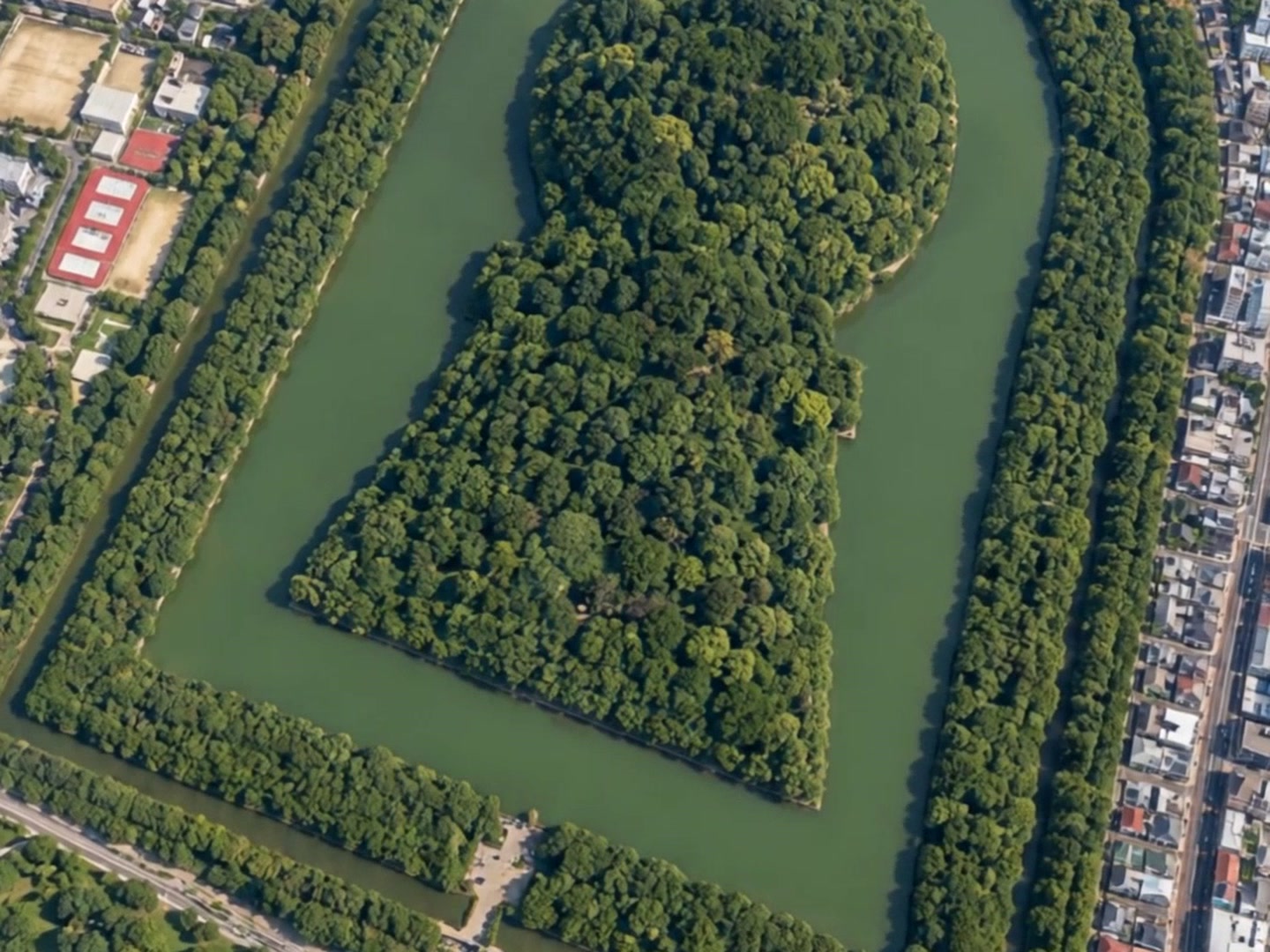
Illustration by Domi Verse X
This is one of the biggest tombs on Earth, and nobody has been inside for over 150 years.
This article contains affiliate links. If you buy through them, we may earn a small commission at no extra cost to you.
It sits in the middle of Sakai, a city just south of Osaka, surrounded by houses, train lines and convenience stores. From street level it looks like a wooded hill behind a wall of water. Most people who walk past it see trees. What they are actually walking past is a burial mound roughly 486 meters long, ringed by three separate bands of water, built for someone whose name nobody can confirm.
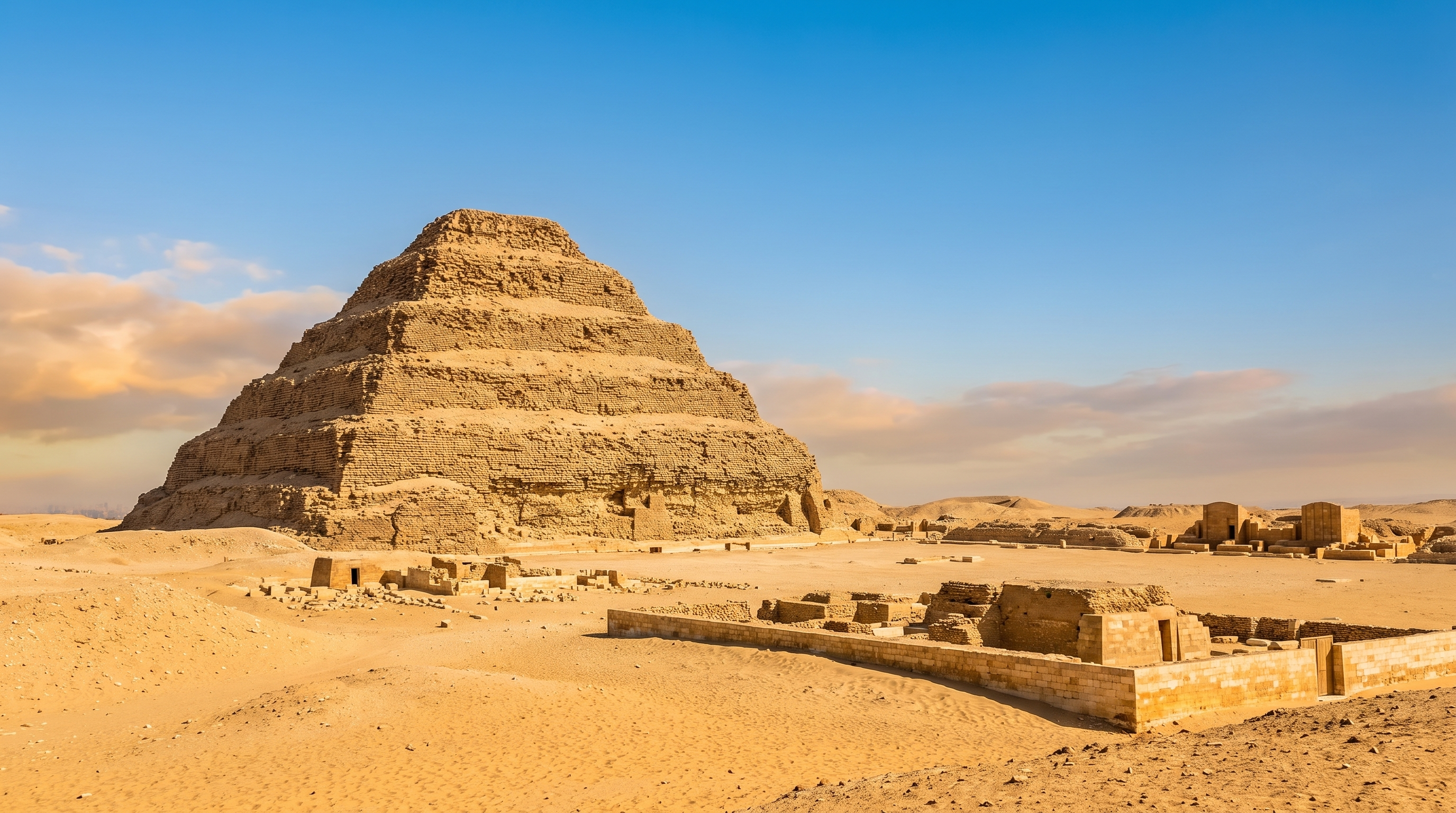
Japan's Imperial Household Agency puts it in a group of three: the Daisen Kofun, the mausoleum of China's first emperor, and the Great Pyramid of Khufu. Three of the biggest tombs ever built by anyone, anywhere. Two of them you can walk into. This one you cannot.
You Cannot See It From the Ground
The shape is the strange part. Seen from above, the mound is a keyhole: a circle joined to a trapezoid, a form that appears across Japan and almost nowhere else. Seen from the ground, it is invisible. The mound is completely overgrown, the water keeps you back, and there is no vantage point in the city high enough to show you the outline.
This is a genuinely odd situation for a monument. The Great Pyramid announces itself from thirty kilometers away. This thing is bigger in footprint than the pyramid and you can stand fifty meters from it without understanding what you are looking at. The only reason we know what it looks like is aerial photography, which means nobody saw the full shape of it for roughly 1,500 years after it was finished.
There is a public viewing area at the south end where you can stand and look across the water, and it is worth bringing a pair of compact binoculars if you go, because the far bank is a long way off and the detail is all in the treeline and the stonework at the water's edge. What you will not get, from any angle available to you, is the keyhole.
The Reason Nobody Goes In Is a Rule, Not a Mystery
Here is the answer to the obvious question, and it is worth saying plainly because the internet tends to make it sound spookier than it is.
There is no curse. There is no structural danger. There is a government department.
The Imperial Household Agency administers the site as an imperial mausoleum, which means it is treated as an active religious site and the resting place of an ancestor of the current imperial family. The agency's stated position is that these are places where peace and sanctity need to be maintained. Under that designation, archaeological excavation of the mound is off the table.
In practice, visitors, researchers and even members of the royal family generally get no further than the bridge over the second band of water. At the end of that bridge is a torii, the open gate that marks the boundary of a sacred area, and a small worship space. That gate is not locked. It does not need to be. The rule does the work.
It is easy to read this as a cover-up, and plenty of people do. The more ordinary explanation is that Japan classified these mounds as imperial graves in the nineteenth century, and once something is officially your ancestor's grave, digging it up becomes a religious problem rather than a scientific one. Most countries have a version of this. Few have one this large sitting in a suburb.
Then a Storm Broke the Rule for Everybody
In 1872, the front slope of the mound collapsed after heavy wind and rain. The damage opened a stone chamber that had been sealed inside the earth.
A local official named Kaichiro Kashiwagi surveyed what had been exposed and made detailed drawings of what he saw: a stone coffin, armor, a helmet, swords, glassware. Then the objects were reportedly reburied and the site was closed again.
For more than 150 years, those drawings were it. That was the entire evidentiary record of what is inside one of the largest tombs on the planet. Not photographs. Not measurements taken by a team. Sketches, made in a hurry, by one man, during a landslide.
Think about how thin that is. Everything anyone claimed to know about the contents of this monument rested on one person's word and one person's pen.
Enjoying this story?
Get a short teaser by email whenever we publish something new. No spam.
If you like the feeling of pinning down the places where history actually happened, a scratch-off world map is a cheap way to keep score of the ones you reach, and Sakai is a twenty minute train ride from central Osaka, so this one is more reachable than most.
In 2025, Two of Those Objects Came Back
In June 2025, Sakai City and the Kokugakuin University Museum announced something that had not happened in the entire modern history of the site. Two objects from the 1872 opening had been found, authenticated, and traced back to the Daisen Kofun: a small gold-plated knife, and fragments of gilded armor.
They had been sitting in a private collection. The trail led back to Takashi Masuda, the founder of the trading company Mitsui and Company, and the pieces were acquired from an art dealer still wrapped in paper carrying Kashiwagi's seal and his handwritten notes about where they came from.
So not everything was reburied. Some of it walked out.
The analysis produced a small correction to history. The armor fragments turned out to be iron coated with gold, not the gold-plated copper that people had assumed for a century based on the old drawings. And the knife appears to be ceremonial rather than practical, with no comparable gold-plated example confirmed from any other fifth century mound. These were objects made to be buried, not used.
That same year, representatives of seventeen historical and archaeological organizations were allowed onto the site with an official escort. It was the first academic visitation since the Second World War. They did not go inside the mound. Nobody has.
Nobody Is Sure Who Is In There
The official name attaches the tomb to Emperor Nintoku, the sixteenth emperor in the traditional imperial line.
Archaeologists have been quietly uncomfortable with that for a long time. The mound appears to date to around the middle of the fifth century, which sits awkwardly against the traditional dates for Nintoku's reign. And the deeper issue is that nobody was writing down who went into which mound at the time. When Japan's first histories were compiled in the eighth century, the memory was already gone, and the compilers were working backwards from what they could reconstruct.
Many researchers therefore avoid the imperial name and simply call it the Daisen Mound. When the Mozu and Furuichi group was put forward for UNESCO listing, which it received in 2019, this argument surfaced publicly, with historians pushing for place names rather than emperor names on exactly these grounds.
Which leaves a strange situation. The tomb is protected because of who is supposedly buried in it. The one thing that could confirm who is buried in it is the thing the protection forbids.
The Part That Is Hard to Get Your Head Around
An estimate published by the construction company Obayashi in 1985 put the build at roughly fifteen years and eight months, with up to 2,000 people working on peak days and something like 6.8 million total working days. It is a modern estimate by a modern contractor, so treat it as a well-informed guess rather than a fact, but the order of magnitude is the point.
Someone convinced a society to spend a decade and a half of its collective labor building a shape that could only be appreciated from an altitude nobody could reach. Whoever ordered it never saw the finished outline. Nobody did, for around a millennium and a half, until aircraft.
If the wider period interests you, a general history of Japan will place the mound builders in context better than any single article can, because the kofun period runs straight into the beginnings of the Japanese state and the two questions are really one question.
For now, the mound sits there with its trees and its water, and the honest summary is short. We know how big it is. We know roughly when it was built. We know two objects that came out of it in 1872, because they came back in 2025. Everything else is on the other side of a gate that anyone can walk up to and nobody can walk through.
Sources
- Newsweek, NASA image and Imperial Household Agency comparison of the three largest mounded tombs
- Wikipedia, Mozu Kofun Group, dimensions, three moats and access
- Archaeology Magazine, 2018 investigation of the dikes
- Archaeology Mag, first confirmed artifacts and the 2025 academic visitation
- Arkeonews, Sakai City and Kokugakuin University Museum announcement of the knife and armor
- Green Shinto, archaeologists' dispute over the Nintoku attribution and the UNESCO naming argument
- Jhistories, Obayashi Corporation 1985 construction estimate
- Osaka Info, official site page on the 1872 exposure and the Museum of Fine Arts Boston holdings