Every Wood's cycad on Earth is the same plant
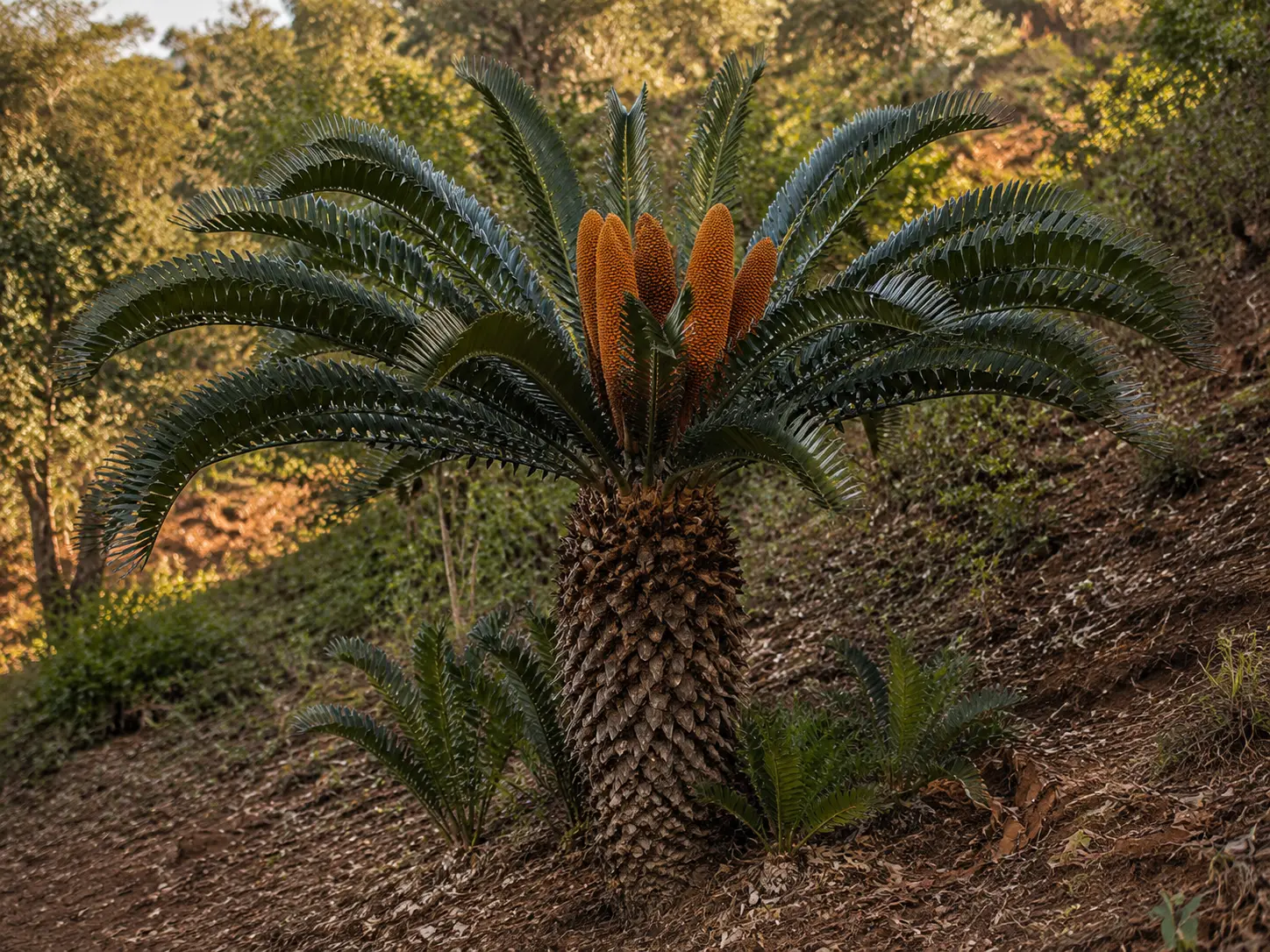
Illustration by Domi Verse X
One male cycad was found in a South African forest in 1895, and botanists have been hunting for its missing other half ever since.
This article contains affiliate links. If you buy through them, we may earn a small commission at no extra cost to you.
Somewhere in a glasshouse near you there may be a plant that has no possible partner anywhere on the planet.
Found once, and never again
In 1895 the botanist John Medley Wood spotted a strange cycad on a steep slope at the edge of the Ngoye Forest in KwaZulu-Natal, South Africa. It was a clump of four stems belonging to a single plant, and every stem was male. Over the next twenty years the stems were dug up and carried away for safekeeping, and South Africa's national biodiversity institute records that the last wild trunk was removed in 1916. The species is now listed as Extinct in the Wild. Nobody has ever found a second one growing wild.
That matters because cycads come in separate males and females, like people do. Male cones make pollen, and beetles carry it to female cones that hold the seeds. With no female, there are no seeds. The cone scales and the beetles that work them are small, close detail, and a folding illuminated loupe is the difference between seeing that and not.
Copies, not children
Enjoying this story?
Get a short teaser by email whenever we publish something new. No spam.
Every Wood's cycad alive today was grown from an offshoot of that one plant, or an offshoot of an offshoot. They are clones, the same individual repeated. Even the number is uncertain: Kew estimates around 110 while SANBI suggests as many as 500, so anywhere from four classrooms' worth of plants to twenty. Kew states plainly that no female plant has ever been found.
Hunting a forest from the sky
Since 2022 a team led by Dr Laura Cinti at the University of Southampton has flown drones over Ngoye Forest, gathering tens of thousands of images and training an image-recognition model to spot the cycad's shape from above. Because there are no wild plants left to photograph, some of the model's training pictures had to be made artificially.
By 2024 the team had covered about 195 acres of a forest of roughly 10,000. That is under two percent, like reading two pages of a hundred-page book and hoping the answer is on them. No female has turned up yet. Herbarium work still runs on pressed specimens, and a proper plant press is how those collections get made.
Meanwhile, growers are trying something slower. Wood's cycad pollen is put onto a close relative, *Encephalartos natalensis*, and the female offspring are pollinated with Wood's cycad pollen again, generation after generation, nudging each batch closer to the original. Cycads take ten to fifteen years to make their first cones, long enough for a baby born today to reach secondary school. And a plant that is nearly Wood's cycad is still not Wood's cycad. Jonathan Drori's Around the World in 80 Plants tells a lot of stories that end in this same shape.
Sources
- Wood like to meet: the loneliest plant in the world | Kew
- Encephalartos woodii | PlantZAfrica, SANBI
- The high-tech hunt for a lonely plant's partner | University of Southampton
- Searching for a female partner for the world's loneliest plant | The Conversation
- The World's Loneliest Plant Could Soon Find a Mate With a Little Help From A.I. | Smithsonian Magazine