This tree bleeds red and hides its own age
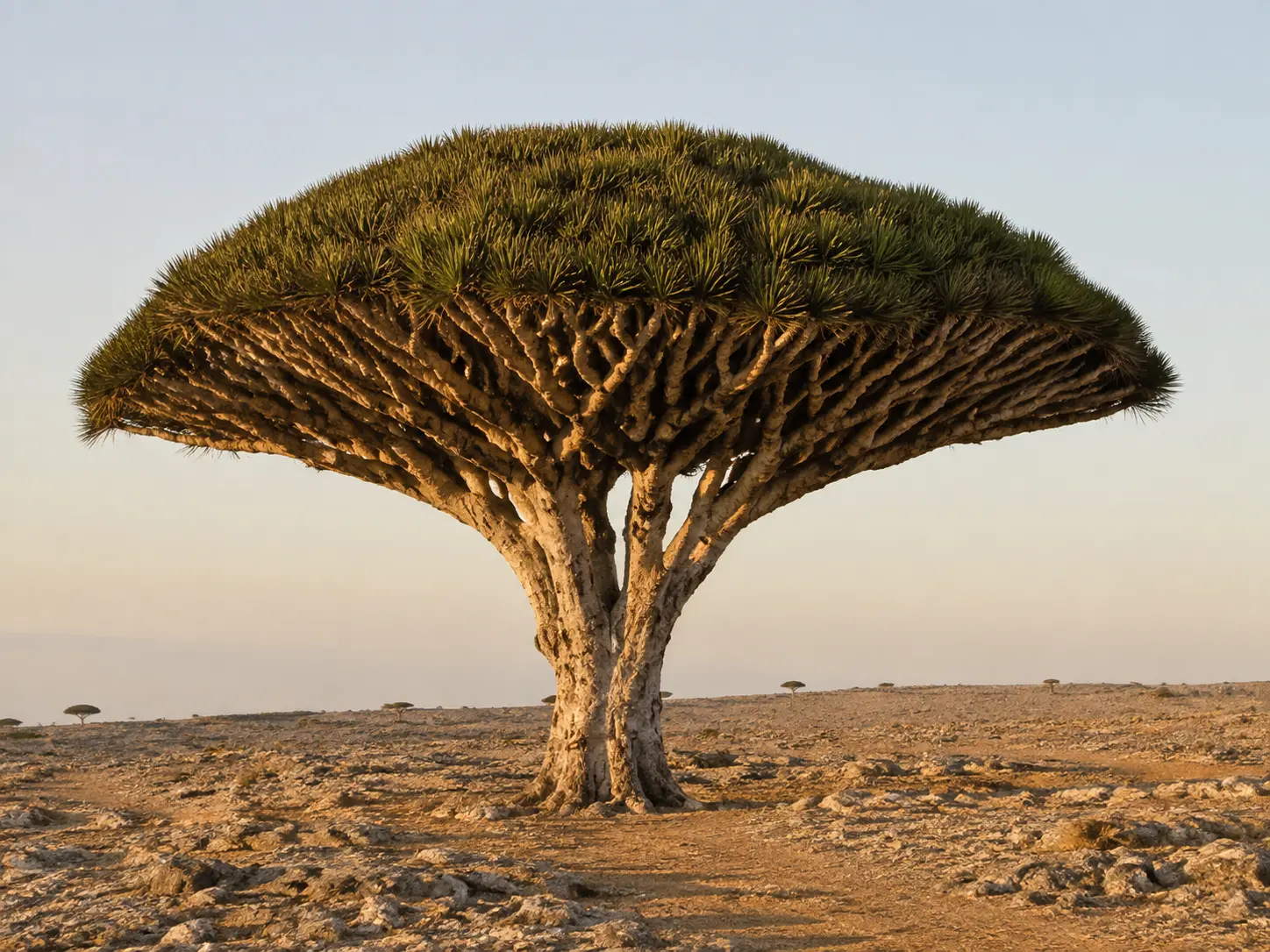
Illustration by Domi Verse X
On one island in the Indian Ocean grows a tree shaped like an upside-down umbrella, and cutting it makes it run red.
This article contains affiliate links. If you buy through them, we may earn a small commission at no extra cost to you.
Socotra is a rocky island off the coast of Yemen, and it is the only place on Earth where a strange umbrella-shaped tree grows wild. Kew's Plants of the World Online lists *Dracaena cinnabari* as native to Socotra and nowhere else, and rates it Vulnerable.
The red stuff is resin, not blood
Cut the bark and a dark red resin oozes out and dries into crumbly lumps. People have collected it for thousands of years. The Royal Botanic Garden Edinburgh says the resin was historically used as a dye and as a medicine, and a 2023 review of the species says Greeks, Romans and Arabs used it as medicine and as colouring matter for varnishes and dyes. That is what people did and believed. It is not evidence that the resin heals anything, and nobody should treat it as a cure.
Why it grows like an umbrella
Enjoying this story?
Get a short teaser by email whenever we publish something new. No spam.
This tree is a monocot, so it is more closely related to a lily than to an oak, and it does not branch the way an oak does. A branch splits only after the tree flowers. Researchers writing in the journal *Trees* estimated the gap between flowerings at about 6.5 years at one Socotran site, roughly the time it takes a newborn to reach the first day of school. Repeat that split dozens of times and you get the flat, crowded crown. Edinburgh's botanists describe that crown as a parasol that shades the soil and catches mist, so water drips down to the roots. From the ground the crown reads best from a distance, which is what a pair of compact folding binoculars is for.
Very old, and not being replaced
You cannot count rings here, because the tree does not make annual ones. So the "thousands of years old" figures you see online are unsupported. A team publishing in *Forests* in 2023 measured 1,077 trees in 2011, measured them again in 2021, and calculated age from how much the trunks widened. Their largest trees, about 90 cm across, came out near 672 years old. That is a seedling sprouting around 1350, more than a century before Columbus crossed the Atlantic. Very old. Not ancient beyond counting. That kind of work is a decade of field notes, and field notes in that climate need a weatherproof notebook.
The bigger worry is what is missing. Almost every tree is old. Goats eat the seedlings, and the 2023 review reports that young plants barely survive in open habitat unless they are protected. The same review says the tree now occupies only about 5% of the ground that could suit it, one square out of twenty. Jonathan Drori's Around the World in 80 Trees covers several species in the same slow trouble. Which raises an awkward question about what these forests looked like before the goats arrived.
Sources
- Dracaena cinnabari | Plants of the World Online, Kew
- Dracaena cinnabari | Botanics Stories, Royal Botanic Garden Edinburgh
- Age Estimation of Dracaena cinnabari on Socotra Island | Forests, 2023
- Crown age estimation of Dracaena cinnabari using logistic regression | Trees
- Dragon's Blood Tree: A Cenozoic Relict | IntechOpen, 2023