The bee orchid gave up waiting for bees
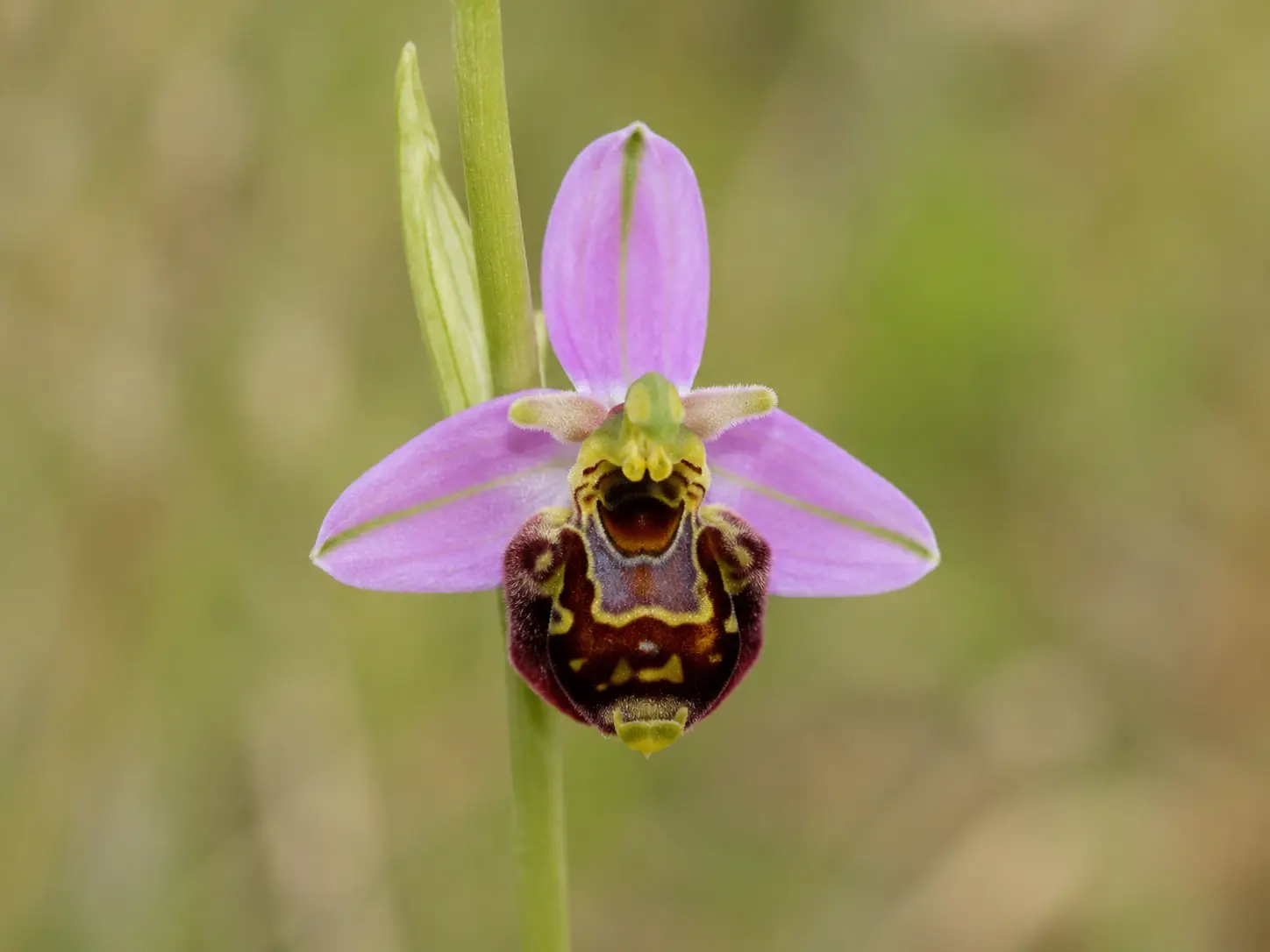
Illustration by Domi Verse X
It spent millions of years learning to fool a male bee, and now, in Britain, it does the job itself.
This article contains affiliate links. If you buy through them, we may earn a small commission at no extra cost to you.
In southern Europe, this small pink and brown flower runs one of the best confidence tricks in botany. Move north, and the trick stops working.
A flower that pretends to be a bee
The bee orchid's lower petal, called the lip, looks like a furry female bee sitting on the bloom. Kew describes it as resembling a female of a solitary bee in the genus *Eucera*. The flower adds smell to the picture: a 2025 study in *Scientific Reports* reports that the plant mimics a female insect by secreting pheromones to pull in long horned bees.
A male bee lands, tries to mate with the petal, gets nowhere, and flies off wearing two sticky lumps of pollen on his head. He carries them to the next flower. He gets no food and no reward for any of it. The disguise only really gives up its detail under magnification, which is what a 10x triplet loupe is for.
In Britain, almost nobody turns up
Enjoying this story?
Get a short teaser by email whenever we publish something new. No spam.
Here is the part most articles skip. In Britain the show plays to an empty room. Kew states plainly that in the UK the orchid does not need to use its powers of deception because it is self-pollinating, and the pollen lumps simply swing forward on their stalks onto the flower's own stigma. The 2025 study found the same pattern more widely, reporting that at the northern edge of the species' range the flowers appear to be almost exclusively self-pollinating. That habit is probably what let the orchid spread into Poland, Denmark and Germany without bringing its bees along.
The bee is not quite gone
It is tempting to say the bee is simply missing. That goes too far. Sussex Wildlife Trust says the original pollinator does not exist in the UK, but Buglife reports that British male long horned bees, *Eucera longicornis*, are attracted to bee orchid flowers. Buglife also calls that bee a UK Priority Species with roughly a dozen surviving inland colonies, about the number of eggs in an egg box.
So the orchid keeps its costume, mostly for an audience that is not there. The plant is easy to walk past, usually under 30 cm tall according to Britannica, no taller than a school ruler. If you want to keep the ones you find, a wooden flower press preserves the shape better than a heavy book, and Newcomb's approach to keying out wildflowers teaches you to name them properly. Why it still bothers with the disguise is a question nobody has finished answering.