This plant survives losing 95% of its water
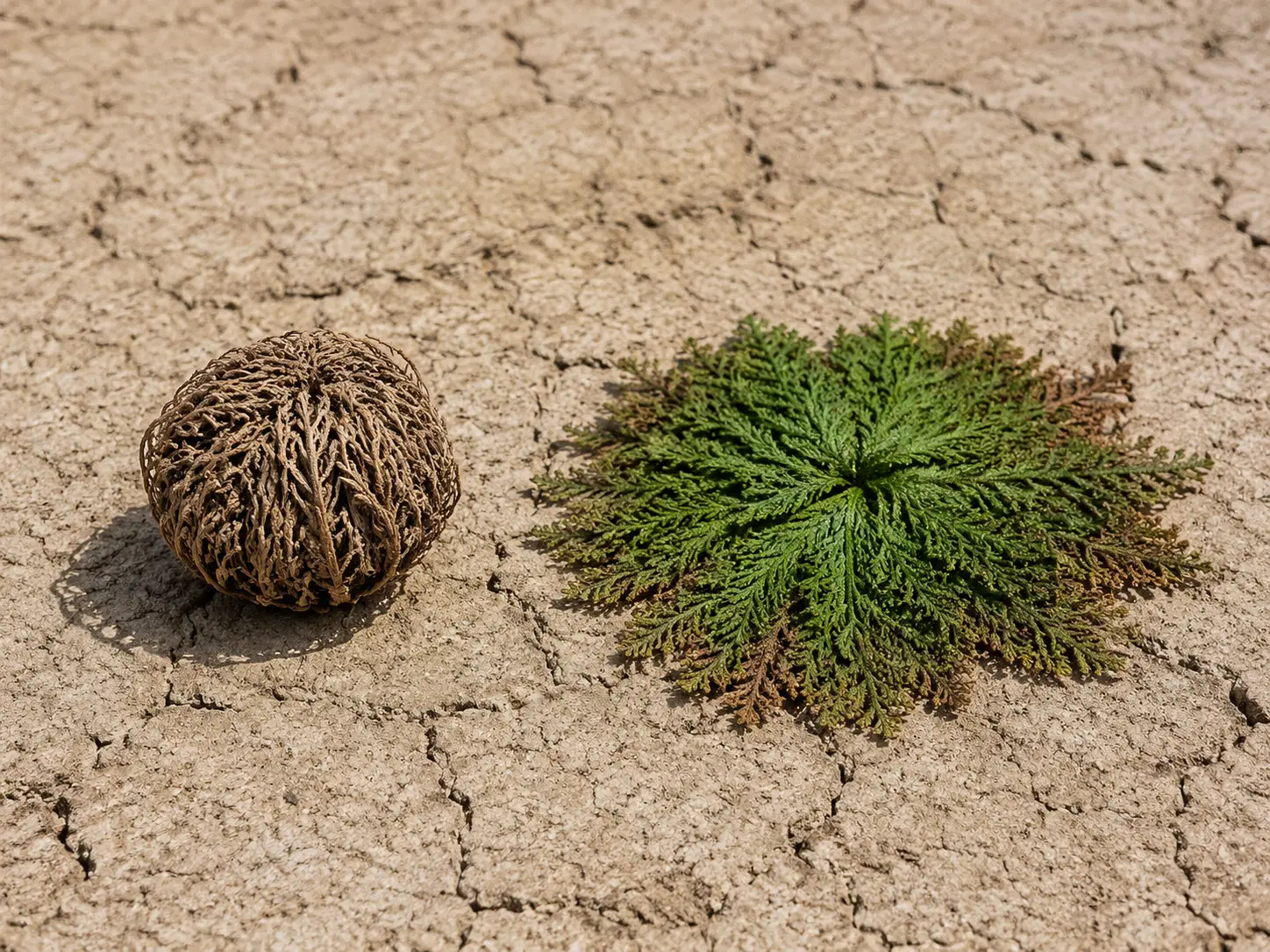
Illustration by Domi Verse X
A brown desert ball that looks long dead can open into a green rosette after a splash of water.
This article contains affiliate links. If you buy through them, we may earn a small commission at no extra cost to you.
Nudge one across a table in the Chihuahuan Desert and it rolls like a dry paper fist. Add water, and it slowly opens its arms. You can buy the same species as a live resurrection plant and watch it happen on a saucer, which is the rare case where the internet plant does exactly what the article says.
Not a moss, and not the famous Jericho plant
*Selaginella lepidophylla* is a spikemoss. It is not a true moss and it is not a flowering plant. According to the Lady Bird Johnson Wildflower Center, it makes no flowers at all and reproduces by spores, and it grows in dry, rocky soils from Texas and New Mexico south into Mexico.
It is also not the true rose of Jericho. Britannica explains that the real one, *Anastatica hierochuntica*, sits in the mustard family, the same group as cabbage and broccoli. Two unrelated plants, one shared party trick, which is why *S. lepidophylla* gets called the false rose of Jericho.
How dry is dry
Researchers who sequenced its genome, writing in Nature Communications, report that it can survive the loss of more than 95% of its cellular water for decades. Picture a one litre bottle with about three tablespoons left in the bottom.
Enjoying this story?
Get a short teaser by email whenever we publish something new. No spam.
Sugar is often given the credit, especially trehalose. That story is shakier than it looks. A 2014 review notes that its drought sensitive relative *Selaginella moellendorffii* actually holds more trehalose, while sugar alcohols such as sorbitol and xylitol are far more abundant in *S. lepidophylla*. Nobody has nailed down which molecule matters most.
The curling is partly just plumbing
The curl itself is mechanics. In a 2015 Scientific Reports study, outer stems bent into tight rings within about an hour of drying, while inner stems took roughly five hours to spiral shut, and the outer shell shaded the core so hard the authors calculated it blocked more than 99.7% of sunlight, leaving about three rays in every thousand.
Here is the part that spoils the magic a little. A 2019 study in Journal of the Royal Society Interface found that this bending happens in dead tissue as well as living tissue, and its authors tracked stems changing shape over roughly six hours, about one school day. So a dead specimen still unfurls. Opening is machinery. Turning green again is biology, and the genome team was still calling plants fully recovered only at 120 hours, five days after watering. A terrarium starter kit keeps the humidity steady enough to tell the two apart.
Which raises an awkward question about all those souvenir balls sold online. Robin Wall Kimmerer's Gathering Moss is the best thing written about the small green things nobody looks at.
Sources
- Extreme haplotype variation in the desiccation-tolerant clubmoss Selaginella lepidophylla | Nature Communications
- Hydro-Responsive Curling of the Resurrection Plant Selaginella lepidophylla | Scientific Reports
- Three-dimensional functional gradients direct stem curling in Selaginella lepidophylla | Journal of The Royal Society Interface
- The desiccation tolerant secrets of Selaginella lepidophylla | PubMed
- Rose of Jericho | Britannica
- Selaginella lepidophylla | Lady Bird Johnson Wildflower Center