The biggest single flower on Earth has no roots
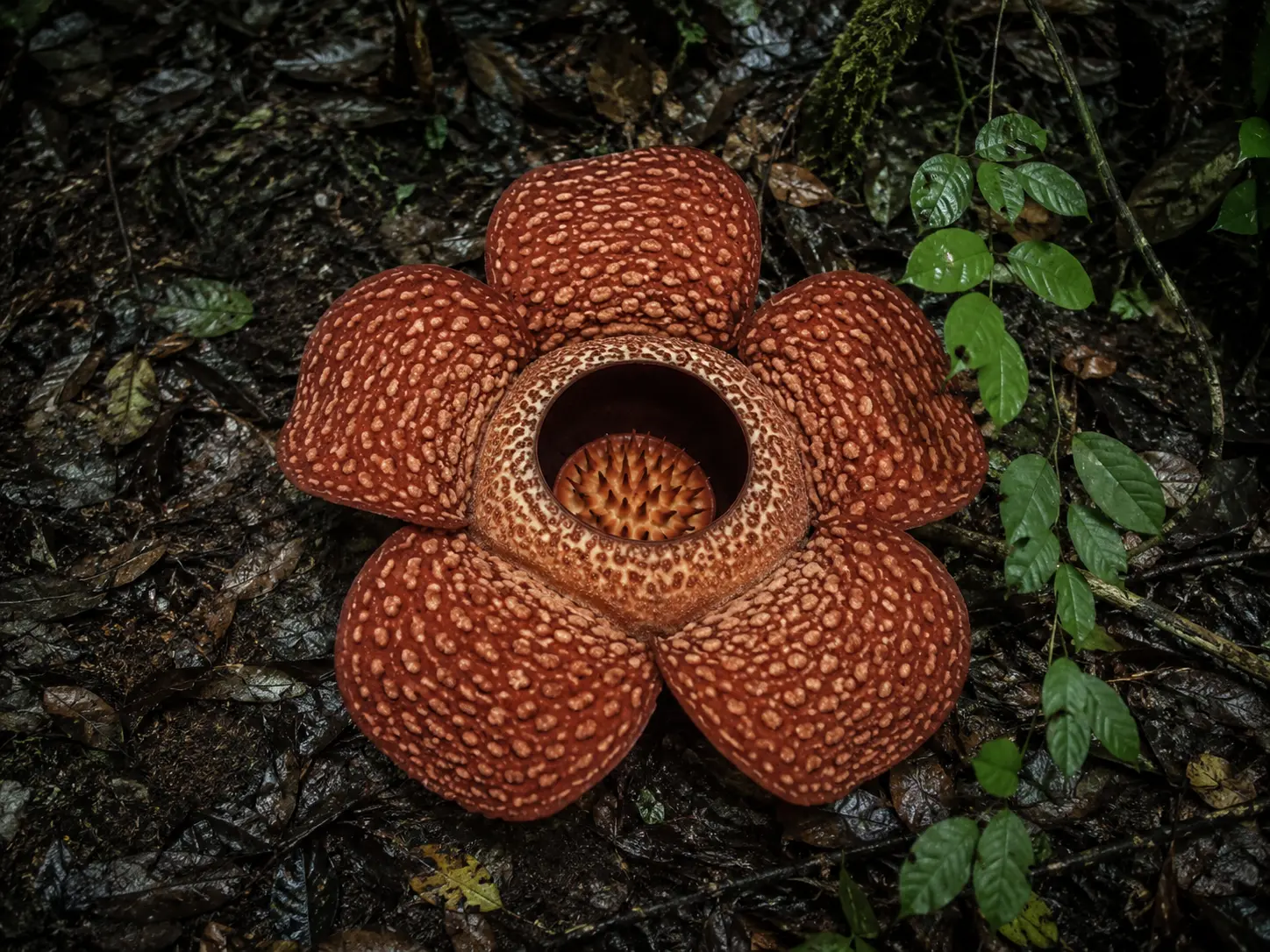
Illustration by Domi Verse X
It has no leaves, no roots and no way to feed itself, yet it grows a bloom the size of a car tyre.
This article contains affiliate links. If you buy through them, we may earn a small commission at no extra cost to you.
Deep in the rainforests of Sumatra grows something that spends most of its life completely invisible. Then a giant reddish bloom pushes out of a vine lying across the forest floor.
A flower with no plant attached
*Rafflesia arnoldii* has no leaves, no stems and no roots, and it makes no chlorophyll, so it cannot feed itself the way other plants do. Kew Gardens describes it as living inside its host as a mass of fleshy strands that soak up water and nutrients from woody vines in the genus *Tetrastigma*. The biggest flower on Earth is, in plain words, a freeloader living inside another plant.
The bloom itself grows up to about a metre across, roughly the width of a doorway, and Britannica says it can weigh up to 11 kg, about as heavy as a full bucket of water. Before it opens it sits on the vine as a brown bud that Kew compares to a cabbage. If you want a piece of that rainforest on a windowsill, a closed glass terrarium kit keeps the humidity that plants like these need.
The record, explained properly
Enjoying this story?
Get a short teaser by email whenever we publish something new. No spam.
You will often read that this is simply the largest flower in the world. The careful version is narrower. It is the largest single flower. Two other plants grow bigger flowering structures, but they do it by cheating a little. The titan arum sends up a spike that Kew says can reach 3 m, taller than most ceilings, but Kew is clear that this is an inflorescence, a cluster of many tiny flowers rather than one flower. The talipot palm goes bigger still, with a branched flower cluster that Wikipedia's entry on Corypha umbraculifera reports at roughly 6 to 8 m, carrying possibly millions of small flowers. So Rafflesia wins for one bloom, not for the biggest flowering display.
Smells like a dead animal, on purpose
An open Rafflesia gives off a stink of rotting meat, and that is no accident. The smell pulls in carrion flies, which crawl over the bloom and carry off sticky pollen. Kew says the flowers are open for about a week, while Wikipedia says only a few days, so the honest answer sits somewhere in that range. The pollen grains themselves are far too small to see, though a pocket microscope will show you the ones on any flower in your garden.
There may not be many chances left to smell one. A 2023 study in *Plants, People, Planet*, reported by Botany One, found that more than 60% of the 42 known Rafflesia species face a severe threat of extinction, and that at least 67% of their known habitat sits outside protected areas. David Attenborough's The Private Life of Plants filmed several of these behaviours before they became this hard to find. Which leaves an awkward question. How do you guard a plant that only shows itself for a few days at a time?