Borneo's giant pitcher plant is a toilet
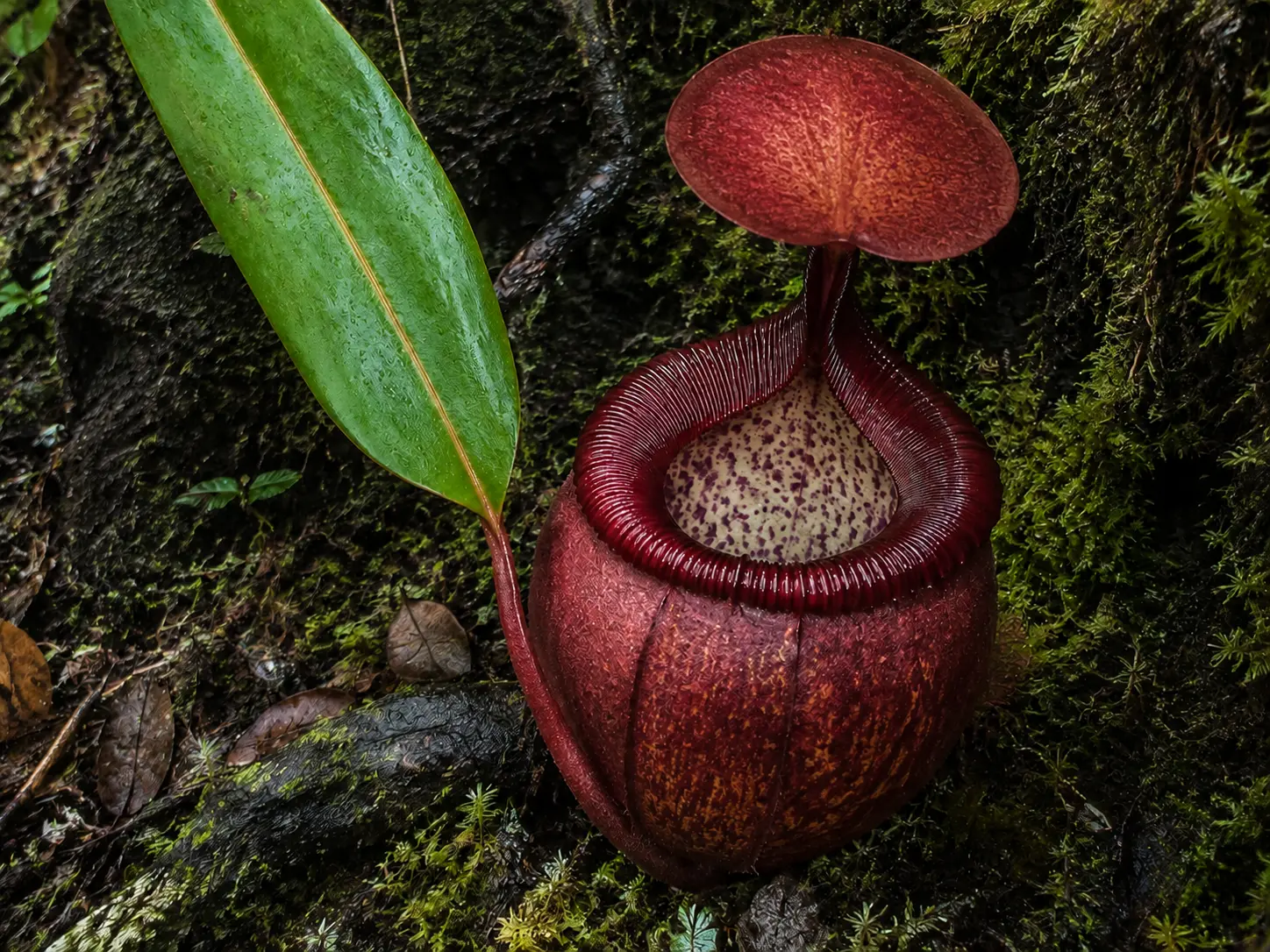
Illustration by Domi Verse X
Everyone says this plant eats rats, but hidden cameras on Mount Kinabalu caught something much stranger happening at the rim.
This article contains affiliate links. If you buy through them, we may earn a small commission at no extra cost to you.
High on Mount Kinabalu in Malaysian Borneo, between about 1,500 and 2,650 metres up, grows a plant you could not miss. That upper limit is roughly eight Eiffel Towers stacked on top of each other. According to Kew's Plants of the World Online, the traps of *Nepenthes rajah* are 20 to 35 cm long and up to 40 cm tall, about the height of a bowling pin, and 11 to 18 cm across, roughly the width of a big grapefruit.
About that "world's largest" title
Guinness World Records lists *N. rajah* as having the largest carnivorous plant traps by volume, and says a single pitcher can hold as much as 3.5 litres of water, nearly two large fizzy drink bottles, or 2.5 litres of digestive fluid. Treat the crown carefully, though. Kew calls these "some of the largest pitchers in the genus" and points out that *Nepenthes attenboroughii*, discovered in 2007, may have overtaken them. Guinness itself admits the winner depends on which kind of "biggest" you measure. If you want to watch a trap work on your own windowsill, a Venus flytrap grow kit is the cheapest way in.
Not a rat trap. A rest stop.
Enjoying this story?
Get a short teaser by email whenever we publish something new. No spam.
The plant's nickname is the rat-eating plant. The evidence for that is thin. When researchers surveyed 42 large, healthy pitchers, they found the body of just one drowned tree shrew. Drownings happen, but they look like accidents, not a diet.
What the cameras actually show is a shift system. Mountain tree shrews turn up in daylight, summit rats after dark, and both lick sweet exudate off the underside of the lid. Over 38 days of watching, one team counted 145 tree shrew droppings inside pitchers against 57 outside, and 117 rat droppings inside against 22 outside. More than twice as much lands in the pot as beside it.
That is not luck. Measurements of three giant Bornean species found that the gap from the lid's nectar to the front of the pitcher's mouth matches a tree shrew's head and body length. To reach the treat, the animal must straddle the opening, which parks its back end directly over the trap. The slippery waxy zone inside the pitcher is worth a look through a 10x hand lens if you ever get near one.
So the giant pitcher is part diner, part loo. Exactly how much of the plant's food arrives as droppings and how much still arrives as insects is a harder question, and it has not been pinned down for *N. rajah* yet. Peter D'Amato's The Savage Garden is the standard book if you want to keep these things alive rather than just read about them.
Sources
- Nepenthes rajah | Plants of the World Online, Kew
- Largest carnivorous plant traps by volume | Guinness World Records
- Pitchers of Nepenthes rajah collect faecal droppings | Journal of Tropical Ecology
- A Unique Resource Mutualism between Nepenthes rajah and a Small Mammal Community | PLOS ONE
- Trap geometry in three giant montane pitcher plant species from Borneo | New Phytologist