This Arrow Points Right From Both Sides
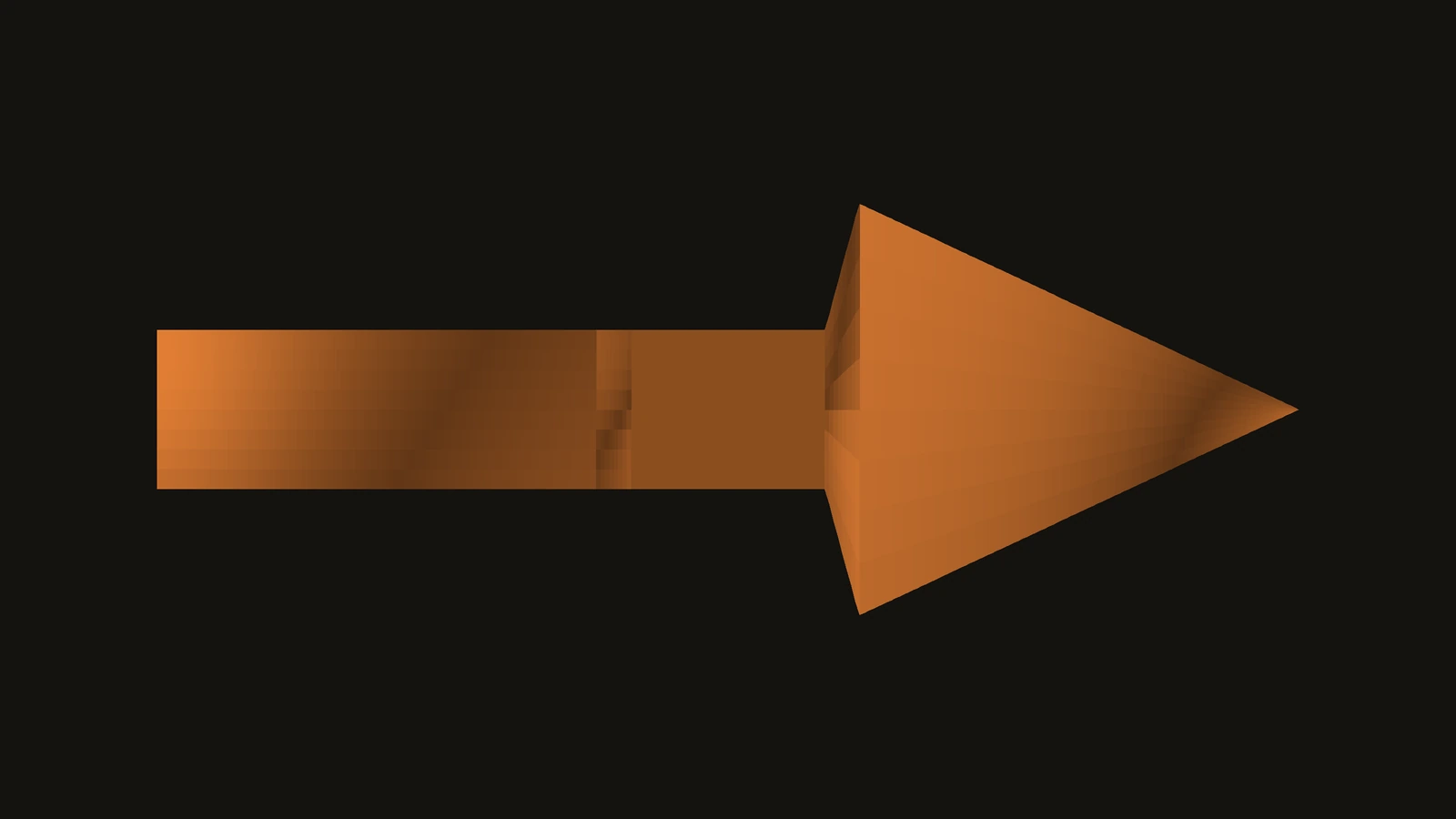
Rendered from the object's own geometry for DomiVerseX
One object, one turn, and the tip never moves. The reason is not in your eyes, it is in your camera.
This article contains affiliate links. If you buy through them, we may earn a small commission at no extra cost to you.
Put an arrow on a table. Walk around it. At some point the tip should swing over and start pointing the other way, because that is what arrows do. That is the whole job of an arrow.
There is one arrow in the world that will not do it. It sits on a desk in Tokyo and in a few hundred homes, it is about the size of a phone, and no matter how you spin it, the tip keeps pointing right. Put it in front of a mirror and the reflection points left while the real one still points right. Nothing is glued, nothing is hidden, and there is no video trick.
The man who made it is not a magician. He is a mathematician named Kokichi Sugihara, and he works at Meiji University in Tokyo. His field is called mathematical engineering, which is a fancy way of saying he uses maths to explain things that happen in the real world. For about forty years the thing he has been explaining is your eyes.
If you want to feel the effect for yourself before reading on, the cheapest way in is a small parabolic mirror toy that makes a solid object appear to float in mid air. It uses the same weakness in your visual system, and it costs about the same as a pizza.
The Object That Refuses To Turn Around
Sugihara has won first prize at the Best Illusion of the Year Contest four times, in 2010, 2013, 2018 and 2020, plus two second places in 2015 and 2016. That is a strange sentence to write about a mathematician. Most of his winning entries are physical objects that you can hold, photograph, and fail to understand.
The arrow belongs to a family he calls left-right reversing objects. He introduced the idea in a paper in 2016 and then wrote a plain-language explanation of it in the European Mathematical Society Magazine in 2022, which is unusual and generous, because most people who invent a good trick do not publish the method.
One thing worth clearing up, because half the internet gets it wrong: the arrow is not the same object as his famous circle-and-square cylinder. Those are two different inventions with two different mechanisms. The cylinder changes its shape in a mirror. The arrow changes its direction. Both belong to the wider family of 3D printed impossible objects that only work from one specific angle, and finding that angle is half the fun of owning one.
Why It Is The Same Object
Here is the part that sounds impossible until it sounds obvious.
The arrow is not two shapes cleverly stitched together. It is one shape that is unchanged when you turn it halfway around. Spin it 180 degrees on a vertical axis and every single point of the object lands exactly where another point of the object already was. The object after the turn is not similar to the object before the turn. It is identical. Same object, same position.
Think of a plus sign drawn on paper. Turn the paper upside down and you get the same plus sign back. Nothing about it tells you it moved. Now imagine building a solid version of that idea, except instead of looking like a plus sign, it looks like an arrow. That is the whole invention.
Mathematicians call this line symmetry. Your bathroom scales have it. A ceiling fan with two blades has it. What nobody expected is that you could build something with line symmetry that still reads as a shape with a clear direction, because "pointing somewhere" feels like the opposite of "symmetrical".
So the arrow does not survive the turn. It never turns in any way your eyes can detect, because there is nothing to detect.
Drag the object with your finger or mouse. Turn it a full 180 degrees and watch where the tip points. Then move the viewing angle away from 35 degrees and the arrow falls apart.
The Twist Nobody Mentions
Now the part that changes how you should think about every illusion video you have ever seen.
The arrow works much better on camera than it does in real life. Sugihara says so himself in his 2022 article, and it is not a footnote. It is the mechanism.
Enjoying this story?
Get a short teaser by email whenever we publish something new. No spam.
You have two eyes, set about six centimetres apart. They see slightly different pictures, and your brain compares the two and works out depth by triangulation, the same way a surveyor measures a distant hill from two positions. That system is fast, it runs constantly, and it is very hard to fool. Hold Sugihara's arrow in your hand and turn it slowly, and you will probably work out that it is a curved wall of plastic within a few seconds.
A camera has one lens. One lens is one eye. When you film the arrow, you throw away the depth information before the video ever reaches the viewer, and the brain is forced to guess.
And it does not guess randomly. Given a flat picture that could be many possible 3D objects, the human brain reliably picks the interpretation with the most right angles in it. This is a documented bias, not a hunch, and Sugihara used it deliberately: he built the object as a wall of constant height so your brain would read the top edge as a flat slice, which is exactly the arrow shape he wanted you to see.
So the honest description of the illusion is this. It is not fooling you. It is fooling your camera, and you are trusting your camera. Maybe that is worth remembering the next time something impossible turns up on your feed with no hands in the shot.
If you want to test the two-eye claim yourself, the cheapest experiment on earth is to close one eye and try to touch two fingertips together in front of you. Then do it with both eyes open. The difference is the thing Sugihara is exploiting.
The Angle Is Everything
There is a catch, and it is the reason you almost never see this object photographed badly.
The illusion only holds from one viewing height. Look down at it from the designed angle and it is a perfect arrow. Raise the camera fifteen or twenty degrees and the shape falls apart into a twisted ribbon with no direction at all. Lower it and the same thing happens the other way.
That is not a flaw in the design, it is a consequence of the maths. The object's depth is calculated by dividing by the tangent of the viewing angle. Divide by a small number and you get a big number, which is why very shallow angles would require an object metres deep. In practice the workable range is roughly 30 to 45 degrees above the table.
This also explains something you may have noticed about illusion videos in general. The camera never moves up or down. It cannot.
Make One On Your Kitchen Table
The generous part of Sugihara's 2022 article is the last third, where he shows how to build one out of paper. Not a simplified toy version. The real thing.
You print a flat net, fold it into a rectangular tube, and cut the top edge along a curve that you use twice. That is the entire secret. Because you use the same curve on opposite sides of the tube, the finished tube is line-symmetric, and line symmetry is all you need. He wrote it up specifically so that children could design their own shapes, and his own examples include a fish, a bird and a jet plane that all reverse direction in a mirror.
You need one more thing to see the mirror version properly, and it is a sheet of flexible acrylic mirror that you can cut with scissors and stand up behind the object. Glass works too, but a shatterproof sheet on a kitchen table with a curious eight year old is the better call.
Why Any Of This Matters To You
You could file this under party trick and move on. I think that undersells it.
Every day, a growing share of what you know about the world arrives as a flat picture on a screen, filmed by one lens, and your brain fills in the missing dimension using rules you never agreed to and cannot switch off. Sugihara's arrow is the cleanest demonstration anyone has built of that gap, and the remarkable thing is that knowing how it works does not protect you. Look at the video again after reading this article and it still points right.
That is possibly the most useful thing here. Not that your eyes can be fooled, everybody knows that. It is that understanding the trick in full detail changes nothing about what you see. The gap between what you know and what you perceive stays exactly as wide as it was.
Sources
- Kokichi Sugihara, "Left-right reversal illusion", European Mathematical Society Magazine 125 (2022), pages 13 to 19, open access
- Kokichi Sugihara, "Anomalous Mirror Symmetry Generated by Optical Illusion", Symmetry 8 (2016), article 21
- Best Illusion of the Year Contest, winners archive
- CNN Style, profile of Kokichi Sugihara's impossible objects
- Live Science, report on the arrow and the 2016 paper
- Kokichi Sugihara, biography and contest record