Give me 20 seconds and I'll prove you can't trust your own brain
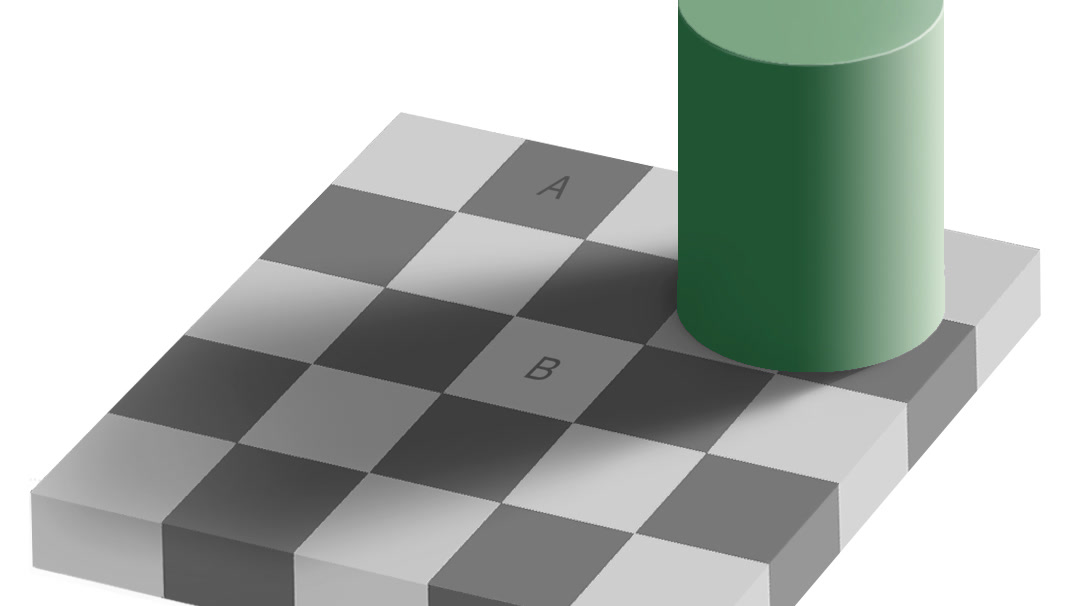
© 1995 Edward H. Adelson, CC BY 3.0
One square looks dark, the other looks light, but an MIT scientist gave them the very same gray. Here is why your eyes refuse to believe it, even after you know.
This article contains affiliate links. If you buy through them, we may earn a small commission at no extra cost to you.
A checkerboard with a secret
Picture a simple checkerboard of light and dark squares. A green cylinder stands on it and throws a soft shadow across part of the board. One square out in the open is labeled A. Another square, sitting inside the shadow, is labeled B.
Look at them for a second. A seems like one of the dark squares. B seems like one of the light squares. If someone asked you to bet your lunch money, you would bet that they are different.
You would lose your lunch money. On the page where he published the picture, its creator says it plainly: the squares marked A and B are the same shade of gray. Not almost the same. The same.
Who made it, and why it spread
The picture is called the checker shadow illusion. It was made in 1995 by Edward H. Adelson, a vision scientist at MIT who works in a lab called the Perceptual Science Group. That is about 30 years ago, more than a decade before the first iPhone, and it still stops people in their tracks.
Part of the reason it spread so far is that Adelson let it. His own page says the images "may be reproduced and distributed freely," and the credit line reads ©1995, Edward H. Adelson. So teachers, textbooks and websites all over the world copied it. Today it sits among the classics, the kind you might see on an optical illusion poster in a science classroom.
Why does this matter to you? Because this is not a trick of a weird screen or a bad printer. It happens inside your own head, every time, and it shows how your eyes and brain really work together.
The proof: a strip of gray
Here is the test that settles it. Adelson made a second version of the image with a gray strip laid across the board so that it touches both square A and square B.
The moment the strip connects them, the difference melts away. A and B suddenly look like what they are: two patches of the same middle gray, like two socks from the same pair. It is the same kind of jolt you get from a 3D night lamp that looks like a solid shape until you see it is a flat sheet of plastic.
You can also test it at home. Take a sheet of paper and cut two small holes in it. Lay it over the picture so only square A shows through one hole and only square B through the other. With the rest of the board hidden, the two little windows look the same. Your brain has lost the clues it was using, so it stops "fixing" the colors.
Painters know this effect well. Spin a color wheel and you will notice that a color can look quite different depending on what sits next to it.
The twist: your brain is not measuring gray at all
So what is going on? The big idea is this: your brain is not trying to tell you how much light hits your eye. It is trying to tell you what color the surface really is.
Those are two very different jobs. Think of a white T-shirt. In bright sun it sends a huge amount of light into your eyes. In a dim room it sends much less, maybe even less than a black shirt does outdoors. Yet you never think your white shirt turned gray when you walked inside. Your brain quietly adjusts for the lighting. Scientists call this lightness constancy, and the Illusions Index uses exactly that term to explain Adelson's picture.
The same skill is why a Rubik's Cube held near a window, with one face in sun and one in shade, still shows you "white" and "yellow" in the right places instead of a jumble of new colors.
In the checkerboard, your brain spots the shadow. It reasons, without asking you: "B is in shadow, so the real square must be lighter than it looks. A is in full light, so the real square must be darker than it looks." Then it shows you its corrected answer, not the raw light.
Adelson lists the clues it uses in his explanation of the illusion:
- Neighbors. B is surrounded by darker squares, and A by lighter ones. In his words: "A check that is lighter than its neighboring checks is probably lighter than average, and vice versa."
- Soft edges. "Shadows often have soft edges, while paint boundaries (like the checks) often have sharp edges." The blurry shadow gets filed under "lighting," not "paint."
- Where lines meet. The checks run straight through the shadow's edge, a hint that this is one board under two kinds of light.
Enjoying this story?
Get a short teaser by email whenever we publish something new. No spam.
It is a bit like autocorrect on your phone. Most of the time it helps. Once in a while it changes the word you actually meant.
A feature, not a bug
This is where the story flips. It is tempting to say your brain failed. Adelson says the opposite: "The visual system is not very good at being a physical light meter, but that is not its purpose." And: "As with many so-called illusions, this effect really demonstrates the success rather than the failure of the visual system."
Why would a brain be built this way? A likely answer, and the way many vision scientists frame it, is that recognizing things matters far more than measuring light. Imagine an animal that thought a ripe fruit changed color every time a cloud passed, or that a predator vanished the moment it stepped under a tree. Saying "same object, just in shade" is useful every minute of the day. The price is that a clever drawing can fool the same system.
Why knowing the answer doesn't fix it
Now the strangest part. Go back and look at the original picture. You know A and B are the same. And yet, for most people, A still looks darker.
Psychologists and philosophers have a name for this idea: cognitive impenetrability. The claim, linked to Jerry Fodor in 1983 and Zenon Pylyshyn in 1984, is that some parts of seeing run on their own and cannot be changed by what you know. The Open Encyclopedia of Cognitive Science gives a classic example: the two lines of the Müller-Lyer illusion "continue to appear unequal in length even after one learns that they are equal in length." The checker shadow seems to behave the same way.
To be fair, this is still argued about. The same encyclopedia notes that whether thinking can change seeing "is a subject of debate." But for this picture, the everyday experience is hard to argue with: knowledge goes in, the illusion stays.
Why does this matter to you? It is a reminder that "I saw it with my own eyes" is not always the final word. Your eyes report the brain's best guess, and the guess is usually excellent, but not always.
The dress that split the internet
If this sounds familiar, you may be thinking of the dress. In 2015, a photo of a striped dress went viral because people could not agree whether it was white and gold or black and blue.
Neuroscientist Pascal Wallisch at NYU later ran an online study with more than 13,000 people. According to ScienceDaily's report, people who believed the dress was in shadow were much more likely to see white and gold, while those who assumed yellowish indoor light tended to see black and blue.
It is the same trick as the checkerboard, just with color instead of gray. Your brain guesses the lighting, then "subtracts" it. If two people guess different lighting, they really do see different colors. You can explore this hands-on with a small optical illusions science kit on the kitchen table.
Try it on your friends
Show someone the checkerboard and ask which square is darker. Most people pick A. Then do the paper trick, and then ask them to look at the original again. Most people laugh, because it has not changed.
That moment, when you know the truth but still cannot see it, is the whole point. For many more pictures that do this, Al Seckel's The Ultimate Book of Optical Illusions is packed with them.
So what are you really seeing?
Every day, your brain quietly edits the world before you see it. It removes shadows, fixes colors and guesses what things are made of. Most of the time, that editing keeps you from getting confused. Sometimes, like with two gray squares, it gets caught in the act.
Which leaves an odd question: if your brain can rewrite a gray square this easily, what else around you today has already been "corrected" before you noticed?
Sources
- Checker Shadow Illusion, Edward H. Adelson, Perceptual Science Group @ MIT
- Checkershadow Illusion: description, Edward H. Adelson, MIT
- Adelson's Checker-Shadow Illusion, The Illusions Index
- Checker shadow illusion, Wikipedia
- Cognitive Penetrability, Open Encyclopedia of Cognitive Science (MIT)
- Why did we see 'the dress' differently? The answer lies in the shadows, ScienceDaily (2017)
- Here's why we disagreed about 'the dress', Futurity