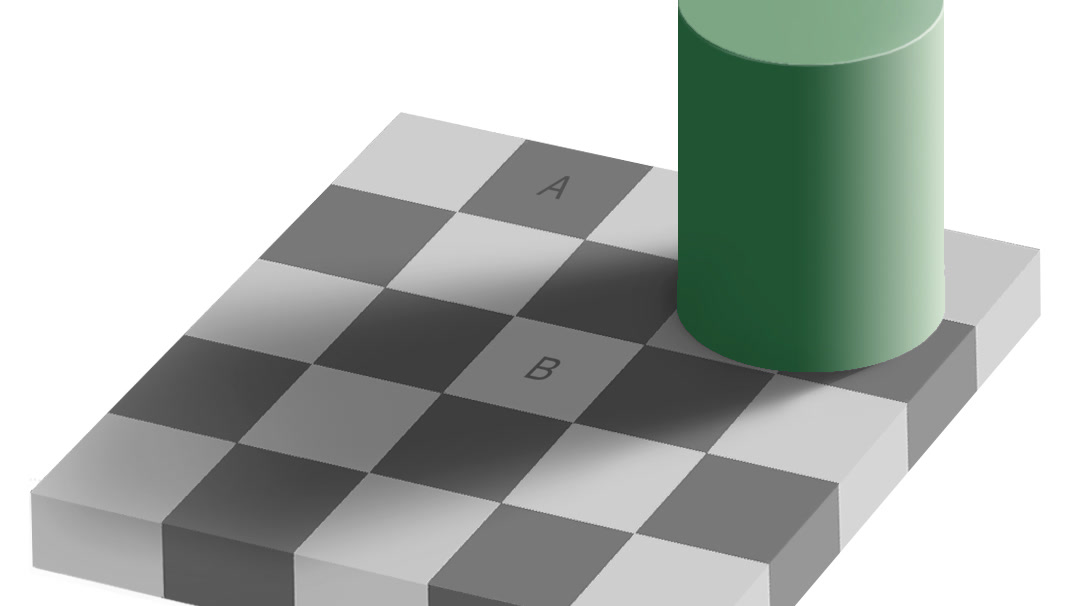
The Parthenon's famous optical illusion may never have existed
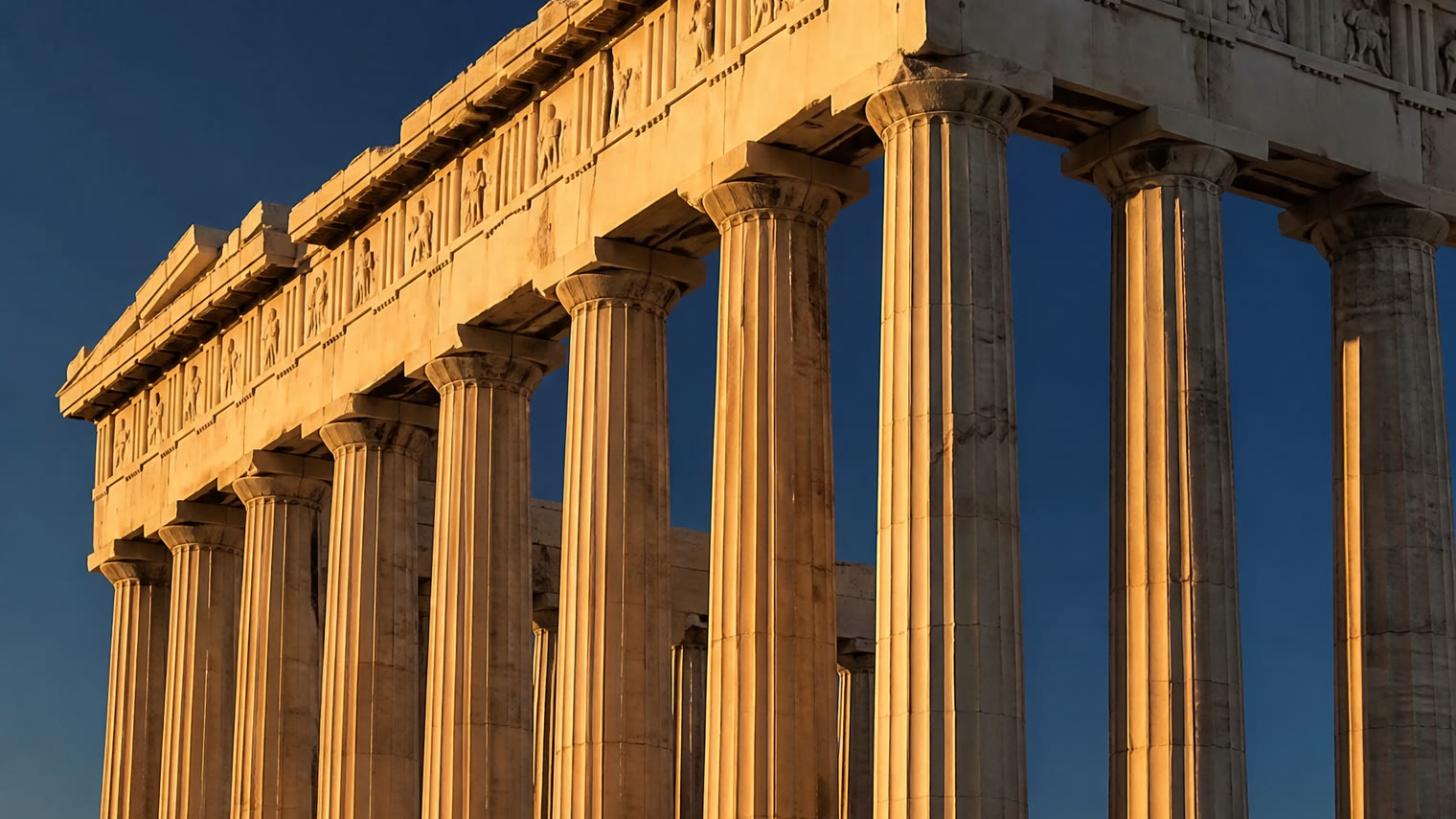
Illustration generated with AI for DomiVerseX
One of the most repeated stories in all of architecture is about a trick that the builders of a Greek temple supposedly played on our eyes. A mathematician went looking for the proof, and came back with an awkward question.
This article contains affiliate links. If you buy through them, we may earn a small commission at no extra cost to you.
Stand at one end of the Parthenon in Athens and look along its marble floor. The floor at that end is about 31 meters wide, a little more than the length of a basketball court. It looks perfectly flat. It is not.
The middle of that floor is about 6 centimeters higher than the corners. The columns standing on it are not straight tubes either. They bulge very slightly on the way up.
The Parthenon was built between 447 and 432 BCE, so it was finished more than 2,400 years ago. The architects were named Iktinos and Kallikrates, and the sculptor Phidias was in charge of the statues and carvings. And for most of the time since, people have told one story about why they bent the stone.
Why does this matter to you? Because you will probably hear that story in school. It is a good example of how a clever explanation can be repeated for centuries without anyone checking it.
Curves you can measure
First, the part nobody argues about. The curves are real. People began measuring them carefully in the 1800s, with a famous survey by Francis Penrose in 1851. That was almost 2,300 years after the temple was finished.
The platform under the columns is 30.9 meters by 69.5 meters. That is a bit more than one basketball court length on the short side and about two and a half court lengths on the long side. On the short ends, it rises about 6 centimeters toward the middle, roughly the length of a chicken egg. On the long sides the rise is bigger, about 10 to 11 centimeters, which is about the width of a grown-up's hand.
The columns are about 10.4 meters tall, as high as a three floor building. Their bulge is 18 millimeters at most. That is about the width of a grown-up's finger.
The corner columns are a little fatter than the rest: about 4.2 centimeters thicker at the base. That is two coins side by side, if each coin is an American nickel.
Why does this matter to you? A curve this faint, carved on purpose over the length of a building, is no accident. Somebody wanted these curves badly.
The famous explanation
So why did they do it? The answer in guidebooks goes like this. Long straight lines can fool the eye. A long flat floor can seem to sag in the middle. A straight column can seem to get thinner halfway up. So the builders bent everything the other way, just enough to cancel the tricks. The temple is curved so that it will look straight.
The story comes from Vitruvius, an architect of ancient Rome who wrote in the first century BCE.
Vitruvius was writing about 400 years after the Parthenon was finished. That is like somebody now explaining exactly what a builder was thinking in the 1620s.
Why does this matter to you? The story did not come from the people who built the temple. It came from a writer who lived about 16 generations later.
A mathematician checks the story
In September 2026, Alain Goriely, a mathematician at the University of Oxford, published a paper in the journal Royal Society Open Science. Its title is blunt: "The illusion of illusions: there are no optical corrections in the Parthenon."
Goriely does not say the curves are fake. As Smithsonian Magazine reports, he accepts the measurements. What he doubts is the reason. In his words: "There is strictly no evidence that the refinements in the Parthenon actually produce the proposed visual illusions."
His paper says at least twelve different eye tricks have been suggested over the years. He looks closely at four main ones, and argues that each either has never been shown to exist or is too small for a visitor to notice.
Take the floor. The idea of a sagging line is linked to a drawing trick called the Hering illusion. Goriely argues that it works on flat paper but has not been shown to work on a real building that you walk around. He also points out that the floor's curve hides nothing. Crouch at a corner and look along the steps, and you can see it.
Take the columns. He argues that nobody has ever shown, in an experiment, that a straight column looks pinched in the middle. If the trick is not there, there is nothing for the bulge to fix.
Enjoying this story?
Get a short teaser by email whenever we publish something new. No spam.
Take the corners. Vitruvius said corner columns look thinner because of the bright light around them. Goriely argues that this could only be true from a few viewing spots, so a fix for those spots would make things uneven from everywhere else.
Why does this matter to you? He is asking a question you can ask about anything: has somebody actually tested this, or does it only sound right?
The twist: the experts were never so sure
Here is what the short video leaves out. This is not really a story about one outsider proving all the experts wrong.
Doubts are not new. In 2007, a study from the University of York tested whether the bulge in columns makes up for any trick of the eye. It found little evidence that it does.
In the same year, according to Smithsonian Magazine, the Acropolis expert Jeffrey Hurwit told the TV network PBS that there were "good grounds to question" whether the architects wanted the temple to look perfectly straight at all.
Goriely's own paper quotes Manolis Korres, the architect who led the modern repair of the Acropolis, as saying the eye trick theory "does not hold water in most cases". We have that quote only from Goriely's paper, so treat it with a little care.
So where did the confident version live? In guidebooks and textbooks, and now in chatbots. If GreekReporter has it right, Goriely asked three AI chatbots, ChatGPT, Gemini and Claude, and each one repeated the old story as a fact.
Why does this matter to you? The popular story may have run far ahead of what the experts actually believed.
So why carve the curves?
Goriely is careful here. "Finding no evidence for optical corrections does not explain the presence of architectural refinements," he says, as quoted by ScienceAlert.
He offers some possibilities. The curved floor could help rainwater run off. The curves could simply be what the builders found beautiful. Or they could be habits of the trade, passed from one generation of stone workers to the next.
Marge Livingstone, a brain scientist at Harvard Medical School, likes the rain idea. "I think it must have been for drainage, just like on roads," she said.
But even that answer has a problem. According to the Spanish news site Ecoticias, the paper's own numbers suggest that a thin film of water would take about 44 minutes to cross 30 meters of a slope that gentle. That is about as long as a school lesson, which is slow for a drain. We found that figure in one report only.
Why does this matter to you? "We do not know yet" is a real answer in science. It is often the most honest one.
What has not been tested
Goriely worked from measurements, calculations and older studies of how we see. He did not run an experiment at the Parthenon itself. That is why this article says he argues, and not that he has settled it.
And the other side has hardly spoken. We found no formal reply from the archaeologists who study the Acropolis. One architecture historian, Mark Wilson Jones, is reported by Ecoticias to have told Scientific American that the ancient builders had no modern way to prove or disprove ideas like this one. We could not read that interview ourselves.
There is a way to find out more. Far across the globe from Athens, in Nashville, Tennessee, stands a full size copy of the Parthenon, built in 1897. Goriely suggests it would be a good place to test the eye tricks on real visitors. Until then, his advice to readers is to look for themselves: "Trust your own eyes, question what you see and decide for yourself whether the theory of optical corrections holds up."
So the curves are still there, measured and real. The old reason for them may be gone. If the builders were not trying to fool anyone's eye, why did they go to the enormous trouble of carving them? And will anyone go to Nashville and run the test?
Sources
- The illusion of illusions: There are no optical corrections in the Parthenon, Alain Goriely, arXiv
- Centuries Ago, an Architect Characterized the Parthenon's Curves as a Clever Optical Illusion. Now, a Mathematician Begs to Differ, Smithsonian Magazine
- The Parthenon's Famous Optical Illusion May Itself Be an Illusion, Study Shows, ScienceAlert
- Parthenon's Famous Optical Illusion Theory Is a Myth, Oxford Mathematician Says, GreekReporter
- We've Been Giving the Parthenon's Architects Credit for a Trick They Might Not Have Even Used, Gizmodo
- Un matemático de Oxford sostiene que las curvas del Partenón no corrigen ninguna ilusión óptica, Ecoticias
- Entasis, Wikipedia
- Parthenon, Wikipedia