The first powered flight in history covered less distance than the wingspan of a modern jumbo jet.
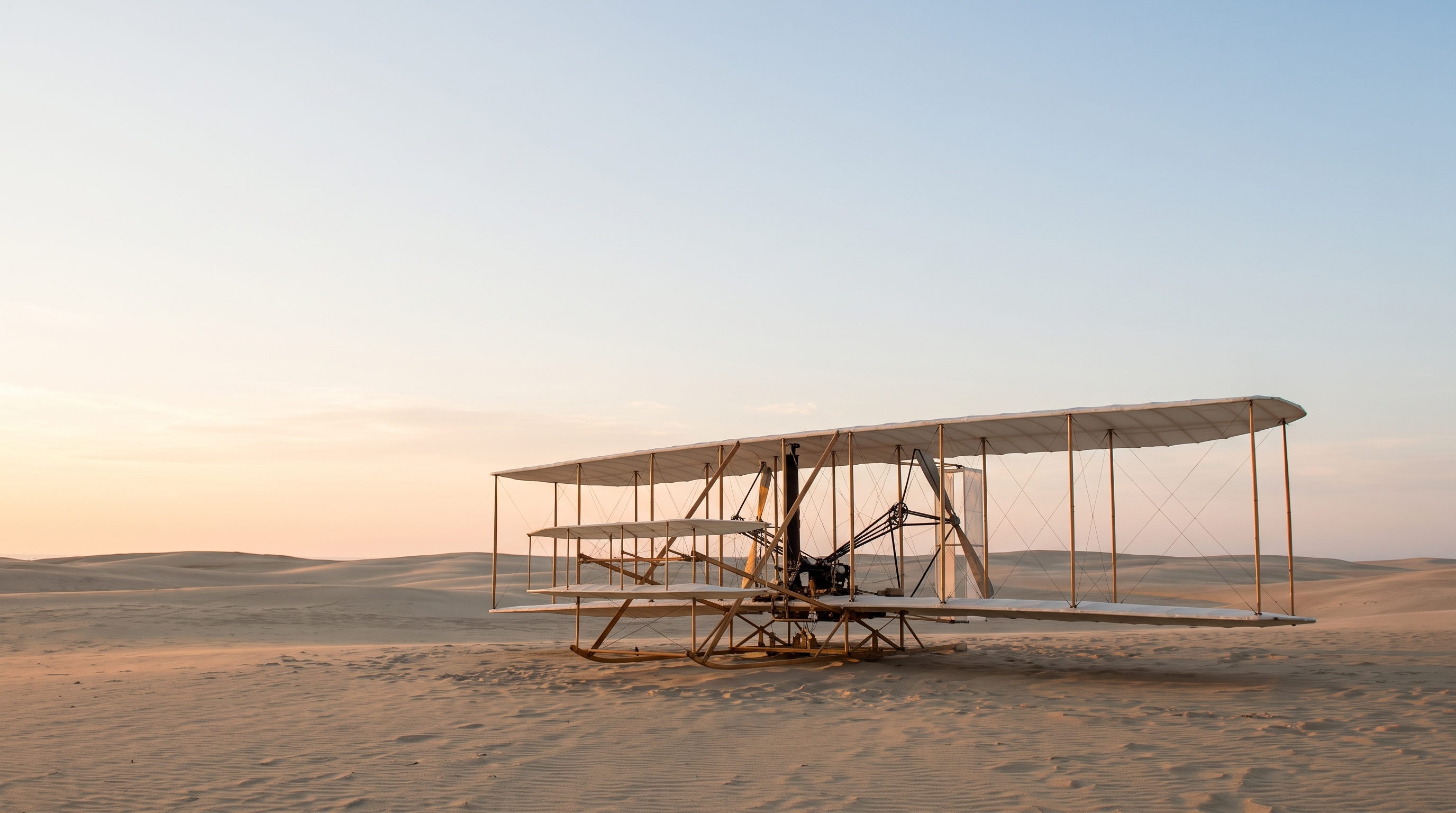
AI-generated illustration
On a freezing, windy morning at Kitty Hawk, North Carolina, two bicycle makers from Ohio built a machine that no human had ever flown before. It stayed in the air for less time than it takes to read this sentence out loud twice.
This article contains affiliate links. If you buy through them, we may earn a small commission at no extra cost to you.
A Cold Morning at Kitty Hawk
On December 17, 1903, Wilbur and Orville Wright stood on a sandy beach near Kitty Hawk, North Carolina. It was cold and windy that morning. According to the National Park Service, a steady 27 mile per hour wind was blowing, stronger than the brothers really wanted for a first try. They had spent three years testing gliders on these same windswept dunes because the soft sand made for safer crash landings and the strong, steady coastal winds helped a flying machine lift off. Now they had something new: a wood and fabric biplane with a homemade gasoline engine, called the Wright Flyer.
If you want to hold a piece of that machine in your own hands, this detailed laser-cut Wright Flyer model kit rebuilds the exact aircraft piece by piece.
Five people stood on the sand to watch. According to a historical account from the University of Houston's Engines of Ingenuity program, the witnesses were John T. Daniels, W.S. Dough, and A.D. Etheridge from the local Life-Saving Station, plus a visitor named W.C. Brinkley and a teenager named Johnny Moore. That is not a typo. Only five people saw one of the biggest moments in human history happen live.
Twelve Seconds, One Hundred Twenty Feet
At 10:35 in the morning, Orville Wright climbed onto the lower wing of the Flyer and lay down flat, facing forward, his hips in a cradle that controlled the wings. The brothers had flipped a coin earlier, and it was Orville's turn to fly first. The engine roared, the machine slid down a 60-foot wooden launch rail, and then it lifted into the air.
Both NASA and the National Park Service agree on the numbers: the flight covered about 120 feet and lasted 12 seconds. Since the wind was blowing so hard into the Flyer's nose, the machine's speed over the ground was only 6.8 miles per hour, slower than a person jogging, even though its speed through the air was much faster because of the headwind. The whole flight was over almost as fast as it began.
If you want the full story of how two brothers with no college degree solved a problem that had stumped inventors for centuries, this bestselling book about the Wright brothers is considered one of the best ever written on the subject, and it reads like an adventure story.
Four Flights in One Morning
The Wright brothers did not stop after one flight. They flew three more times that same morning, taking turns as pilot. According to National Park Service records of the day, the second flight covered about 175 feet in 12 seconds, and the third covered about 200 feet in 15 seconds. Then came the big one.
On the fourth flight, Wilbur took the controls, and the Flyer soared 852 feet and stayed up for 59 seconds, more than four times farther than the very first hop. NASA, the Smithsonian, and the National Park Service all confirm these numbers. Wilbur had finally out-flown his younger brother, at least for that day.
Enjoying this story?
Get a short teaser by email whenever we publish something new. No spam.
For kids who want to read the whole adventure in a way made just for their age, this popular kids' biography of the Wright brothers breaks the whole story down step by step.
Right after that fourth flight, disaster almost struck. A sudden gust of wind caught the Flyer and flipped it over on the sand. According to the Smithsonian, the aircraft was so badly damaged that it never flew again. John Daniels, one of the witnesses, was standing near the machine when it flipped, and he got tangled up in the wires and wood. He survived without serious injury, but he came close to being remembered as the first person ever hurt in an airplane accident instead of the man who helped make history.
The Photograph That Almost Wasn't
You have probably seen the famous photo: the Flyer just barely off the ground, Orville lying at the controls, Wilbur running alongside. That photo exists today because of pure luck. Before the first flight, Orville set up his camera on a tripod and pointed it at the spot where he hoped the plane would lift off. He asked John Daniels, one of the five witnesses, to simply squeeze the rubber bulb that triggered the shutter the moment the Flyer left the ground.
According to the same historical account from the University of Houston, Daniels had never taken a photograph in his life before that morning. He was so excited watching the machine fly that he was not even sure he had remembered to squeeze the bulb. When the glass photographic plate was developed later, it turned out perfectly. Today the original photograph is held by the Library of Congress, and it is one of the most famous pictures ever taken.
Some collectors like to display that historic moment on their own wall with this large print of the original 1903 first flight photo.
Shorter Than a Jet's Wing
Here is the detail that tends to surprise people most. The Wright Flyer's first flight covered about 120 feet, or roughly 36 to 37 meters. According to HistoryFacts and other sources, a Boeing 747 jumbo jet has a wingspan of somewhere between 195 and 224 feet, depending on the exact model. That means the entire distance of the world's first powered airplane flight was shorter than the wingspan of a single modern jet sitting still on the runway. The National Park Service makes a similar point a different way, noting that the flight covered less ground than the total length of a modern passenger airliner.
The Wright Flyer itself was tiny compared to today's planes too. According to the Smithsonian, which now displays the original 1903 Flyer, its wingspan was about 40 feet 4 inches, or 12.3 meters, and the whole machine weighed only about 605 pounds empty.
It is strange to think that something so small and so short helped start an age when humans now fly around the entire planet in a single day. If you want a model of that tiny, history-making machine to build yourself, this 3D wooden puzzle kit of the Wright Flyer is a popular way to see just how small it really was.
So the next time you sit on a modern airplane, with its huge wings stretching out past your window, think about two brothers on a cold beach in 1903, a machine that barely left the ground, and twelve seconds that somehow changed everything that came after. What would Wilbur and Orville think if they could see an airport today?
Sources
- 115 Years Ago: Wright Brothers Make History at Kitty Hawk — NASA
- The First Flight — National Park Service — https://www.nps.gov/articles/firstflight.htm
- Four Powered Flights — National Park Service
- 1903 Wright Flyer — Smithsonian National Air and Space Museum
- No. 2551: Five Witnesses to History — Engines of Our Ingenuity, University of Houston
- John Daniels, Orville Wright's First Flight — Library of Congress
- First flight, 120 feet in 12 seconds — Library of Congress photo record
- The Wright brothers' first flight was shorter than the wingspan of a 747 — HistoryFacts