
They made ice in the desert with no electricity.
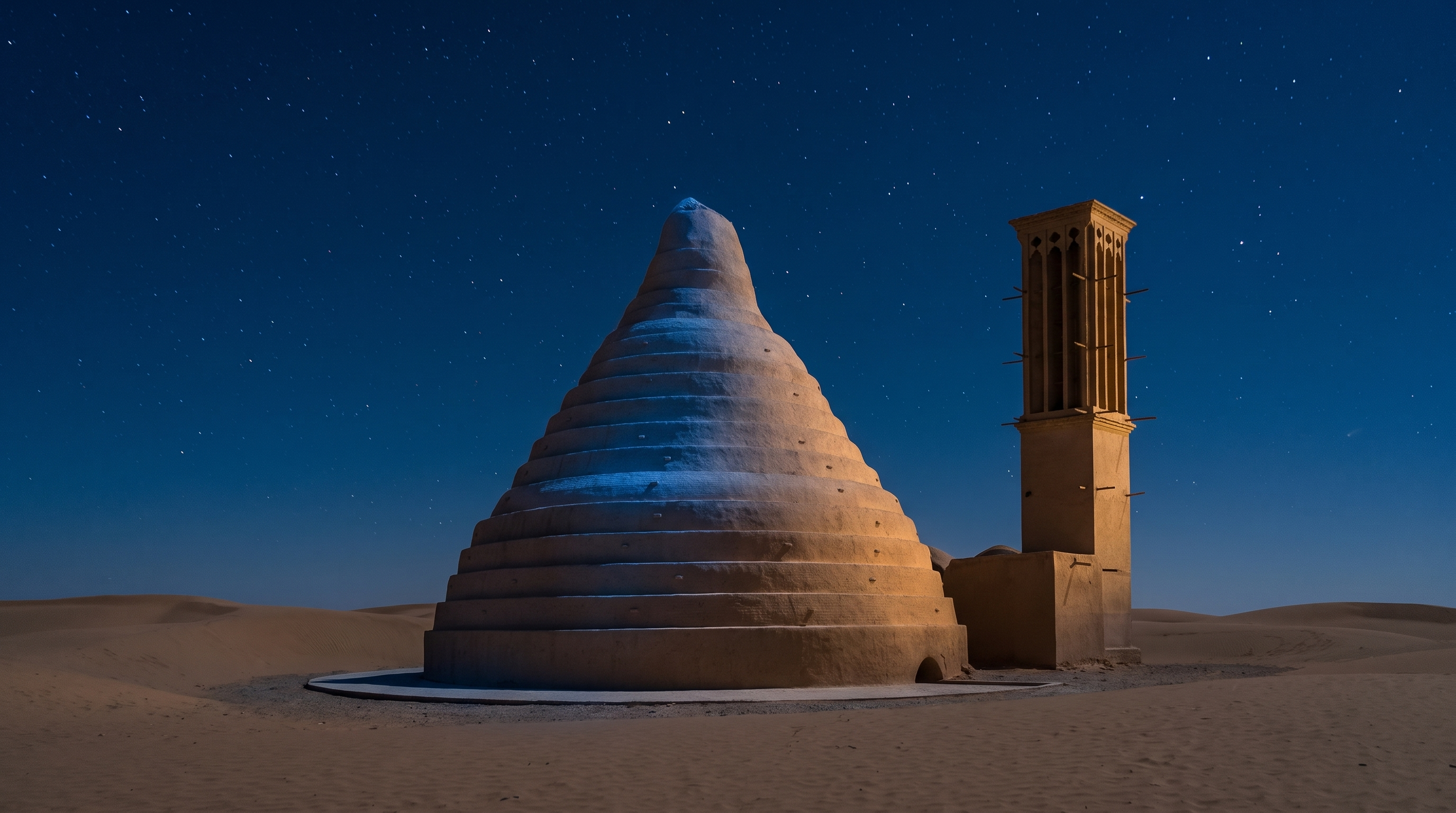
AI-generated illustration
Nobody had a freezer. Nobody had electricity. Yet in the middle of a scorching desert, people found a way to make solid ice appear overnight, using nothing but mud walls, wind, and the cold night sky.
This article contains affiliate links. If you buy through them, we may earn a small commission at no extra cost to you.
Nobody had a freezer. Nobody had a plug or a power line. Yet people in one of the hottest deserts on Earth figured out how to make solid ice appear overnight, using nothing but mud walls, moving air, and the cold night sky above them.
The trick lived inside a strange, cone shaped building called a yakhchal. In Persian, the word roughly means "ice pit," and it worked almost like an ancient ice factory. According to Wikipedia and the UK engineering firm Max Fordham, people in ancient Persia, in what is now Iran, were building and using these structures by around 400 BC. That is more than two thousand years before anyone plugged in an electric refrigerator. If you want to understand where our obsession with cold drinks actually started, the secret behind old school cooling tech is a good place to look, and it has nothing to do with electricity.
A Giant Cone Made of Mud
A yakhchal looks a bit like a beehive or a rocket poking out of the sand. According to the architecture site Earth Architecture, the dome above ground could rise as tall as about 18 meters, close to 60 feet, with an underground storage chamber below it large enough to hold thousands of cubic meters of ice. Wikipedia gives a similar figure for a preserved yakhchal in the city of Kerman.
The walls at the base were at least two meters thick, according to both Wikipedia and Earth Architecture. Builders did not use plain mud either. They mixed a special waterproof plaster called sarooj, made from sand, clay, ash, goat hair, and even egg whites in careful amounts. That mixture kept the thick walls from cracking or leaking for centuries. In a way, this kitchen gadget freezes water in minutes using a tiny modern motor, but the yakhchal builders were doing the same basic job, just with mud, shade, and patience instead of electricity.
Water Brought In From Underground
None of this works without water, and deserts do not exactly have rivers running through them. Persian engineers solved that problem with qanats, long underground tunnels that carried water from mountains or underground sources into desert towns, often for many kilometers. Several sources, including Wikipedia and the site Earth Architecture, describe qanats feeding water directly into the shallow pools built next to yakhchals. This handy travel size version of staying cool shows up in modern gear too, and it turns out humans have been chasing the same problem for thousands of years.
Because the water traveled underground, it arrived cool and shaded from the sun the whole way. That mattered a lot, since every degree the water started warmer meant more work for the freezing process that happened next. If you like the idea of never running out of cold water on a hot day, grab one before summer hits, because the Persians clearly understood the value of planning ahead.
Towers That Pull In the Wind
Many yakhchal complexes also used badgirs, tall wind catching towers built from mud brick. According to Wikipedia's article on windcatchers, these towers could rise as high as 34 meters in some regions, though most were much shorter, and they worked by either catching moving air and funneling it downward, or by using rising warm air to pull cooler air up from below, a process called the stack effect. The tiny version that fits on any desk today runs on a battery instead of wind, but the basic idea of moving air to cool a space has not really changed.
Wikipedia also notes that windcatchers could lower the temperature inside a building by roughly 8 to 12 degrees Celsius, or about 14 to 22 degrees Fahrenheit, compared to the outside air. Around a yakhchal, that moving air helped dry out the underground ice chamber and kept warm air from settling near the stored ice. You will not believe how easy this is to picture once you imagine a tower with no motor, no fan blades, and no electricity, just shaped mud brick catching wind like a sail.
The Real Trick: A Cold, Clear Sky
Here is the part that surprises most people. The air in the desert at night often stayed above freezing, yet the water in the shallow pools froze solid anyway. How?
This cooling trick sounds made up but it is real, and according to Max Fordham's engineering analysis of the yakhchal in the city of Yazd, the main reason was not the air temperature at all. It was something called radiative cooling. On a clear night, a flat surface of water constantly loses heat by radiating it upward, toward the night sky, which acts like a giant cold surface in comparison to the ground. Max Fordham's team explains that because Yazd's winter nights are dry and often cloudless, the pond's surface could lose heat fast enough to drop below freezing even while the surrounding air stayed a few degrees warmer. The same source adds that evaporation played a role too, since dry desert air pulls moisture, and heat, off the surface of water very efficiently.
Enjoying this story?
Get a short teaser by email whenever we publish something new. No spam.
Not everyone frames it exactly the same way. Some general history articles, including pieces from Ancient Origins and Earth Architecture, describe the process more simply as water freezing "in the cold desert night," without getting into the physics of radiation versus air temperature. Both explanations agree on the outcome, ice forming overnight in open pools, they just differ in how much detail they give about why it worked even when the air itself was not freezing. The modern version people are obsessed with today is a technology called passive radiative cooling, which several climate tech companies are now studying specifically because it echoes what yakhchal builders figured out with no science textbooks at all.
The pools themselves were shallow on purpose. Based on details reported by Wikipedia, some measured around 100 meters long and 10 meters wide, but only 40 to 50 centimeters deep, since a thin layer of water freezes and loses heat much faster than a deep pool would.
Layers of Ice, Layers of Straw
Once a layer of ice had formed, workers broke it up and carried it into the underground pit inside the yakhchal. According to both Wikipedia and the ice house article on Earth Architecture, the ice was stacked in layers, separated by straw, wood, or mud, which acted as insulation between each layer and slowed down melting.
This simple trick still works today in camping coolers and picnic boxes, where people still separate ice packs with cloth or paper to make them last longer, even though almost nobody thinks about where that idea originally came from. The yakhchal's thick sarooj walls and the shaded courtyard around it kept the underground chamber cool through the blazing daytime heat, so the stored ice barely felt the outside temperature at all.
Exactly how long the ice lasted is not something every source agrees on with hard numbers. Several general articles claim the ice could last well into the hot summer months, but few of them cite a precise number of weeks. Researchers have since modeled the pools with computer simulations, which helps confirm just how efficient the original design really was.
Ice for Kings, and Ice for Everyone
What was all that ice actually used for? A few things, according to different sources. One detail that surprises people is that ice was not only a luxury for the wealthy. Earth Architecture and Ancient Origins both mention that yakhchal ice was used to keep everyday food fresh, including fruit, dairy, and possibly meat, in a climate where food would otherwise spoil within hours.
Ice was also turned into a treat. According to the travel and food site Atlas Obscura, along with the blog Rimping, stored ice was shaved or crushed and mixed with fruit syrup or rosewater to make faloodeh, a frozen Persian dessert with thin noodles made of starch, sometimes described as an early relative of sorbet. This tiny cooler feels like magic when you first taste something icy on a scorching day, and it is easy to imagine people in Yazd or Kerman feeling exactly the same way, just without a single electric part involved.
Some sources describe yakhchals as a widespread, fairly affordable technology, since Ancient Origins notes they were "fairly simple to make" and available even to people who were not wealthy. Other sources lean more toward describing the grandest yakhchals, the eighteen meter tall ones with huge underground chambers, as elite or civic structures tied to a town's water and food supply. Both things were probably true at once, small versions for ordinary families and massive versions for whole communities.
Still Standing in the Desert
You can still see yakhchals today. Locations named across multiple sources, including Wikipedia, Earth Architecture, and Atlas Obscura, include the desert cities of Yazd, Kerman, Meybod, and Sirjan in Iran. Some are crumbling ruins now, half swallowed by sand, while others have been restored enough that visitors can walk inside the cool, shaded dome and imagine what it felt like when workers were still hauling in blocks of ice.
The trick that keeps drinks cold for hours in a modern insulated bottle is, in a strange way, a distant descendant of what happened inside those mud domes. Engineers today studying passive radiative cooling, the same physics Max Fordham describes for the Yazd pools, are trying to build materials that cool buildings and even electronics without using any power at all. It turns out the core idea behind a lot of newer cooling gadgets is thousands of years old.
So the next time the sky is clear and the night feels cool against a warm desert wall, it is worth wondering what else people figured out with nothing but patience, mud, and a very careful look at the sky above them. Read the full story behind it, and the desert starts to look a lot less empty than it seems.
Sources
- Wikipedia, "Yakhchāl" — https://en.wikipedia.org/wiki/Yakhch%C4%81l
- Wikipedia, "Windcatcher" — https://en.wikipedia.org/wiki/Windcatcher
- Max Fordham, "The Physics of Freezing at the Iranian Yakhchal" — https://www.maxfordham.com/practice-people/journal/the-physics-of-freezing-at-the-iranian-yakhchal
- Archaeology Now, "Persian Ice Towers" — https://www.archaeologynow.org/blog/persian-ice-towers
- Earth Architecture, "Yakhchal: Ancient Refrigerators" — https://eartharchitecture.org/?p=570
- Ancient Origins, "Ancient Advanced Technology: 2,400-Year-Old Yakhchals Kept Ice in the Desert" — https://www.ancient-origins.net/artifacts-ancient-technology/ancient-advanced-technology-021700
- Atlas Obscura, "This Ancient Sorbet Used To Be Made Inside Giant Ice Houses" — https://www.atlasobscura.com/foods/faloodeh-sorbet-noodles
- Rimping, "Discover Faloodeh" — https://www.rimping.com/blog/7802/discover-faloodeh