
A robot dog ran a full marathon on one battery charge
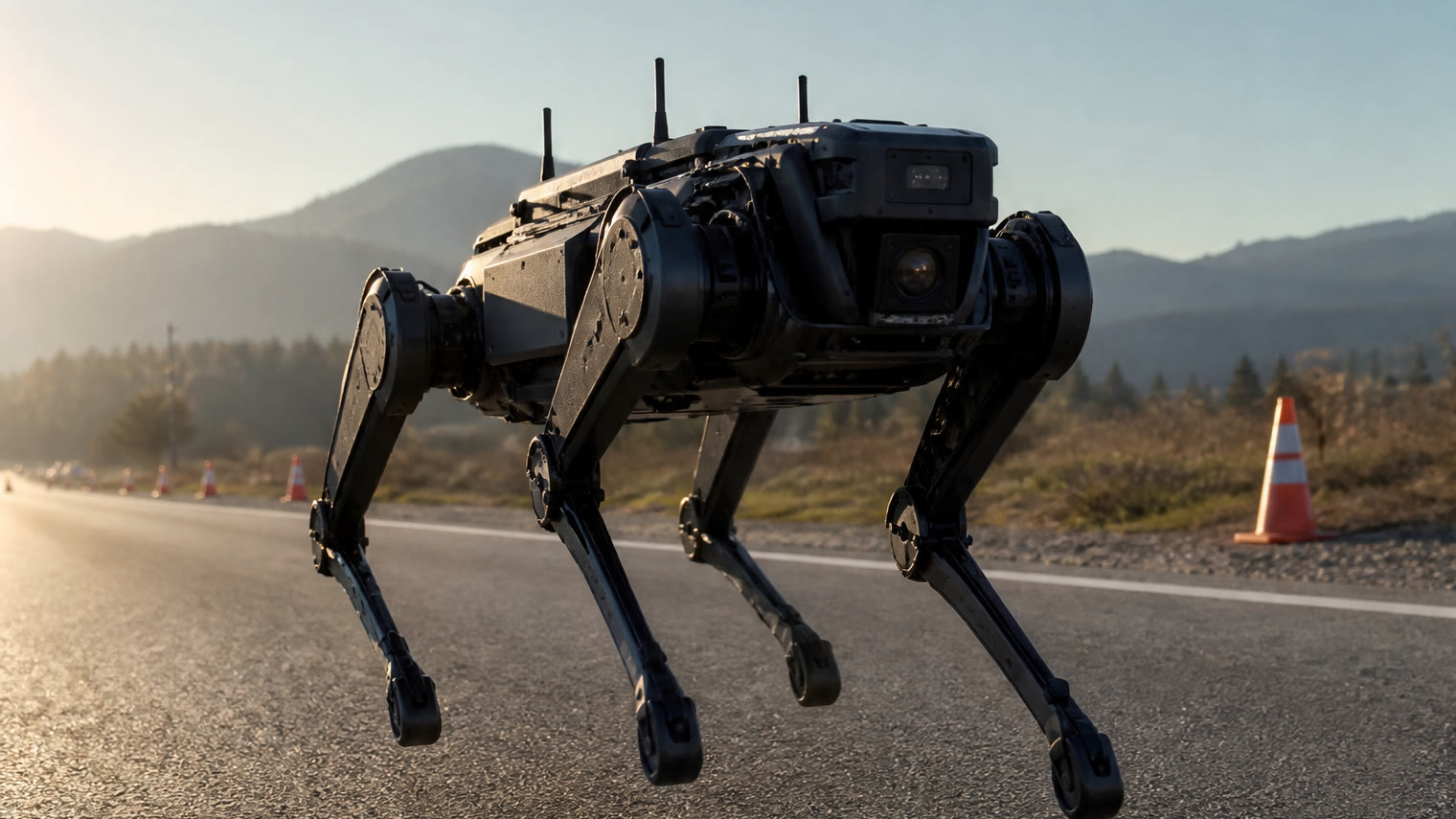
Illustration generated with AI for DomiVerseX
Machines on legs are famous for running out of power fast. One of them lined up at a real road race with human runners, and it reached the finish line with something to spare.
This article contains affiliate links. If you buy through them, we may earn a small commission at no extra cost to you.
It is November 2024, in the city of Sangju in South Korea. Runners are lining up for the 22nd Sangju Dried Persimmon Marathon. Among them stands an entrant with no shoes, no lungs and four mechanical legs. It is not a toy car or a remote control submarine, and it is not one of those little drones that buzz over parks. It is a walking, running robot on four legs, and it is officially signed up for the race.
Its name is RAIBO2. It was built by the team of Professor Hwangbo Je-min at KAIST, a science university in South Korea, together with a company called Raion Robotics that grew out of his laboratory.
A full marathon is 42.195 kilometers long. If your school is two kilometers from home, that is the walk to school and back every school day for more than two weeks, done in one go.
Why does this matter to you? Because a robot on legs can go where wheels get stuck: up steps, over kerbs, across rough ground. But only if its battery lasts long enough to be useful.
Four hours, nineteen minutes, fifty two seconds
RAIBO2 crossed the finish line in 4 hours, 19 minutes and 52 seconds. It never stopped to recharge, and nobody swapped its battery along the way.
That works out to a little over six minutes for every kilometer, or a bit under 10 kilometers an hour. That is the speed of a steady jog, the kind where a grown-up can still talk.
How does it compare with people? If the figure quoted by Popular Science is right, the average human takes around 4 hours and 32 minutes to finish a marathon. That number comes from a running company's blog, so treat it with care. If it holds, the robot would have been about 12 minutes ahead of an average runner.
The road was not flat either. The course had 286 meters of ups and downs in total, about as much as climbing the stairs of an 87 floor building. According to Live Science, it included two climbs of 50 meters each, with slopes as steep as 10 degrees.
Why does this matter to you? Lots of machines can do something amazing for five minutes. Doing a plain thing for more than four hours without help is much harder, and far more useful.
The battery that would not run out
Here is the number the builders care about most. RAIBO2 started with a battery holding 2,016 watt hours of energy. A typical LED light bulb uses about 10 watts, so that battery could keep one bulb glowing for more than eight days.
The race used up 1,280 watt hours. That left 736, which is more than a third of a full battery. Think of a phone that still shows 36 percent after the longest day of its life.
With that much left, how much farther could it have gone? At the rate it burned energy in the race, the leftover charge was good for about 24 more kilometers. Live Science reports a top range of about 67 kilometers on one charge, but that is the researchers' own estimate for straight, flat paths, not a run that anyone watched. The Korea Times gives 65 kilometers.
Other four legged robots are limited to roughly 20 kilometers per charge, according to the press release from the journal Nature. So RAIBO2 ran about twice that in the race, and may be able to go about three times as far.
Why does this matter to you? Every gadget you own is a fight between what it can do and how soon it dies. This robot moved that line a long way.
The twist: it failed first, and it did not run alone
The short video shows the win. Here is what came before it.
If Live Science has it right, RAIBO2 had already tried a marathon once, and it did not finish. That earlier attempt had to be stopped at around 37 kilometers, with about 5 kilometers still to go. The battery was empty.
Enjoying this story?
Get a short teaser by email whenever we publish something new. No spam.
One reason the builders gave, as Live Science tells it, is almost funny. The robot kept speeding up and slowing down to match the human runners around it. Anyone who has run a school race knows that feeling: you chase the person next to you, and you are worn out before the end.
The fix was not only a bigger battery, although the team did raise its capacity by 33 percent, again according to Live Science. They also went hunting for small leaks of energy. The Nature press release lists three things: lighter legs, more efficient circuits to drive the motors, and a way of moving that the robot learned through training.
Before the real race, Live Science says, the robot also ran 43 kilometers on one charge around a flat athletic field, guided by GPS. That took 4 hours and 40 minutes.
And now the second half of the twist. RAIBO2 did not find its own way around Sangju. According to Popular Science, a camera on its head sent pictures of the road ahead to a human operator, who steered it so that it did not drift off course. The legs, the balance and the energy saving were the robot's work. The steering was a person's.
Why does this matter to you? The result looks like one perfect run. Really it is a failed run, a list of small repairs, a practice run and a helper with a controller. Most big wins are built like that.
Better than a human, in one narrow way
Scientists have a score for how much energy it costs to move a body a certain distance. They call it the cost of transport, and lower is better. The score takes weight into account, so a big runner and a small one can be compared fairly.
RAIBO2 scored 0.25 in the race. The researchers put an average human runner at 0.37. In plain words, the robot needed about one third less energy than a person to move each kilogram of itself over each kilometer. The team proposes that it is the first four legged robot to beat a human on this score.
There is one hole in the picture. None of the reports we read says how much RAIBO2 weighs.
Be careful with the word "first" in general. The builders say RAIBO2 is the first four legged robot to complete an official marathon without recharging. That is their claim, and it has those limits built in: four legs, official race, no recharge. Nobody is saying it is the first robot ever to cover the distance.
Why does this matter to you? People and animals are very good at moving without wasting energy. This is a sign that machines with legs are starting to catch up on that dull, important skill.
Why the story came back
The race was in November 2024. So why are people talking about it again? Because on 23 September 2026, almost two years later, the team published the full details in Nature, one of the best known science journals on the globe. The paper has a very plain title: "A quadruped robot designed to complete a marathon on a single battery charge."
The Korea Times calls it the first Korean robotics research to appear in the main pages of Nature, though we found that claim in that one newspaper only. The same report says Raion Robotics plans to build the robot in large numbers.
Why does this matter to you? If that happens, robots like this could stop being a science project and start being something you might meet on a street.
How far can legs really go?
A marathon course is a kind gift to a robot. It is a road, and a person is steering.
The places where legs beat wheels look nothing like that. Put RAIBO2 on a map with no roads on it, with mud, stairs and loose stones, and nobody knows what its estimated 67 kilometers would shrink to. Its first marathon attempt, by Live Science's account on a real course among real runners, ended early. Its best range figure comes from straight, flat paths.
So here is the question the finish line in Sangju did not answer. When the ground stops being a road and nobody is holding the controller, how far can a robot on four legs really go?
Sources
- Robotics: Robot runs a marathon (Nature), press release, Nature Asia
- South Korean robot dog becomes first to run a marathon on a single battery charge, Live Science
- Robot dog runs a marathon faster than the average human, all on a single charge, Popular Science
- Korean quadruped robot's marathon triumph featured in Nature, The Korea Times
- KAIST's 4-legged robot becomes 1st in the world to finish full marathon, The Korea Times