Most Places Wait 375 Years for a Total Solar Eclipse. On August 12, 2026, Somebody's Wait Ends.
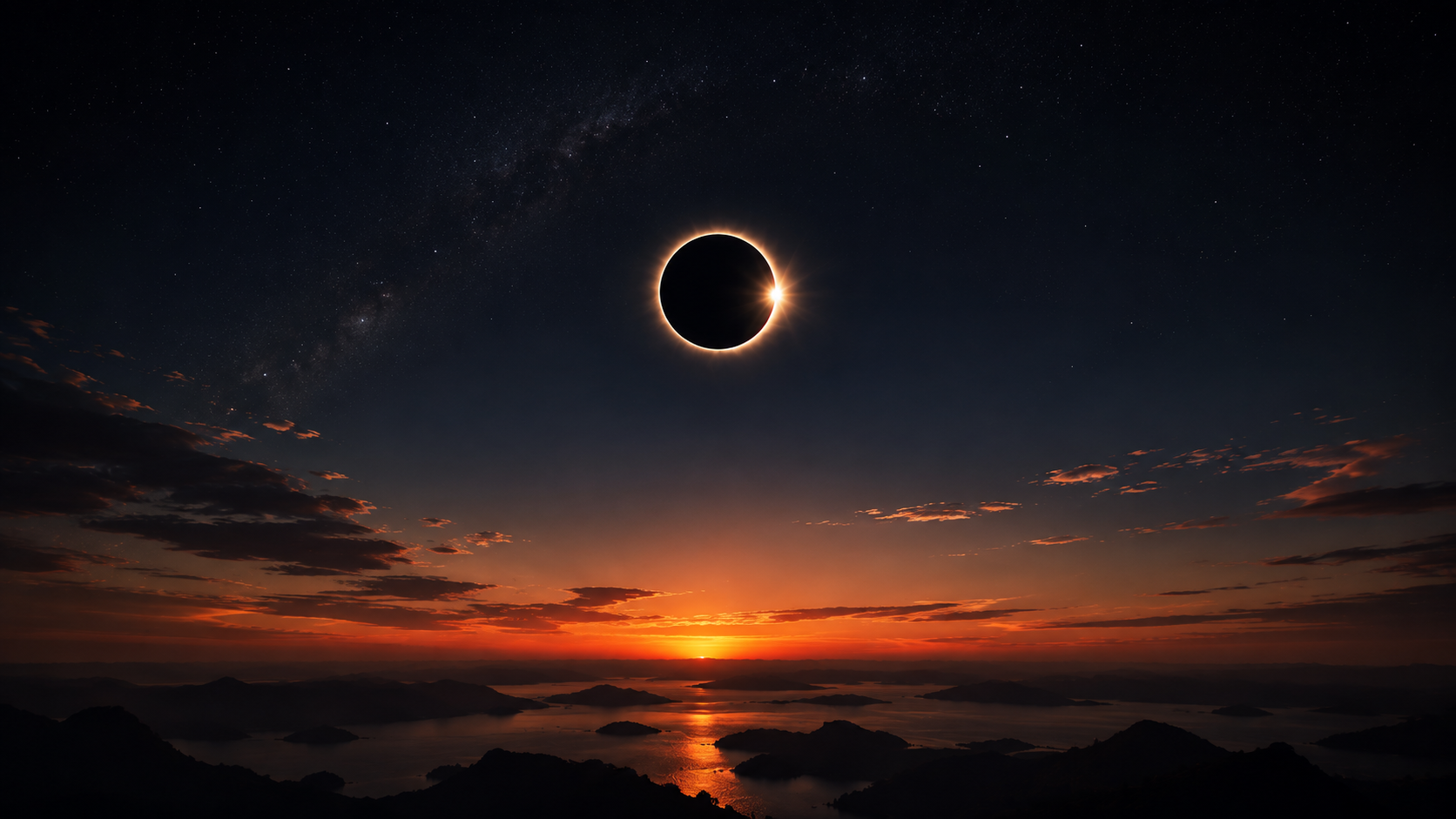
Illustration by Domi Verse X
Most Places Wait 375 Years for a Total Solar Eclipse. On August 12, 2026, Somebody's Wait Ends.
This article contains affiliate links. If you buy through them, we may earn a small commission at no extra cost to you.
There is a number that eclipse astronomers keep in their back pocket, and it does more to explain this event than any photograph ever could.
First, one thing needs to be clear, because almost every headline blurs it. What happens on August 12, 2026 is a total solar eclipse. That means the Moon covers the Sun completely, daylight drains away, stars come out and the Sun's outer atmosphere becomes visible. It is a fundamentally different event from a partial eclipse, where the Moon only takes a bite out of the Sun and the sky stays bright. And it does not happen at noon. Where and when this darkness arrives depends entirely on where you stand: near the middle of the day in one remote corner of Siberia, late afternoon in Greenland and Iceland, and late evening just before sunset in Spain. Almost everyone reading this will get the partial version, if they get anything at all. A very small number of people will get the real thing.
Pick a spot on Earth. Any spot. Your street, your rooftop, the field behind your school. On average, that exact spot sits under a total solar eclipse once every 375 years.
That figure comes from the Belgian astronomer Jean Meeus, who worked it out statistically decades ago. A newer analysis published in 2026, using nearly 15,000 years of eclipse data, refined the number slightly to about 373 years. Either way, the takeaway holds: for almost any single spot on the map, the wait is measured in centuries, not decades.
Sit with that for a second. Three hundred and seventy five years is longer than most countries have existed in their current form. A house standing on your street would have to survive without being demolished, rebuilt, or burned down since before your national anthem was written, just to be there for both events.
NASA's own eclipse office ran the calculation for a single point in central Washington, DC. Between the year 1 and the year 3000, that spot catches exactly five total solar eclipses. Five, in three thousand years. The last one was in 1478. The next one is in 2444.
So Why Does It Feel Like Eclipses Are Common?
Because they are, somewhere. A total solar eclipse happens on Earth roughly every 18 months. That is two of them every three years, which sounds generous until you look at where the shadow actually lands.
The Moon's dark inner shadow, the umbra, is tiny compared to the planet it falls on. It paints a stripe across the surface that is usually only a couple of hundred kilometres wide. Most of the time that stripe lands on ocean, ice, desert, or empty tundra where nobody is standing. The eclipse still happened. It just happened to nobody.
That is the whole trick. Eclipses are not rare. Being underneath one is.
The Numbers That Decide Who Gets To Watch
For August 12, 2026, those numbers have already been calculated down to the person.
Around 980 million people live somewhere that will see at least a sliver of this eclipse. That is 12.08 percent of everyone alive, according to population modelling by timeanddate using data from Columbia University's Center for International Earth Science Information Network. Roughly one in eight humans.
Now the other number. The people who will see the Sun vanish completely, the full darkness, the corona, the stars coming out in the wrong part of the day: 15.2 million. That is 0.19 percent of the world population. Fewer people than live in the Netherlands.
So the crowd splits into two very unequal groups. Nearly a billion people get a bite taken out of the Sun. About fifteen million get the actual event. And for anyone in that first group, the bite will be completely invisible to the naked eye unless you are looking through certified eclipse glasses, because a partially eclipsed Sun is still blindingly bright and your pupils simply adjust without telling you anything is wrong.
What Is Actually Happening Up There
The mechanics are almost embarrassingly simple, and that is what makes the whole thing feel like a setup.
The Sun is about 400 times wider than the Moon. It is also about 400 times further away. Those two numbers cancel out, so from the ground the Sun and the Moon look almost exactly the same size. Hold your thumb at arm's length against a distant streetlight and you have the same effect: a small near object perfectly covering a large far one.
A solar eclipse happens when the Moon slides directly between us and the Sun. That alignment is only possible at new moon, which comes around every 29 and a half days. So why is there no eclipse every month?
Because the Moon's orbit is tilted by about five degrees relative to Earth's orbit around the Sun. Most new moons, the Moon passes slightly above or slightly below the Sun from our point of view, and its shadow misses Earth entirely, sailing off into space. Only when the alignment happens near one of the two points where the two orbital planes cross does the shadow actually touch us.
When it does touch, it arrives in two parts. The umbra is the dark core where the Sun is completely blocked, and that is the narrow stripe. Wrapped around it is the penumbra, a vastly wider region thousands of kilometres across where the Moon covers only part of the Sun. Everyone in the penumbra gets a partial eclipse. Only the umbra gives you totality. If you want the full account of why the geometry works out this way, the standard reference is Totality: Eclipses of the Sun by Mark Littmann and Fred Espenak, the latter being the man whose calculations sit underneath nearly every eclipse map you will ever look at.
The Strangest Path in Years
Most eclipse shadows sweep roughly west to east, dragged along by Earth's rotation. This one does something else. It comes down over the top of the world.
The path of totality begins in far northern Siberia near the North Pole, curves south through the Arctic, crosses eastern Greenland, clips the west coast of Iceland, runs down the North Atlantic, and finally comes ashore over northern Spain and the extreme northeastern corner of Portugal. NASA describes the strong north to south component as the combined result of Earth's rotation, the tilt of Earth's axis, and the descending path of the Moon at that moment. In plain terms, the usual eastward drag gets cancelled out for the first half of the journey.
Globally, the first location sees the partial phase begin at 15:34 UTC. The first totality starts at 16:59 UTC. Maximum eclipse falls at 17:47 UTC. Totality ends worldwide at 18:35 UTC and the last partial phase wraps up at 19:58 UTC. Start to finish, the whole thing occupies about four and a half hours of one Wednesday.
The longest totality anyone can get is 2 minutes and 18 seconds, and it happens over open ocean west of Iceland where essentially nobody will be standing. For most people inside the path, the Sun will be fully covered for less than two minutes.
The line, step by step. If you want to trace the shadow yourself, this is the order in which it touches ground:
- Far northern Siberia, near the North Pole. Totality begins here, near local midday, in terrain with almost no permanent population.
- The Arctic Ocean, curving south rather than east.
- Eastern Greenland, late afternoon.
- The west coast of Iceland, including Reykjavík, at 5:48 pm local time.
- The open North Atlantic, where the longest totality of the whole eclipse happens with nobody underneath it.
- The northwest corner of Spain at A Coruña, coming ashore in the evening.
- Diagonally across northern Spain through Bilbao, Zaragoza and Valencia, plus the extreme northeast corner of Portugal. The shadow crosses the entire Iberian Peninsula in about five minutes, from 20:27 to 20:32 local time.
- The Balearic Islands, Mallorca, Ibiza, Menorca and Formentera, where the Sun sets while still eclipsed.
The band is about 293 kilometres wide. Madrid and Barcelona both sit just outside it.
Europe: The First Mainland Totality in a Generation
This is the headline for Europe, and it is genuinely a generational gap. You will see two different dates quoted for how long that gap is, and both are correct. The last total eclipse anywhere on the European continent was March 29, 2006, over Turkey. The last one on the continental territory of the European Union was August 11, 1999, over Britain, France, Germany and Romania. For Spain the wait has been far longer than either: most sources point to August 30, 1905 as the last true total solar eclipse over mainland Spain, more than a century ago, though a few note a brief hybrid eclipse crossed the country in 1912 with only a few seconds of totality.
Where totality happens (all times local, source: NASA):
| City | Partial begins | Totality begins | Totality ends | Partial ends |
|---|---|---|---|---|
| Reykjavík, Iceland | 4:47 pm | 5:48 pm | 5:49 pm | 6:47 pm |
| León, Spain | 7:32 pm | 8:28 pm | 8:30 pm | 9:22 pm |
| Zaragoza, Spain | 7:34 pm | 8:29 pm | 8:30 pm | 9:07 pm |
| Valencia, Spain | 7:38 pm | 8:32 pm | 8:33 pm | 9:01 pm |
Note the clock. In Spain and northwestern Portugal the Sun is not fully covered until late evening, shortly before it sets. In Iceland it happens in the late afternoon. Only in that small, remote stretch of northern Russia does totality land near the middle of the day.
Nowhere in Spain does totality last a full two minutes. The best Spanish locations get somewhere between one minute forty and one minute fifty seconds, with the Sun only a few degrees above the western horizon, which should produce an unusually dramatic darkened landscape underneath it.
Where Europe gets a partial eclipse (percentage of the Sun covered at maximum, source: NASA):
| City | Maximum | Coverage |
|---|---|---|
| Barcelona, Spain | 8:29 pm | 99% |
| Madrid, Spain | 8:32 pm | 99% |
| Lisbon, Portugal | 7:36 pm | 95% |
| Dublin, Ireland | 7:10 pm | 94% |
| Paris, France | 8:17 pm | 92% |
| Milan, Italy | 8:20 pm | 92% |
| London, UK | 7:13 pm | 91% |
| Berlin, Germany | 8:08 pm | 85% |
| Vienna, Austria | 8:10 pm | 85% |
| Oslo, Norway | 7:57 pm | 83% |
| Stockholm, Sweden | 7:56 pm | 81% |
| Saint Petersburg, Russia | 8:51 pm | 79% |
| Kraków, Poland | 7:56 pm | 64% |
Enjoying this story?
Get a short teaser by email whenever we publish something new. No spam.
A few more European locations worth knowing, from Space.com's sunset viewing guide: Corsica 96 percent at 8:25 pm, La Spezia in Italy 94 percent, Modena 92 percent, Venice 91 percent, Munich 88 percent, Prague 86 percent, Wrocław 84 percent and Warsaw 83 percent. At the Strait of Gibraltar the figure reaches 92 percent.
One warning about numbers you will find elsewhere. Some published guides list far lower figures for European cities, for example 30 to 40 percent for London. Those conflict with NASA, the BBC Sky at Night guide and Space.com, which all put London and Paris above 90 percent. The likely cause is the difference between obscuration, meaning the area of the Sun covered, and magnitude, meaning the diameter covered. The figures in this article are the higher, better corroborated set.
Around the British Isles the numbers are remarkably even. The BBC Sky at Night guide puts Edinburgh at 91 percent, Cardiff and Belfast at 93 percent and Cork at 96 percent, with the whole event running from roughly 18:15 to just after 20:00 local time.
One borderline case is worth knowing about. Madrid is listed as a 99 percent partial in most tables, but a very small part of the city actually falls inside the path of totality. If you are in Madrid, your exact street matters.
A 91 percent eclipse over London sounds close to total. It is not. Even a thin remaining crescent of Sun is thousands of times brighter than the fully covered disc, so the sky will dim in a strange, flat, thundery way but it will not go dark. If you are stuck in the partial zone and want to actually see the crescent rather than just read about it, compact solar binoculars with the filters built into the lenses are the safest cheap option, because there is nothing to fall off. Reviewers are clear about the trade-off: at this size you get a small, dim image that is fine for following the crescent but poor for picking out sunspots. For those you need a larger and considerably more expensive pair. That gap between 99 percent and 100 percent is the entire difference between an odd looking evening and something people rearrange their lives around.
The Nordic countries sit well inside the partial zone. In Finland the eclipse runs from roughly 7:43 pm to 9:42 pm local time, deep into a summer evening when the Sun is already low.
North America: Everyone Gets a Bite, Nobody Gets the Meal
No part of the United States or Canada sees totality on August 12. Not one. What they get instead varies enormously depending on how far north and east you are.
| City | Maximum (local) | Coverage |
|---|---|---|
| Fairbanks, Alaska | 8:27 am | 37% |
| Anchorage, Alaska | 8:21 am | 28% |
| Bangor, Maine | 1:53 pm | 24% |
| Portland, Maine | 1:53 pm | 19% |
| Juneau, Alaska | 8:24 am | 17% |
| Boston, Massachusetts | 1:55 pm | 16% |
| New York, New York | 1:54 pm | 9% |
| Philadelphia, Pennsylvania | 1:53 pm | 7% |
| Washington, DC | 1:53 pm | 4% |
| Detroit, Michigan | 1:36 pm | 3% |
| St. John's, Canada | 3:35 pm | 53% |
| Halifax, Canada | 3:00 pm | 31% |
| Montreal, Canada | 1:45 pm | 18% |
| Toronto, Canada | 1:40 pm | 8% |
| Edmonton, Canada | 10:38 am | 6% |
| Winnipeg, Canada | 12:02 pm | 5% |
| Nuuk, Greenland | 4:35 pm | 79% |
EarthSky adds two useful Canadian figures that NASA's list leaves out: Kuujjuaq in far northern Quebec gets just over 50 percent, and Quebec City around 24 percent. Northern Maine reaches roughly 29 percent, better than any of the cities in the table above.
Fairbanks is the winner in the United States, not Anchorage. On the mainland, Maine beats every other state. Below roughly 20 percent coverage there is nothing to notice with your eyes at all, and Washington DC at 4 percent means the Moon barely grazes the edge of the solar disc.
Large parts of the country are outside the shadow completely. California, Texas, Florida, the southern Midwest and most of the mountain west see nothing whatsoever.
Africa: The Evening Eclipse
Northwestern Africa does surprisingly well, better than almost all of North America.
| Location | Maximum (local) | Coverage |
|---|---|---|
| Cape Matifou, Algeria | 7:42 pm | 98.5% |
| Algiers, Algeria | 7:33 pm | 96% |
| Nador, Morocco | 7:45 pm | 93% |
| Rabat, Morocco | 7:44 pm | 88% |
| Casablanca, Morocco | 7:43 pm | 87% |
| Essaouira, Morocco | 7:47 pm | 81% |
| Canary Islands, Spain | 8:00 pm | 66 to 74% |
| Tunis, Tunisia | 7:11 pm | 50% |
| Nouakchott, Mauritania | 7:20 pm | 46% |
| Dakar, Senegal | 7:12 pm | 37% |
| Banjul, Gambia | 7:13 pm | 34% |
For much of this region the Sun sets while still partially covered, which produces one of the best photographic opportunities of the whole event: a bitten Sun sinking into the horizon. Ghana catches the tail end of it for barely five minutes before sunset. Mali, Mauritania, Burkina Faso, Guinea, Sierra Leone, Liberia, Cabo Verde and Western Sahara are all inside the zone.
Asia: One Country, and Barely That
There is no meaningful top ten here, and pretending otherwise would be dishonest. Asia's entire involvement is Russia. The path of totality begins in far northern Siberia near the North Pole, in terrain with almost no permanent population, and the partial zone reaches only the western Russian cities.
| City | Maximum (local) | Coverage |
|---|---|---|
| Saint Petersburg, Russia | 8:51 pm | 79% |
| Far northern Siberia | midday | 100%, totality |
China, Japan, Korea, India, Southeast Asia and the entire Middle East see nothing at all. Not a partial, not a dimming. No Arab country lies in the path.
South America: A Sliver of One Country
Same situation, smaller. Northeastern Brazil catches a shallow partial eclipse between roughly 4:15 pm and 4:43 pm local time, and that is the whole of South America's involvement. Argentina, Chile, Peru, Colombia and everywhere south of the equator on that continent get nothing.
The Places That Get Nothing
Here is the honest list. India sees nothing. The Philippines, Malaysia, Indonesia and all of Southeast Asia: nothing. Australia, New Zealand and the Pacific islands: nothing. Kenya, South Africa and everything in the southern half of Africa: nothing. China, Japan and Korea: nothing. Mexico, Central America and the Caribbean: nothing. The eclipse is a northern hemisphere event pressed up against the Arctic, and roughly seven billion people will go about their Wednesday with no idea it happened.
There is one consolation, and it applies to almost everyone on the planet. The Perseid meteor shower peaks on the same day. It needs no glasses, no filters and no special location, only a dark sky after midnight. Anyone outside the eclipse zone entirely can still get something out of August 12.
This is the part that usually surprises people. We talk about eclipses as global events. They are the opposite. They are the most geographically selective thing the sky does.
How To Look Without Damaging Your Eyes
This part is not optional. During every partial phase, and everywhere outside the path of totality, looking at the Sun without proper protection can cause permanent retinal damage. Sunglasses do not work, and neither does stacking several pairs of them.
Certified solar viewers conforming to the ISO 12312-2 standard block around 99.999 percent of visible light. Never look through a camera, telescope or binoculars while wearing them, because the concentrated light will burn straight through the filter. Optics need their own filter fitted at the front, which is what a dedicated solar filter kit is for.
If you have no glasses, punch a small hole in a piece of card, stand with your back to the Sun, and let the light fall on a pale surface. You will see a small crescent image. The gaps between leaves on a tree do the same job for free, scattering hundreds of tiny crescent Suns across the ground.
The single exception is totality itself, and only inside the path, and only for those brief seconds when the Moon covers the disc completely. That is the moment eclipse chasers spend decades and thousands of kilometres pursuing.
What Comes After
If you miss this one, the calendar is not entirely unkind. A total solar eclipse crosses southern Spain, north Africa and the Middle East on August 2, 2027, and that one runs for about 6 minutes and 20 seconds near Luxor in Egypt, making it the longest totality visible from land for well over a century. An annular eclipse reaches South America, Portugal and Spain on January 26, 2028.
For the United States, the wait is longer and it depends on where you live. The next partial eclipse visible from the country comes on January 14, 2029. Alaska gets a genuine totality on March 30, 2033. The contiguous states have to wait until August 23, 2044, when the shadow clips Montana and the Dakotas near sunset, and even that one lasts only about 90 seconds. A true coast to coast totality follows on August 12, 2045.
Which brings the whole thing back to that first number. Most places wait 375 years. A few lucky strips of ground get two in a decade. Nobody chooses which one they were born on top of, and the only way to find out which group you are in is to check the map for the exact place you happen to be standing.
Sources
- NASA Science: Total Solar Eclipse on August 12, 2026
- NASA Scientific Visualization Studio: Map of the August 12, 2026 Total Solar Eclipse
- ESA: Total solar eclipse 12 August 2026, global map
- timeanddate: Total Solar Eclipse on August 12, 2026
- National Solar Observatory: August 12, 2026 Solar Eclipse Map
- NASA GSFC: Solar eclipse circumstances for Washington, DC
- BBC Sky at Night Magazine: August 2026 solar eclipse path map, key locations and timings
- EarthSky: The total solar eclipse of August 12, 2026
- NationalEclipse: 2026 partial solar eclipse data for U.S. and world cities