The Photo Almost Nobody Understands
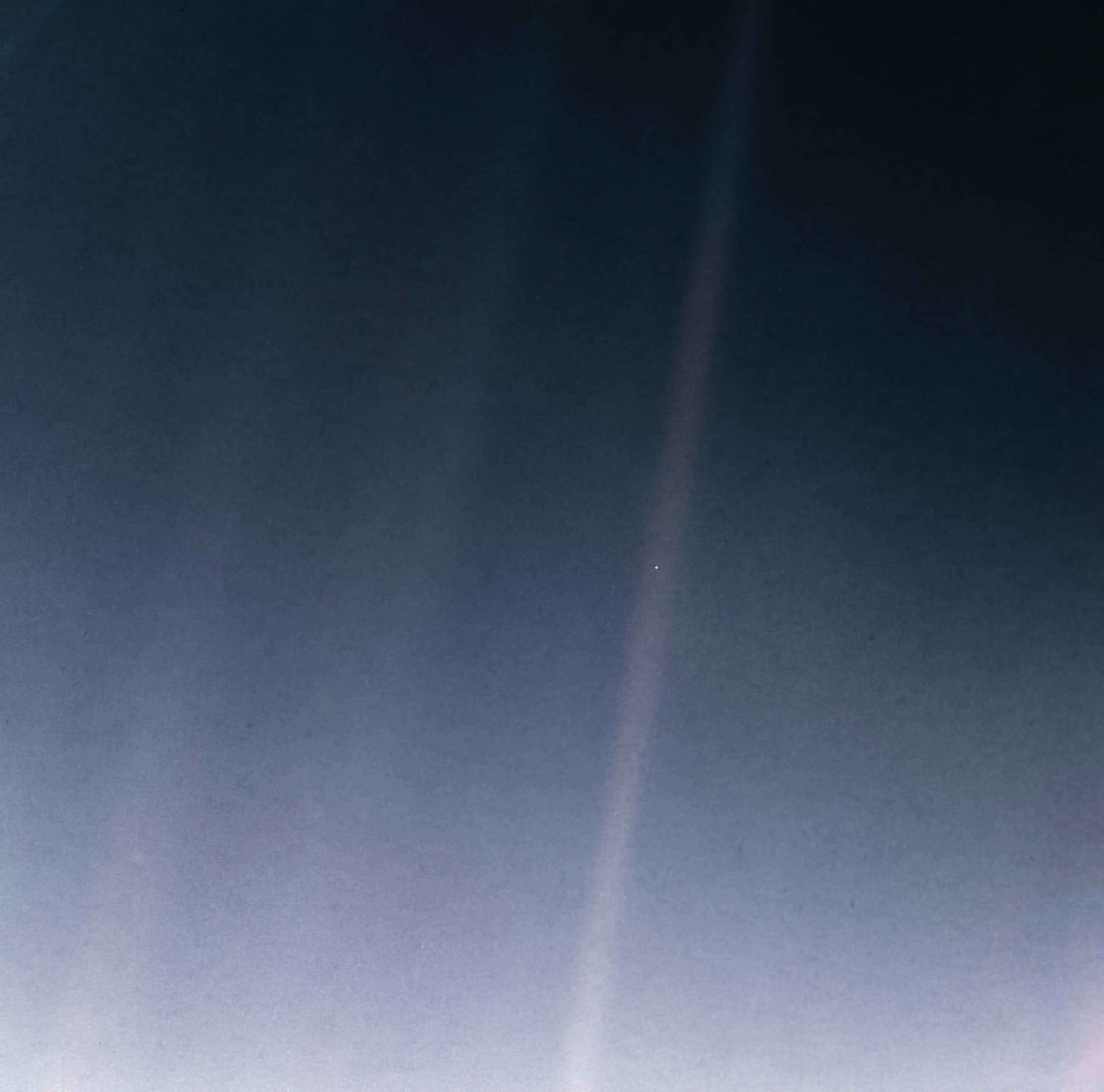
Credit: NASA/JPL-Caltech
One last look back. A single frame that still stops people cold, decades later.
This article contains affiliate links. If you buy through them, we may earn a small commission at no extra cost to you.
On February 14, 1990, a spacecraft already leaving the solar system turned its camera around and took one last photograph of home. In the resulting image, Earth is a single pale dot, less than a pixel across, suspended in a scattered band of sunlight. That photograph is called the Pale Blue Dot, and it is one of the most quietly devastating pictures ever taken.
Why the camera turned around at all
By February 1990, the spacecraft that took this photo had long finished the planetary flybys it was built for, and was roughly 6 billion kilometers from the Sun, far beyond the outer planets, with nothing left in range for its cameras to usefully study. NASA was preparing to switch the imaging system off permanently to save power for the instruments still collecting scientific data.
Before that happened, astronomer Carl Sagan, who had worked on the mission's imaging team, pushed for one final sequence: turn the camera back toward the Sun and photograph the solar system from the outside, including a shot of Earth itself.
Why the photo almost didn't happen
The idea was not universally welcomed. Several engineers and scientists on the mission considered it scientifically pointless: pointing a camera that close to the Sun risked damaging the optics, and the resulting image would contain essentially no research data. Sagan argued for it anyway, on the grounds that its value was not scientific but perspective, and NASA eventually agreed. It took three more years before Sagan and his colleagues finished processing the full sequence of 60 images, known as the Family Portrait, and released them publicly in 1994.
What is actually in the frame
Enjoying this story?
Get a short teaser by email whenever we publish something new. No spam.
Earth appears in the photograph as a single point of light, roughly 0.12 pixels across, sitting inside a faint, streaked band. That band is not a special effect. It is scattered sunlight, an optical artifact caused by the camera pointing so close to the Sun that light bounced around inside its own internal structure before reaching the detector. Earth happened to fall inside one of those scattered light bands purely by chance of its position in the frame that day.
There is nothing more to the image than that: no continents, no clouds, nothing recognizably a planet. Its entire impact comes from context: knowing that every person who has ever lived is contained inside that single point of light.
The words that made it famous
The photograph might have remained a technical footnote if Sagan had not later written about it. In his 1994 book, also called Pale Blue Dot, he described Earth as a mote of dust suspended in a sunbeam, and argued that seeing our entire history, every war, every ambition, every human life, compressed onto a fraction of a pixel, ought to change how seriously people take their conflicts with each other. That passage, not the raw image itself, is largely what turned the photograph into a cultural landmark still quoted decades later.
Why it matters
The Pale Blue Dot was never really about astronomy. It exists because one scientist insisted that a picture with no research value was still worth taking, and it is remembered because of what it revealed about scale: not the scale of the universe this time, but the scale of everything humanity has ever done, viewed from far enough away that all of it fits inside less than a single pixel of light.