The Gold in Your Ring Is Older Than the Sun
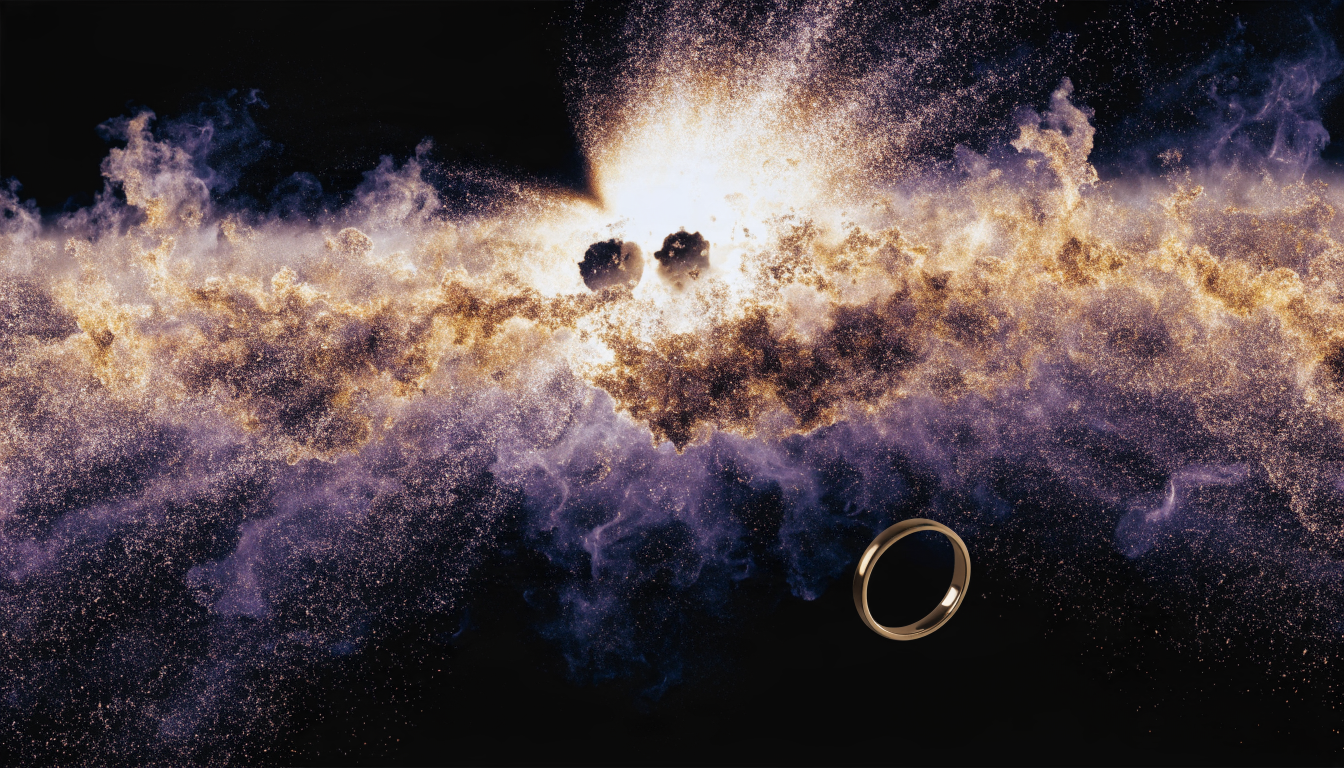
Illustration by Domi Verse X
Every atom of gold in your hand is older than the solar system. Astrophysicists are still arguing about which cosmic catastrophe made it.
This article contains affiliate links. If you buy through them, we may earn a small commission at no extra cost to you.
Look at anything gold you own. A ring, a chain, the invisible contacts inside your phone. Every atom of it is older than the Sun, older than the Earth, older than the solar system itself. None of it was made here. None of it was made by our star. And the strangest part is this: after two centuries of chemistry and a century of astrophysics, nobody can tell you with confidence where most of it actually came from.
Stars Cannot Make Gold
The usual story says that everything is made in stars, and that is almost true. Stars fuse hydrogen into helium, then helium into carbon, oxygen, neon, silicon. Each step releases energy, and each step builds heavier elements out of lighter ones.
Then the process hits iron and stops dead.
Iron sits at the bottom of a nuclear energy well. Fusing anything heavier than iron costs energy instead of releasing it, so a star gets nothing out of the deal. A star can burn for ten billion years and never produce a single atom of gold. Whatever made the gold in your ring, it was not the calm, patient nuclear furnace at the heart of an ordinary star.
Something far more violent had to happen.
The Recipe Requires a Catastrophe
There is a way past iron, and it is brutal. If you flood an atomic nucleus with free neutrons fast enough, it can swallow one after another before it has time to fall apart. The overloaded nucleus then decays into something heavier and more stable. Repeat this often enough and you climb the periodic table past iron, through silver, into gold, platinum, and uranium.
Astronomers call this the rapid neutron capture process, or r-process. The word rapid is not decoration. A free neutron outside a nucleus survives roughly fifteen minutes before it decays, so the entire chain has to happen in an environment that is dense with neutrons and finished in seconds.
Almost nothing in the universe meets that description. The list of places violent enough is very short, and working out which one made your ring has taken astronomers most of a century.
August 2017: Caught in the Act
The first real answer arrived on 17 August 2017.
Two neutron stars, each the collapsed core of a dead giant star, each packing more mass than the Sun into a sphere the size of a city, had been circling each other for millions of years in a galaxy 130 million light years away. That day, they finally touched.
Gravitational wave detectors on Earth felt the collision as a ripple in spacetime. Seconds later, gamma ray telescopes caught the flash. Within hours, observatories across the world were pointed at the same patch of sky, watching a kind of explosion nobody had ever confirmed before: a kilonova.
The light was the giveaway. As the fireball cooled, it glowed in exactly the way freshly made heavy elements should glow, and it faded in exactly the way their radioactive decay predicted. Astronomers at Berkeley and elsewhere calculated that the merger produced several percent of the Sun's mass in heavy elements. How much of that was gold is a harder question than it sounds. Different research groups have published figures ranging from a few times the mass of the Earth up to several hundred, and reviews of the event conclude that even with unusually good data the ejecta mass cannot be pinned down better than a factor of two, and arguably not better than an order of magnitude. Treat any single number you see for this event with suspicion, including the ones quoted confidently elsewhere.
For a moment it looked like the case was closed. Gold comes from colliding dead stars. Print it.
Then the Numbers Stopped Adding Up
The problem is timing.
Neutron star mergers are rare. Two massive stars have to form together, both have to explode, both remnants have to stay bound to each other, and then they have to spiral inward for hundreds of millions or even billions of years before they finally collide. In our galaxy this may happen once every million years or so.
That is fine for gold made recently. It is a serious problem for gold made early. Astronomers have found ancient stars, formed when the universe was young, that already contain r-process elements. Mergers are too slow and too rare to have seeded them in time.
There is a second wrinkle. When researchers looked closely at what came out of the 2017 collision, some analyses found the very heaviest elements underrepresented compared to the pattern seen in old stars in our own galaxy's halo. If neutron star mergers were the only factory, the books should balance. They do not.
A New Suspect Appeared in 2025
Enjoying this story?
Get a short teaser by email whenever we publish something new. No spam.
In April 2025, a team led by Anirudh Patel at Columbia University, working with Brian Metzger and colleagues, published a result that reopened the case. Their suspect was the magnetar: a neutron star with a magnetic field trillions of times stronger than Earth's.
Magnetars occasionally suffer what amounts to a starquake. The crust ruptures, the magnetic field rearranges, and the star releases a giant flare that blasts crustal material outward at enormous speed. That material is neutron rich, and it is ejected fast. It is, in other words, exactly the environment the r-process needs.
The team went looking for evidence and found it in data that had been sitting in an archive for twenty years, from a giant flare recorded in 2004. Their estimate, described by NASA as a possible answer to a century old question, is that magnetar flares could account for up to ten percent of everything heavier than iron in our galaxy.
Crucially, magnetars existed early. They do not need a billion year courtship first. They could have made the universe's first gold.
A third candidate is also still standing: rare, extremely energetic supernovae from rapidly spinning, heavily magnetised stars as they collapse. Metzger himself has been blunt about the state of the field, noting that a third or fourth production site cannot be ruled out. We have observed exactly one neutron star merger and one giant magnetar flare up close. That is not a large sample.
How It Ended Up in Your Hand
Whatever forged it, the gold was already drifting through space when the cloud that became our solar system began to collapse, about 4.6 billion years ago. It was mixed into the dust, and the dust became the Earth.
Then most of it disappeared.
As the young Earth melted, iron sank toward the centre and dragged the heavy metals down with it. Gold is what geologists call siderophile, meaning iron loving, and it followed the iron down. Analysis of Hawaiian basalt carrying material from deep inside the planet indicates that more than ninety nine percent of Earth's gold now sits in the core, thousands of kilometres beneath your feet, enough to cover every piece of land on the planet in a layer around half a metre deep. Counting all the precious metals together rather than gold alone, the Bristol team behind the meteorite work put the core's hoard at a four metre layer over the entire surface. Either way, no human will ever touch a gram of it.
By rights, the crust should have been left with essentially nothing. It was not. Researchers at the University of Bristol analysed 3.8 billion year old rocks from Greenland and found a tungsten isotope signature showing that Earth's accessible precious metals arrived in a meteorite bombardment more than 200 million years after the planet formed, once the core had already closed off. The work was published in Nature and the same conclusion was reported independently at the time: the metal we mine was delivered late, by the same bombardment that cratered the Moon. Geochemists call this the late veneer. It is the favoured explanation rather than a settled one.
So the gold in your ring did not rise up from below. It fell out of the sky, long after the Earth was made, and was later concentrated into veins thin enough for humans to chase by billions of years of hydrothermal circulation and plate tectonics.
We Can Make Gold Now. It Changes Nothing.
Here is a fair objection: alchemy works. We can turn one element into another.
In 2025, the ALICE collaboration at CERN confirmed it directly. When lead nuclei race past each other at 99.999993 percent of the speed of light, their electromagnetic fields can strip exactly three protons from a lead nucleus, leaving 79 protons behind. That is gold.
Then comes the punchline. Across the entire second run of the Large Hadron Collider, from 2015 to 2018, the machine produced about 86 billion gold nuclei totalling 29 picograms. That is 29 trillionths of a gram. The gold was an unstable isotope, not the durable gold of jewellery, and it survived for roughly a microsecond before falling apart. CERN does not publish a figure for how long making a useful quantity would take, but the arithmetic on its own numbers is not encouraging: at that rate, producing a single gram would occupy the collider for a length of time vastly longer than the age of the universe.
Every ring, coin and bar ever made is the old gold. All of it. The World Gold Council estimates that around 219,890 tonnes have been mined in all of human history, which would form a cube roughly 22 metres on each side. That cube is the entire human supply, and every atom in it predates the Sun.
The Part Nobody Can Explain
So we know gold cannot be made inside an ordinary star. We know one confirmed cosmic factory and at least two strong candidates. We know how the accessible fraction reached the crust. We can even manufacture the stuff ourselves, in quantities too small to see.
What we still cannot say is which of those violent events produced most of the gold that exists. The confirmed source cannot account for the timing. The new candidates are promising and unproven. The honest answer, in 2026, is that the biggest question about the most famous metal in human history is open.
The next magnetar flare, caught quickly enough across gamma ray, ultraviolet and optical wavelengths, would narrow it down considerably. Until then, you are wearing a piece of an unsolved problem.
Check your hand. Something out there died to make it.
Sources
- Where Does Gold Come From? NASA Data Has Clues, NASA Science
- Astronomers strike cosmic gold, Berkeley News on the GW170817 kilonova
- ALICE detects the conversion of lead into gold at the LHC, CERN
- Where does all Earth's gold come from? University of Bristol, published in Nature
- How Much Gold Has Been Mined? World Gold Council
- Earth's Core Holds a Vast Reservoir of Gold, ScienceAlert
- Did meteorites bombard Earth with gold? EarthSky