Something Is Heading for Us and It Might End Life as We Know It
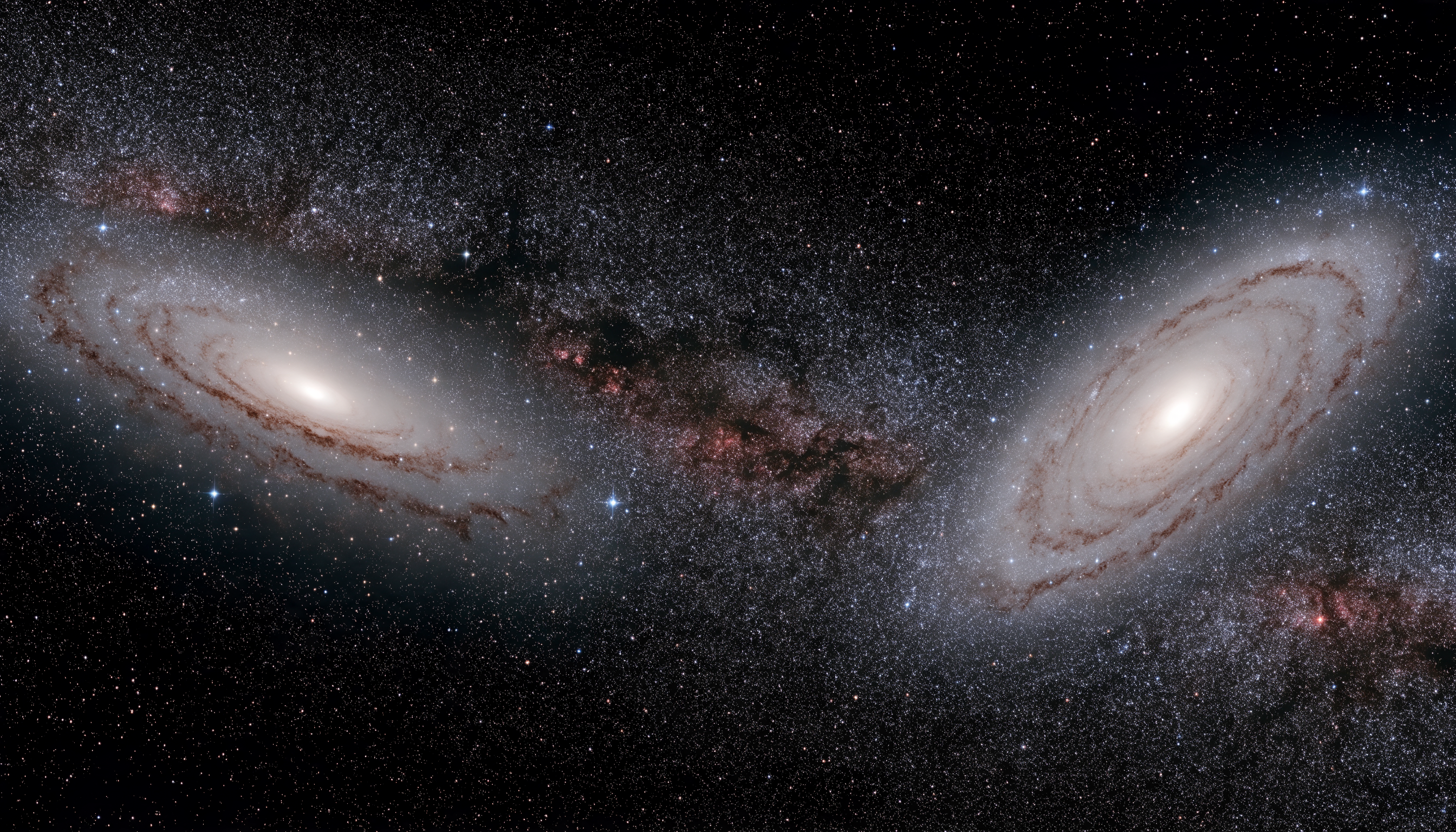
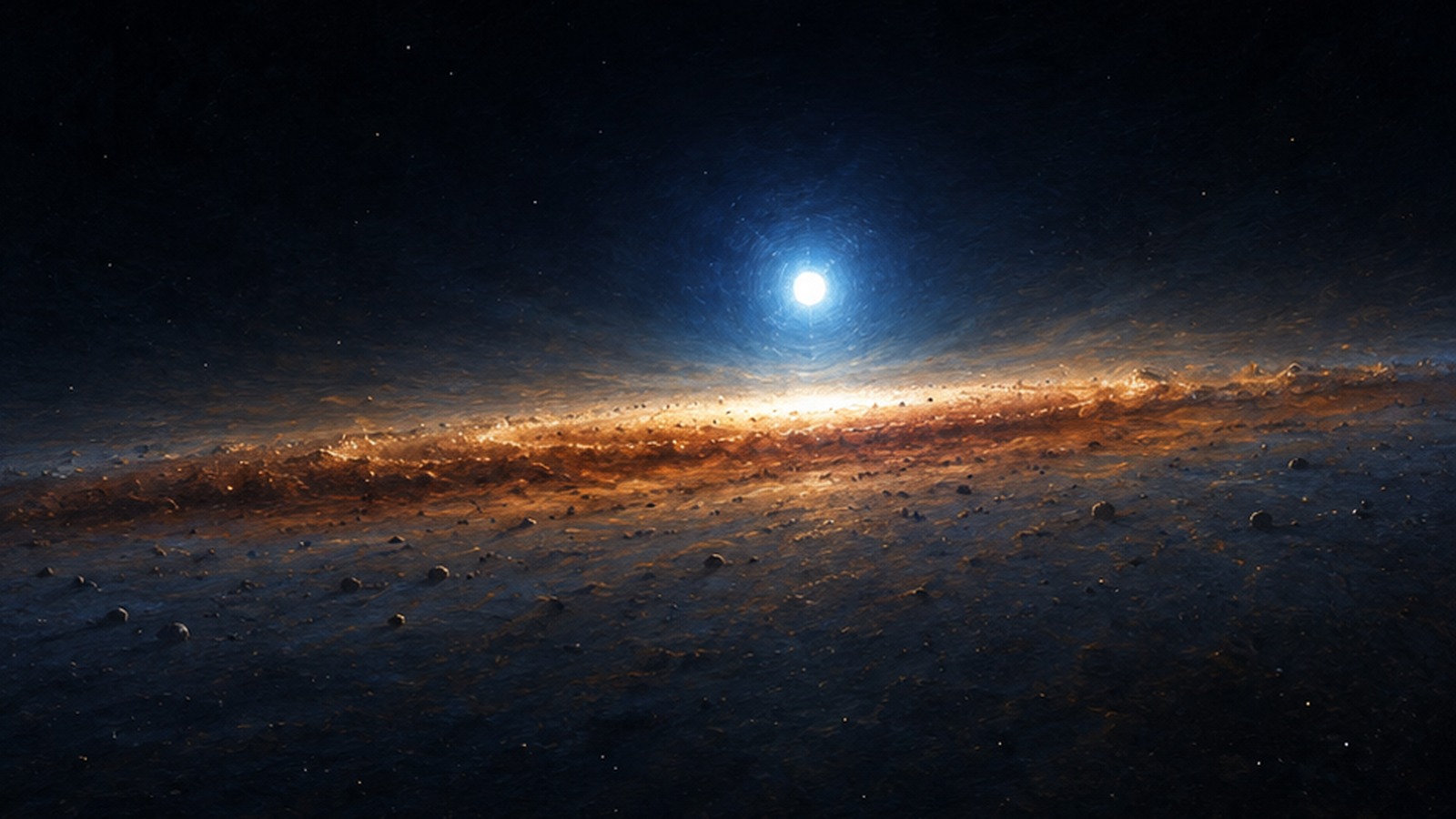
Illustration by Domi Verse X
For a century the collision looked certain. New data from Hubble and Gaia turned it into a coin flip.
This article contains affiliate links. If you buy through them, we may earn a small commission at no extra cost to you.
For most of the last century, the ending was written. The Milky Way and the Andromeda galaxy were falling toward each other, gravity had already decided the outcome, and in roughly four billion years our galaxy would be torn apart and rebuilt as something else. It appeared in textbooks, documentaries and museum films. It was one of the few things about the deep future that astronomers said out loud without hedging.
Then a team of astronomers ran the numbers again with better data and a more complete picture of our galactic neighbourhood. The certainty did not survive.
A century of watching Andromeda fall toward us
Andromeda sits about 2.5 million light years away. It is the most distant thing most people have ever seen with their own eyes, a faint smudge in a dark sky, and it is the nearest large galaxy to our own.
As far back as 1912, astronomers noticed something strange about it. Almost every galaxy in the sky shows a redshift, its light stretched toward longer wavelengths as it moves away from us. Andromeda does the opposite. Its light is shifted toward the blue end of the spectrum, which means it is coming closer, at something like 250,000 miles per hour.
That measurement is the easy half of the problem. A Doppler shift only tells you how fast something is moving directly toward you or away from you. It says nothing about sideways motion. A bullet aimed at your chest and a bullet that will pass a metre in front of you can look identical if all you can measure is how fast they approach.
For a galaxy two and a half million light years away, that sideways drift is brutally hard to measure. It is the astronomical equivalent of watching a hair grow from across a city.
The prediction that became a fact
In 2012, astronomers at the Space Telescope Science Institute finally pinned it down. Roeland van der Marel, Sangmo Tony Sohn and their colleagues used the Hubble Space Telescope to track the positions of Andromeda's stars across five to seven years of observations, then compared them frame by frame.
The sideways motion they found was tiny. Too tiny to save us. If Andromeda is barely drifting across our line of sight, then it is falling almost straight at us, and the two galaxies must eventually meet.
NASA announced the result in language it almost never uses, saying astronomers could now predict with certainty the next major cosmic event to affect our galaxy. The impact was placed at about four billion years from now, with the two galaxies settling into a single elliptical galaxy roughly two billion years after that. The Sun would likely be flung into a completely different part of the new galaxy, though the Earth itself would not be destroyed by the encounter.
That was the story for more than a decade. Not a possibility. A schedule.
What the older studies left out
The problem with a schedule is that it depends on every input being right.
To predict where two galaxies will be in ten billion years, you need their current positions, their current velocities in three dimensions, and their masses, including the enormous halos of dark matter that surround them and stretch far beyond the visible stars. Every one of those numbers carries an error bar. Small uncertainties at the start turn into wildly different endings.
And there is a second problem. The Milky Way and Andromeda are not alone. The Local Group contains dozens of galaxies, and two of them are heavy enough to pull the main pair off course. Andromeda has the Triangulum galaxy, M33. The Milky Way has the Large Magellanic Cloud, a satellite galaxy far more massive than astronomers assumed a generation ago.
Earlier work tended to treat the encounter as a two body problem. That is a reasonable simplification, right up until it isn't.
A coin flip, not a countdown
In 2025, a team led by Till Sawala at the University of Helsinki, working with researchers at Durham University, the University of Toulouse and the University of Western Australia, redid the calculation properly. They combined the latest Hubble measurements with data from the European Space Agency's Gaia mission, modelled all four major galaxies instead of two, and ran thousands of simulations that sampled the full range of the observational uncertainties rather than the single best guess.
Enjoying this story?
Get a short teaser by email whenever we publish something new. No spam.
The results split almost evenly. Their paper in Nature Astronomy found roughly a 50 percent chance that the Milky Way and Andromeda merge at all within the next ten billion years. Sawala summarised it bluntly: the probability went from near certainty to a coin flip.
The two extra galaxies matter, and they pull in opposite directions. Including M33 makes a merger more likely. The Large Magellanic Cloud does the reverse, because its orbit runs roughly perpendicular to the Milky Way and Andromeda axis, nudging our galaxy sideways just enough to change the geometry of the encounter.
The head-on crash from the old illustrations turns out to be the least likely version of all. The new work leaves only about a 2 percent chance of a direct hit in four to five billion years.
In about half the simulations, the galaxies sweep past each other first, separated by half a million light years or less, then swing back and merge much later as dynamical friction between their dark matter halos drains the orbit of energy. In most of the rest, they never come close enough for that friction to bite, and the two galaxies simply keep orbiting each other, indefinitely, without ever touching.
It is worth being clear about what this is not. Sawala's team did not find an error in the 2012 analysis. They started from newer data, favoured somewhat lower galaxy masses, and included parts of the system that had been left out. Same sky, more of it accounted for.
What a merger would actually look like
If it does happen, nothing hits anything.
Galaxies look solid in photographs, but they are mostly empty space. The stars inside them are separated by distances so large that when two galaxies pass through each other, individual stars almost never collide. What collides is gas. Vast clouds slam together, compress, and ignite a burst of new star formation, while the two spiral disks are pulled into long streamers and eventually settle into a single, rounder elliptical galaxy.
The night sky would be the spectacle. Over hundreds of millions of years Andromeda would swell from a smudge into a structure filling the sky, distorting as it came. Nobody on Earth would be watching, but the view would be extraordinary.
Why it barely matters for Earth
Here is the twist that makes the whole debate feel oddly academic. Our galaxy's fate is uncertain. Our planet's is not.
The Sun is slowly brightening. In roughly a billion years, long before any galactic encounter, the increase in solar output is expected to leave Earth uninhabitable, oceans boiled away. In about five billion years the Sun will swell into a red giant, swallowing Mercury and Venus and probably scorching or engulfing the Earth.
Whatever happens between the Milky Way and Andromeda, no Earth-bound observer will be there to see the outcome. As one summary of the study put it, a collision with Andromeda is the least of our cosmic worries.
The honest answer
The satisfying version of this story would end with a new certainty replacing the old one. It doesn't. The current state of knowledge is that our galaxy might merge with Andromeda, or might dance around it for the rest of cosmic time, and the available data cannot yet tell us which.
That will change. The precision of a proper motion measurement improves the longer you keep watching, and teams are still tracking Andromeda with Hubble, aiming to more than double the accuracy of the 2012 result. Gaia's final data releases will sharpen the mass estimates that drive so much of the uncertainty.
Until then, the correct answer to what happens to the Milky Way is the one astronomers spent a century trying to avoid giving. We do not know.
Sources
- NASA: Hubble Shows Milky Way is Destined for Head-on Collision with Andromeda Galaxy (2012)
- Sawala et al., "No certainty of a Milky Way-Andromeda collision", Nature Astronomy (2025)
- ESA/Hubble: Hubble casts doubt on certainty of galactic collision
- NASA Science: Apocalypse When? Hubble Casts Doubt on Certainty of Galactic Collision