Every Star You See Orbits a Black Hole You'll Never See
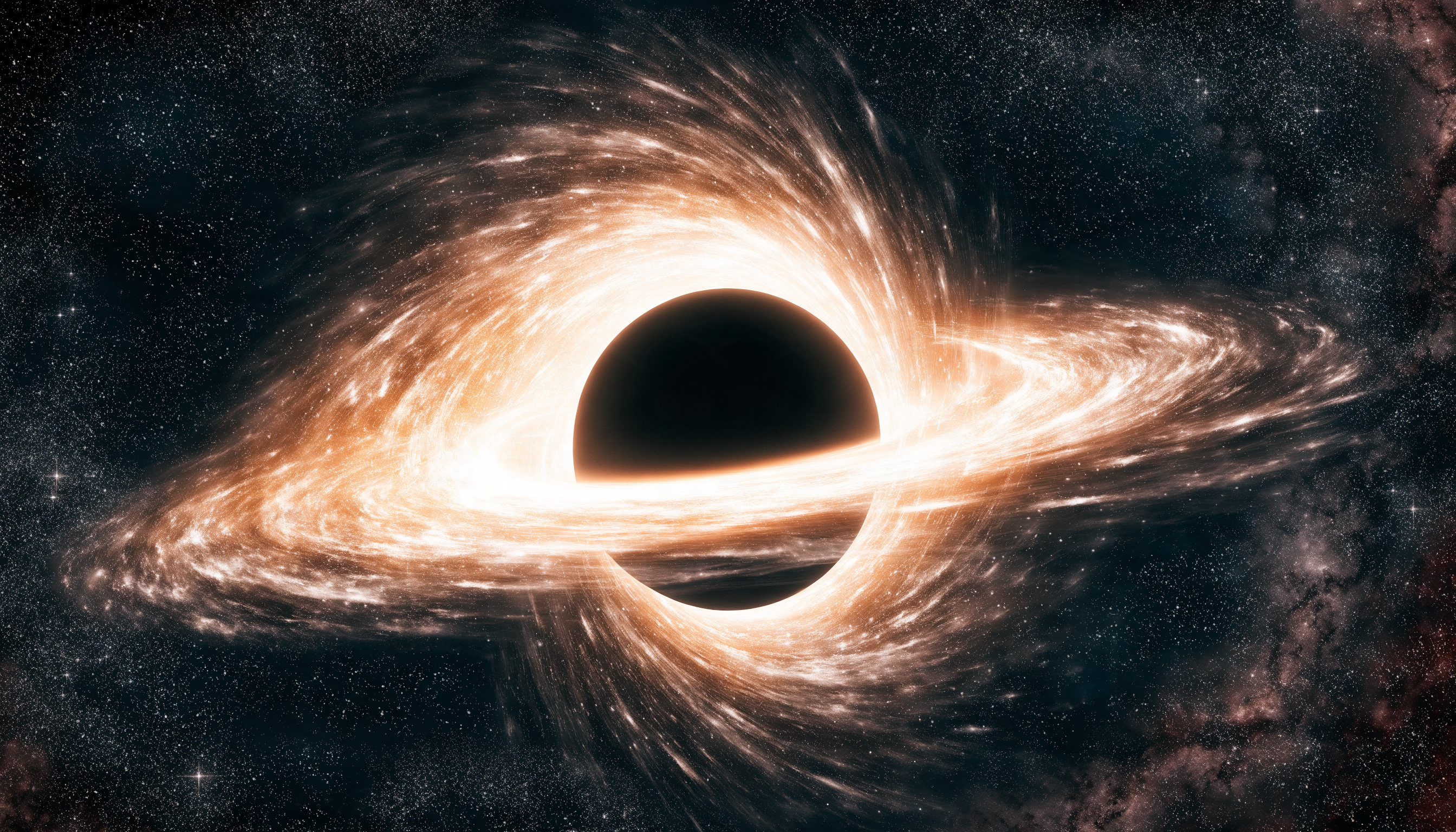
Illustration by Domi Verse X
Every star in the Milky Way, including our Sun, is quietly orbiting a black hole four million times heavier than the Sun, one it took eight telescopes and five years to finally photograph.
This article contains affiliate links. If you buy through them, we may earn a small commission at no extra cost to you.
Look up at the night sky and pick any star. It doesn't matter which one. Every star in the Milky Way, including the Sun and everything orbiting it, is slowly circling something invisible at the center of the galaxy: a black hole four million times heavier than the Sun. It has been there the entire time, quietly anchoring hundreds of billions of stars into a single spinning disk, and for most of human history nobody knew it existed.
Its name is Sagittarius A*, usually shortened to Sgr A* and pronounced "Sagittarius A-star." It sits roughly 26,000 light-years from Earth, buried behind thick clouds of gas and dust in the direction of the constellation Sagittarius, which is exactly why it stayed hidden for so long. Visible light can't get through that dust. Only radio waves and X-rays can, and it took decades of patient work with instruments tuned to those wavelengths before anyone could prove what was sitting at the galaxy's core.
How Astronomers Found Something They Couldn't See
You cannot photograph a black hole directly, because by definition no light escapes it. What astronomers can do is watch how everything nearby behaves, and in the early 1990s a team led by Reinhard Genzel began doing exactly that at the European Southern Observatory in Chile. Around the same time, a separate team led by Andrea Ghez started tracking the same region using the Keck telescopes in Hawaii. Both groups focused on a cluster of stars swarming an apparently empty patch of sky near the galactic center, and one star in particular, called S2, became the key piece of evidence.
S2 does something no star should be able to do near an ordinary object. It swings around Sagittarius A* on a tight, elliptical orbit, and at its closest approach it puts on an astonishing amount of speed, reaching close to three percent of the speed of light. By 2008, after 16 years of tracking S2 and its neighboring stars, both teams had enough data to calculate the mass required to whip a star around that fast in that small a space: roughly four million times the mass of the Sun, all packed into a region only a few times the size of our own solar system. Nothing except a black hole fits that description. In 2020, Genzel and Ghez shared half of the Nobel Prize in Physics for the discovery, with Roger Penrose receiving the other half for his theoretical work on how black holes form in the first place.
The story didn't end with the mass measurement. S2's orbit also let researchers test Einstein's general relativity in one of the most extreme environments available. As S2 swept past Sagittarius A* in May 2018, its light stretched out in wavelength exactly the way relativity predicts near an intense gravitational field, a phenomenon called gravitational redshift. Later observations caught something even stranger: instead of tracing the same ellipse every orbit, S2's path slowly rotates, tracing out a rosette-shaped pattern over time. That effect, called Schwarzschild precession, is another prediction of general relativity, and seeing it play out around a real black hole was a direct confirmation of a century-old theory.
The Photograph That Took Eight Telescopes and Five Years
Knowing a black hole is there and actually picturing its shadow are two very different problems, and the second one took an entirely different kind of instrument: the Event Horizon Telescope, or EHT. Rather than building one impossibly large telescope, which is physically impossible, the EHT team linked eight radio observatories scattered across the planet, from the South Pole to Spain, so that together they behaved like a single telescope roughly the size of Earth itself. The distance between the two farthest stations sets the effective aperture, and that gave the array a resolving power about 4,000 times sharper than the Hubble Space Telescope, sharp enough, researchers said, to read a newspaper in New York from a sidewalk cafe in Paris, or to spot a doughnut sitting on the surface of the Moon.
The EHT collected its data on Sagittarius A* in April 2017, the same observing run that produced the first-ever black hole image, of a much larger object called M87*, in a galaxy 53 million light-years away. Sagittarius A* turned out to be the harder target, even though it's far closer to us. M87*'s black hole is enormous, about 6.5 billion solar masses, so gas circling it takes days to weeks to complete an orbit and the picture holds still while you're taking it. Sagittarius A* is over a thousand times smaller and lighter, which means gas around it can complete a full orbit in a matter of minutes. The team was effectively trying to photograph something that kept changing shape faster than they could record it, which meant averaging thousands of individual images collected across multiple nights just to produce one final, stable picture.
Enjoying this story?
Get a short teaser by email whenever we publish something new. No spam.
That picture was finally released on May 12, 2022, five years after the data was collected. It shows a dark central shadow ringed by a glowing, lopsided halo of light bent around the black hole by its own gravity, the signature shape predicted for any black hole's silhouette. Side by side, the images of Sagittarius A* and M87* look remarkably alike, which was itself an important result. Two black holes with wildly different masses, sitting in completely different galaxies, produced the same basic shape, exactly what general relativity says should happen regardless of size.
A Black Hole That Behaves, Mostly
For all its mass, Sagittarius A* is a surprisingly quiet neighbor. Unlike M87*, which blasts jets of particles out across thousands of light-years, Sagittarius A* isn't actively feeding on large amounts of material right now, so it doesn't glow brightly the way many supermassive black holes in other galaxies do. It isn't perfectly silent, though. X-ray observatories including NASA's Chandra and Swift have caught it flaring, brief spikes in X-ray brightness produced when clumps of hot gas, some blown off nearby massive stars, get too close and spiral in. During one especially useful observing campaign, Chandra and NuSTAR caught a bright X-ray flare at the same time the EHT was watching in radio, and researchers saw the radio signal brighten within hours afterward, a rare chance to watch cause and effect play out in real time around an event horizon.
The event horizon itself, the boundary past which nothing escapes, has a radius of about seven million miles, or 12 million kilometers, which sounds enormous until you remember it belongs to something four million times the Sun's mass. From Earth's vantage point, tens of thousands of light-years away, that boundary appears vanishingly small, roughly the angular size of a blueberry photographed on the surface of the Moon. It took a telescope the size of the planet just to catch that shadow at all.
Why This Matters Beyond the Picture
Sagittarius A* isn't just a curiosity at the center of our galaxy. Nearly every large galaxy astronomers have studied appears to have a supermassive black hole at its core, and the relationship between a black hole's mass and the galaxy surrounding it seems to matter for how that galaxy evolves over billions of years. Because Sagittarius A* is by far the closest supermassive black hole to Earth, it functions as the best natural laboratory available for studying how these objects behave, warp spacetime, and interact with their surroundings, insights that are much harder to gather from black holes millions or billions of light-years farther away.
It also means something more immediate. The Sun, Earth, and everything on it are already part of Sagittarius A*'s gravitational system, tracing an enormous, extremely slow orbit around it that takes roughly 230 million years to complete. It has been that way since before there was complex life on this planet, and it will remain that way long after. The black hole at the center of the galaxy isn't a distant, exotic event. It's the quiet anchor everything you've ever seen in the night sky is circling.
Sources
- Event Horizon Telescope: Astronomers Reveal First Image of the Black Hole at the Heart of Our Galaxy
- NASA JPL Education: How Scientists Captured the First Image of a Black Hole
- NASA JPL Education: Telescopes Get Extraordinary View of Milky Way's Black Hole
- Chandra X-ray Observatory: Sagittarius A*, May 12, 2022
- ESO: 2020 Nobel Prize in Physics for Research on the Milky Way's Supermassive Black Hole