
Nobody Meant to Hit the Moon. We Did Anyway.
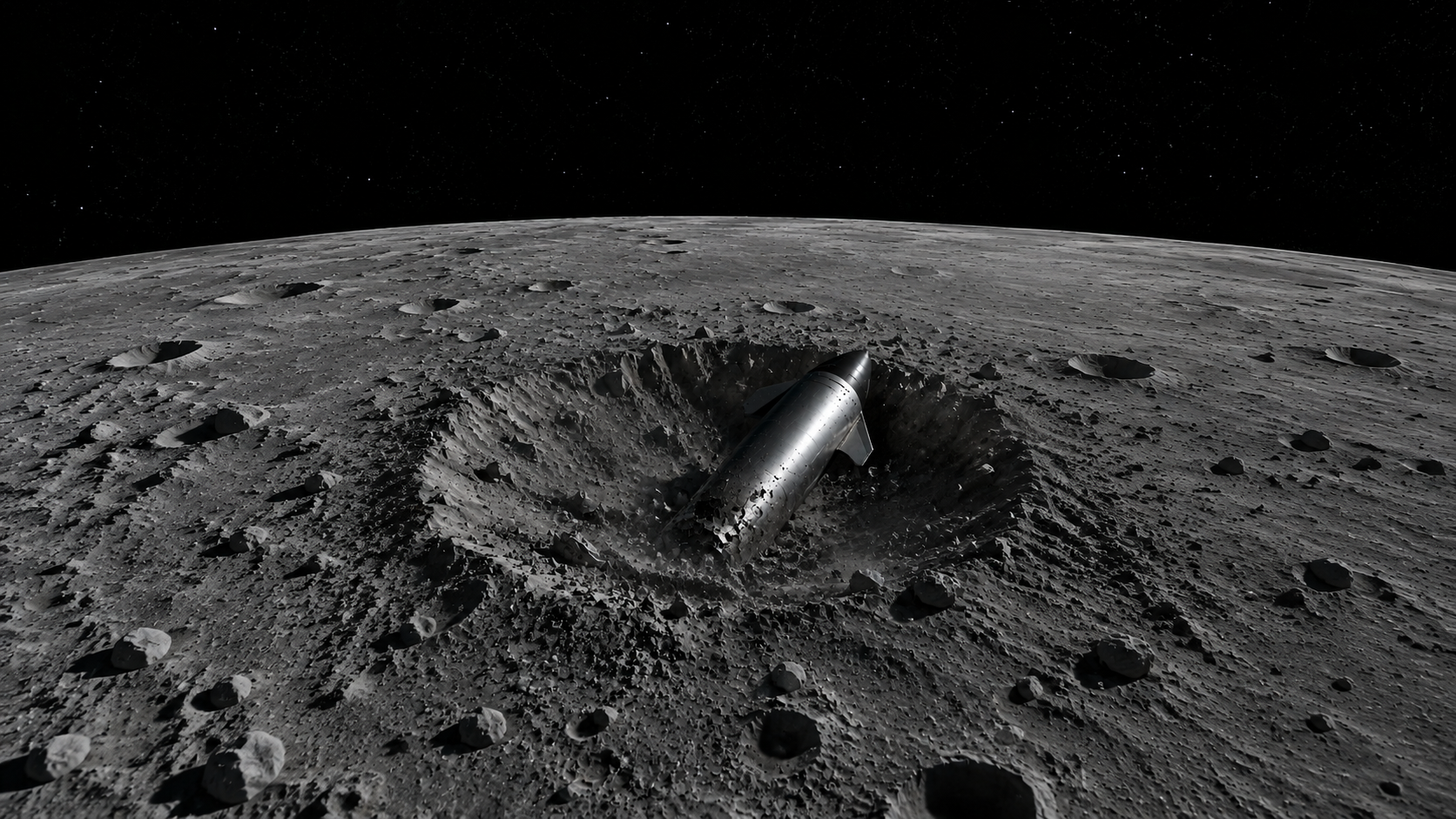
Illustration by Domi Verse X
An independent analyst predicted it months in advance, to within about two minutes. Nobody has measured the crater yet, and the published estimates disagree by nearly a factor of two.
This article contains affiliate links. If you buy through them, we may earn a small commission at no extra cost to you.
On Wednesday, a spent piece of a SpaceX rocket weighing roughly four tonnes hit the Moon. Nobody had planned it. Nobody could have steered it. And the person who worked out where it would land was not employed by any space agency.
The impact happened on 5 August 2026, at about 06:34 UTC, near the Einstein crater. NASA says it posed no danger to Earth. Within a day, the first photographs came back, and they raise a question nobody can answer yet.
There is a small, strange consequence of all this. Most 3D-printed moon lamps are moulded from NASA topographic data, all of which was collected before Wednesday, so the surface on your shelf is now slightly out of date.
How heavy, exactly? Nobody agrees
Before going further, one honest caveat about the numbers in this story.
The stage's mass is quoted differently almost everywhere. The research team modelling the impact used a figure of about 3,900 kilograms. Several news outlets reported 4,000 kg. A Canadian broadcaster reported 4,900 kg. Its estimated mass is somewhere in the range of roughly four to five tonnes, and this article will not pretend to more precision than that.
Its speed is better established: about 2.43 kilometres per second, which works out to roughly 8,700 km/h, or 5,400 mph.
The rocket had been adrift for eighteen months
It launched on 15 January 2025 from Kennedy Space Center, carrying two commercial Moon landers. Firefly Aerospace's Blue Ghost Mission 1 touched down on 2 March 2025, the first successful commercial soft landing on the Moon. ispace's Hakuto-R Mission 2, named Resilience, attempted its own descent on 5 June 2025, and contact was lost roughly ninety seconds before touchdown. Both sites, and the roughly a thousand named features around them, sit on the near side you can trace with a finger on a desk moon globe.
The first stage came back to Earth and landed, the way Falcon 9 boosters normally do. The upper stage did its job, released both landers onto a path toward the Moon, and then had nowhere to go.
This is the part worth being precise about, because "abandoned" implies a choice that was not really available. A Moon-bound mission demands more thrust than a typical orbital flight, which left the stage beyond the reach of a controlled deorbit. It had dumped its remaining propellant and could not be steered. Julianna Scheiman, SpaceX's director of NASA science and Dragon programs, has described what happened next as a mixture of solar activity and gravitational forces putting the stage on a path toward the Moon.
So it drifted. For roughly a year and a half it looped around Earth on an unstable, highly elliptical orbit, catalogued as 2025-010D.
An amateur saw it coming first
Bill Gray writes a piece of astronomy software called Project Pluto, used by both amateur and professional astronomers to track asteroids, comets and human-made objects. He is an independent orbital analyst, not an employee of NASA or any other agency.
Gray has described his own timeline plainly: by January he was fairly sure the stage would hit the Moon, though he had only a vague idea where, and by April he was confident enough to publish an announcement. He appears to have been the first to calculate and publish the prediction.
His final estimate, posted on 1 August, put the impact at 06:35:37.5 UTC, at lunar coordinates 19.461°N, 93.293°W. It was based on 1,053 astrometric observations gathered through February 2026 and updated with observer data through early August. Project Pluto draws on telescope surveys by amateur astronomers alongside US military tracking data, and the entry point to that world is lower than most people assume: a pair of 10x50 binoculars will already show you craters along the Moon's terminator.
How close was he? The Korea Aerospace Research Institute reported the impact at 2:34 a.m. EDT, which is 06:34 UTC. The research paper modelling the event also gives 06:34 UTC. Gray's published prediction was 06:35:37.5 UTC. Some outlets reported 2:35 a.m. EDT rather than 2:34. Compare those figures however you like; the gap is a matter of a minute or two, worked out months in advance from public data.
Gray himself is careful not to oversell any of it. Writing before the impact, he described the event as being of probably minor scientific interest, presenting no danger to anyone, but highlighting a certain carelessness about how leftover space hardware is disposed of.
He got it wrong once before, and the correction matters
In 2022, Gray predicted that a rocket stage would hit the far side of the Moon on 4 March. He was right about the impact. He was wrong about whose rocket it was.
He initially identified the object as a Falcon 9 upper stage from the DSCOVR mission. Then Jon Giorgini, an engineer at NASA's Jet Propulsion Laboratory, pointed out that DSCOVR's post-launch trajectory had not taken it especially close to the Moon. Gray went back through his own email archives, found the seven-year-old assumption he had made, and published a correction: the object was, in his assessment, the upper stage of a Chinese Long March 3C from the Chang'e 5-T1 mission launched in 2014. He described the revised evidence as circumstantial but fairly convincing.
A later study led by Tanner Campbell at the University of Arizona, published in the Planetary Science Journal, supported the Chinese origin through tracking and spectroscopic analysis. The Chinese government disputed the finding.
So, to be unambiguous about it: the 2022 lunar impact was not a SpaceX rocket. Wednesday's was. They are two separate events, launched more than ten years apart, and only one of them involved a Falcon 9.
The episode also illustrates something Gray himself has pointed at. Tracking objects in cislunar space is difficult precisely because the telescopes, radars and identification tools that exist for low Earth orbit do not extend out there. An object hit the Moon, and establishing conclusively who had launched it took more than a year and a dedicated study.
Enjoying this story?
Get a short teaser by email whenever we publish something new. No spam.
The first photographs show a dark smudge
South Korea's Danuri orbiter was in the right place. Korean scientists adjusted its orbit so it would pass over the predicted impact point, began observing about thirty minutes before the collision, and made eight separate imaging passes.
KARI released the images on 6 August. Compared with the before shots, the after images show a patch of surface that has turned distinctly darker, with a brighter spot near its centre. The Korean team also compared against an LRO image of the same terrain taken in 2015.
Einstein sits right on the edge of the Moon's visible disk, which is why sources describe its position inconsistently and why it is an awkward target from Earth. It is marked on most detailed lunar surface charts. The observational planning paper notes that without libration, the slight rocking that periodically tips the Moon's edge toward us, the impact would have happened out of sight beyond the limb entirely.
Astronomers at Spain's Instituto de Astrofísica de Andalucía believe they recorded video from the ground of ejected material rising off the surface at around the predicted time.
What none of this gives you is a measurement. The dark patch is ejected dust and rock. The crater underneath it has not yet been resolved.
Three predictions, and we still do not know which one is right
Before the impact, several estimates were published for how big the hole would be.
Gray put it at about 17 metres across. NASA's Meteoroid Environments Office at Marshall Space Flight Center calculated roughly 18 metres wide and 4 metres deep. The observational planning paper, led by Benjamin Fernando with 23 co-authors and posted in July, expected a final crater diameter of 20 to 30 metres, based on data from the Chang'e 5 and LCROSS impacts and on modelling. A simulation at Los Alamos National Laboratory landed in the same upper range, around 5 metres deep, throwing out roughly 1.1 million kilograms of lunar soil.
The gap between the low and high estimate is nearly a factor of two. That sounds like sloppiness. It is not. A rocket stage is essentially a hollow tank with a heavy engine bolted to one end, and how a hollow object excavates rock at high speed is genuinely hard to model. The Fernando paper notes that a double crater is possible if the impactor is decapitated on the way in.
A separate team led by William Jo at the University of Texas at Austin modelled the debris instead of the hole. Their preprint, submitted to Geophysical Research Letters in late July, predicted an ejecta curtain rising 15 to 20 kilometres, a central spike reaching 75 to 100 kilometres, and material spreading as far as 183 kilometres from the impact point. Their own paper is careful to flag that it models only an upright impact, and that nobody knows what orientation the stage was in when it arrived.
NASA's Lunar Reconnaissance Orbiter is expected to photograph the site in the coming weeks. Its narrow-angle camera can resolve features down to about 50 centimetres, and the area was imaged beforehand to establish a baseline. When those pictures arrive, one of these predictions will turn out to have been closest, and the models used to plan future lunar missions can be checked against a real measurement for once.
So is this vandalism or is it nothing?
Both arguments are reasonable, which is why the disagreement has not settled.
The case for nothing: a NASA official has said that a meteoroid carrying the same energy as this upper stage hits the Moon roughly every six days. On that arithmetic, humanity added about six days' worth of ordinary cratering to a surface that has been absorbing impacts since long before there was anyone to watch. Earth takes the same treatment, and the difference is only that our atmosphere burns most of it up; the pieces that survive turn up in collectors' cases as iron meteorite fragments with a certificate attached.
The case for concern is not really about this crater. It is about who is next. Deliberate lunar impacts are old news: the Soviet Luna 2 was aimed at the surface in 1959, Apollo-era upper stages were crashed into the Moon on purpose, and NASA deliberately struck the surface in 1999 and again in 2009 looking for water ice. What is new is the number of objects arriving by accident, at a moment when NASA, China and several companies are all planning permanent facilities with people in them.
There is something clarifying about having built a rocket yourself, even a small one. Anybody who has assembled a beginner model rocket kit knows the last question you ask before launch is where the thing is going to come down. At this scale, nobody was obliged to ask it.
That is not a figure of speech. The 1967 Outer Space Treaty, still the cornerstone of space law, sets out principles for peaceful use but imposes no disposal requirement on operators for hardware left in cislunar space. The Artemis Accords address cooperation, safety zones and heritage sites, but stop short of binding disposal rules. The international debris mitigation guidelines that do exist cover protected regions only out to geostationary orbit, roughly 36,000 km, and the Moon is more than ten times further away. The US Federal Aviation Administration proposed an upper-stage debris rule in September 2023 and withdrew it on 15 January 2026 after industry objections about cost. The Federal Communications Commission's new cislunar licensing framework, adopted on 22 July 2026, created a category for commercial cislunar spacecraft but no disposal mandate for the spent stages that put them there. ESA's own space debris page states plainly that no clear guidelines currently exist for disposing of spacecraft or spent upper stages sent beyond Earth orbit.
It is worth noting that this is solvable, and partly already solved. Gray has pointed out that recent Chinese lunar launches have put their upper stages into orbit around the Sun rather than leaving them where they might eventually hit something, and that a more recent Falcon 9 upper stage, from the EscaPADE launch in November 2025, was placed on a solar orbit deliberately. The trick only works for missions already heading to the Moon or beyond. It is not a fix for space junk in general. But for exactly the category of object that hit the Moon on Wednesday, the answer already exists and is sometimes used.
What happens next
In the coming weeks, LRO will fly over the Einstein crater region and photograph a hole that nobody has yet measured. Somebody's prediction will be vindicated. Somebody's will not.
And the thing that made this event unusual will still be true: the most accurate warning anybody had came from an independent analyst working with public data and a network of amateurs pointing telescopes at a faint moving dot.
Sources
- NASA Will Attempt to Observe Rocket Part's Lunar Impact, NASA
- Upper stage impacting the moon on 2026 August 5, Bill Gray, Project Pluto
- Observational planning for the 2026 August 5 Falcon 9 Upper Stage lunar impact, Fernando et al.
- Predicted Ejecta Dynamics and Observability of the 2026 Falcon 9 Upper Stage Lunar Impact, Jo et al.
- When a SpaceX rocket crashes into the moon, scientists will be watching, Phys.org
- SpaceX rocket's impact crater on the moon spied by Korean lunar orbiter, Space.com
- SpaceX's Falcon 9 wasn't the first rocket to crash into the moon, Space.com
- A SpaceX Falcon 9 rocket upper stage has crashed into the moon, NPR
- New crater likely to form after SpaceX rocket slams into the moon, CNN
- A SpaceX rocket will collide with the moon this week, CP24
- SpaceX Falcon 9 Stage Moon Impact, Technology.org
- Falcon 9 Impacts Moon in Hours, TechTimes
- Chinese rocket, not Falcon 9, linked to upper stage on lunar impact trajectory, SpaceNews
- AME Doctoral Student Leads Study on Lunar Rocket Crash, University of Arizona
- Incoming! Debris enroute to the Moon, ESA
- Mitigation Methods for Launch Vehicle Upper Stages on the Creation of Orbital Debris, Federal Register