How Small Are You?
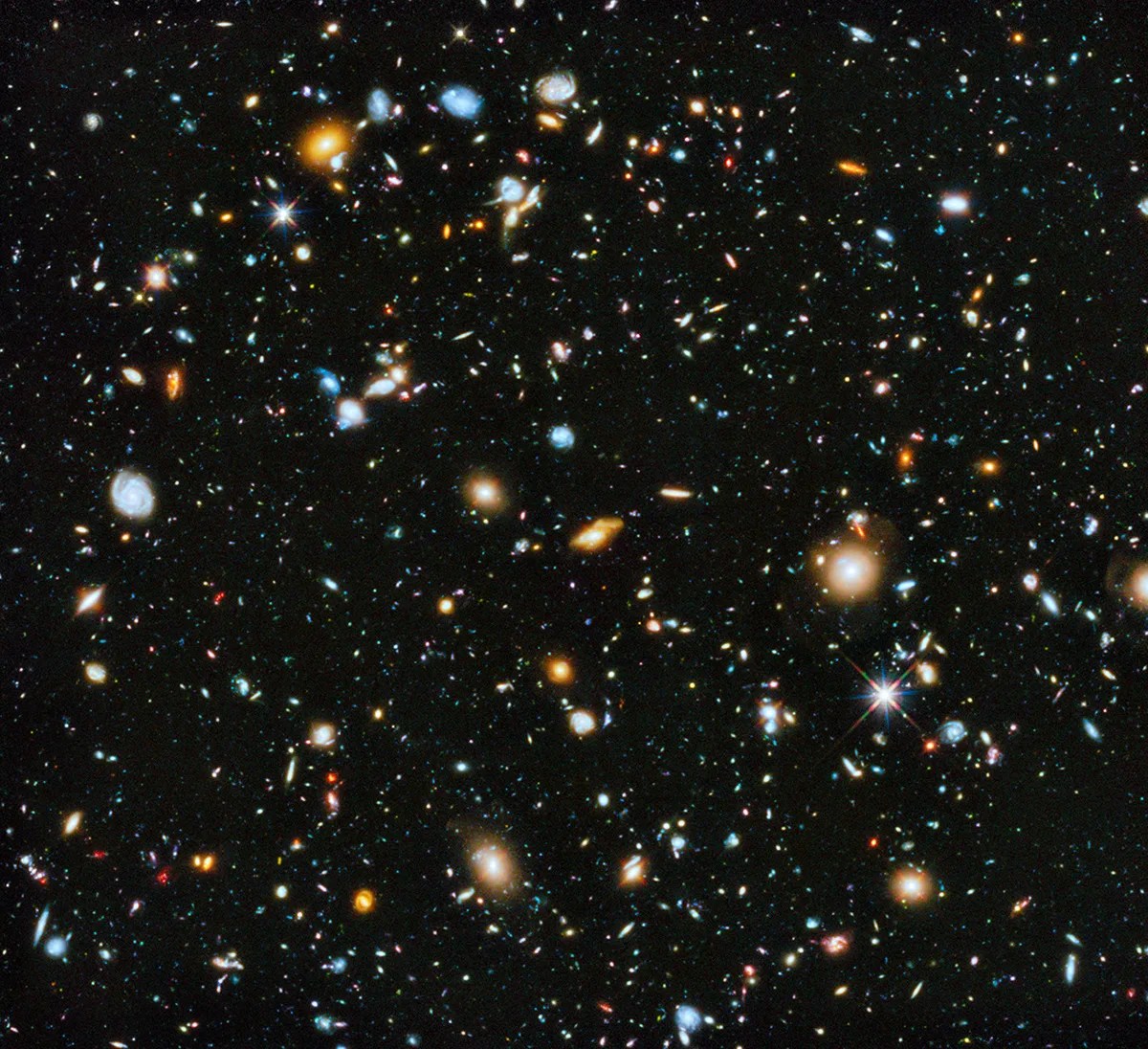
Credit: NASA, ESA, H. Teplitz and M. Rafelski (IPAC/Caltech); A. Koekemoer (STScI), R. Windhorst (Arizona State University) and Z. Levay (STScI)
A few thousand stars tonight is nothing. Zoom out, and you'll see how small we really are.
This article contains affiliate links. If you buy through them, we may earn a small commission at no extra cost to you.
Look up tonight and you'll see a few thousand stars. That's nothing. Zoom out from Earth, and you start to see just how small we really are.
Our tiny corner of space
Earth feels huge when you're standing on it. But Earth is only one of eight planets orbiting the Sun: Mercury, Venus, Earth, Mars, Jupiter, Saturn, Uranus, Neptune. That's it. Eight planets, a handful of dwarf planets, some moons, and a lot of empty space in between.
The Sun itself looks enormous from here, but compared to other stars, it is thoroughly average: not among the largest, not among the smallest. Our whole neighborhood, one ordinary star with eight planets circling it, is already a very unremarkable corner of a very big place.
A galaxy of a hundred billion suns
Our Sun is one star inside a much larger structure: the Milky Way, home to more than one hundred billion stars. The galaxy is so wide that light itself, the fastest thing that exists, takes about one hundred thousand years to cross from one edge to the other.
Our entire solar system is slowly orbiting the Milky Way's center. One full loop takes roughly 230 million years. The last time the Sun was in its current position in that orbit, dinosaurs had not yet appeared on Earth.
Two trillion galaxies (maybe)
The Milky Way is just one galaxy among many. For a while, researchers estimated the observable universe held around two trillion galaxies. More recent surveys suggest the true figure may be considerably lower, and astronomers are still actively working out which estimate holds up as telescopes improve. What is not in dispute is the scale: there are far more galaxies than anyone could count in a lifetime, each one holding its own hundreds of billions of stars and planets.
The universe you can actually see
Enjoying this story?
Get a short teaser by email whenever we publish something new. No spam.
The observable universe, the portion whose light has had time to reach us since the Big Bang, is about 93 billion light-years across. That number describes only what we are currently able to see. Light from anything farther out has not had time to arrive yet, so the full universe could be far larger than the observable part, and there is currently no way to measure how much larger.
A field trip through scale
Picture a walk from small to big. Start with yourself, then step back to your city, your country, the whole planet. Earth already looks like a marble from the Moon.
Shrink Earth further, until the entire solar system fits in your hand. That hand is a speck inside the Milky Way. Shrink the Milky Way onto your desk, and it becomes one dot among countless others filling a room. Shrink that room to fit a stadium, and the stadium is the observable universe.
Every step of that walk is a jump too large to actually feel, even once you know the numbers. That gap, between knowing a number and feeling it, is where wonder tends to live.
So how small are you?
Genuinely, almost impossibly small. And also made of atoms once forged inside stars, then scattered into space when those stars died, long before the Sun or Earth existed. Every part of you passed through a star first.
Out of everything astronomers have found across all those galaxies, one small planet is currently the only place known to hold anything that looks up and asks questions about the rest of it. That planet is Earth. Being small does not mean being unimportant. Sometimes the smallest thing in the room is the only one paying attention.
Sources
- NASA Science, Our Milky Way Galaxy: How Big Is Space?
- NASA Science, Hubble Reveals Observable Universe Contains 10 Times More Galaxies Than Previously Thought
- ESA/Hubble, Observable Universe Contains Ten Times More Galaxies Than Previously Thought (heic1620)
- Caltech/IPAC Cool Cosmos, How Big Is the Universe?