What Happens If You Fall Into a Black Hole?
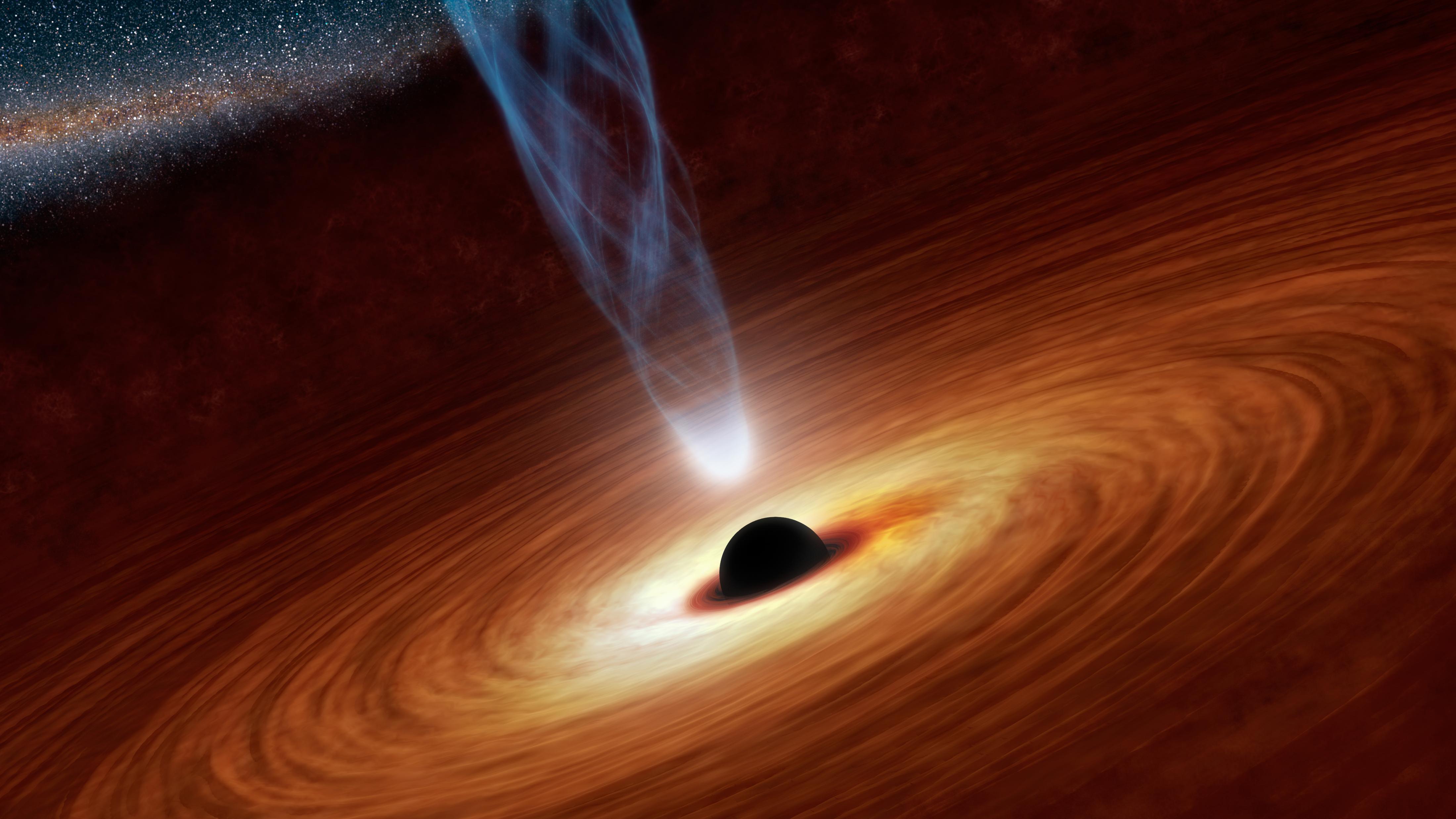
Credit: NASA/JPL-Caltech (artist's concept)
Cross the edge where even light can't escape, and here is exactly what would happen to you, and to everyone watching from outside.
This article contains affiliate links. If you buy through them, we may earn a small commission at no extra cost to you.
Fall toward a black hole, and for a surprisingly long stretch of the trip, nothing feels unusual. You would not hit an invisible wall or bounce off anything. You would simply keep falling, faster and faster, toward a boundary in space that most things in the universe never cross.
What the event horizon actually is
Every black hole has an edge called the event horizon: the boundary beyond which gravity is strong enough that nothing, not light, not radio signals, not anything, can escape back out. It is not a physical surface. There is nothing to touch, no wall, no membrane. It is simply the point past which the escape speed exceeds the speed of light, so escape becomes mathematically impossible rather than merely difficult.
Crossing it, from your own point of view, would not feel like anything special happening at that exact instant. There is no local sign, no flash, no sensation marking the boundary. You would only realize you had crossed it by noticing, some time later, that turning around no longer worked.
The part that actually kills you: spaghettification
The event horizon is not what harms you. Tidal forces are. Gravity pulls harder on whatever part of you is closer to the black hole than on whatever part is farther away. Near an ordinary planet, that difference is too small to notice. Near a black hole, especially a smaller, stellar-mass one, the difference becomes extreme over a very short distance. Your feet, if you were falling in feet first, would be pulled far more strongly than your head. You would be stretched, and eventually torn apart, into a thin stream of material. Astrophysicists actually call this spaghettification, because that is what it looks like happening to anything unlucky enough to fall in.
Here is the detail that surprises people: for a small, stellar-mass black hole, spaghettification happens well before you reach the event horizon. You would never survive to see the crossing. For a supermassive black hole, the kind found at the centers of galaxies, the tidal gradient near the horizon is actually gentler, because the horizon itself is enormous. A person could, in principle, cross the event horizon of a very large supermassive black hole intact, feeling nothing unusual at that moment, and only be torn apart much later, deeper inside.
Two clocks, two true stories
One of the strangest confirmed effects near a black hole involves time itself. Gravity slows clocks down, an effect called gravitational time dilation, confirmed by real experiments, including clocks on GPS satellites needing constant correction because they run measurably faster than clocks on Earth's surface.
Enjoying this story?
Get a short teaser by email whenever we publish something new. No spam.
Near a black hole this effect becomes extreme. If you fell in while a friend watched safely from a distance, your friend would never actually see you cross the horizon. As you approached it, your image would appear to move slower and slower, your light would stretch to longer wavelengths and dim, and you would seem to freeze at the edge forever, fading out rather than visibly vanishing.
From your own perspective, none of that would be happening. Your clock, to you, would feel completely normal. You would cross the horizon in finite time, by your own watch, and keep going. Both descriptions are correct. They are not a paradox, and neither person is wrong: general relativity predicts that observers in very different gravitational conditions genuinely experience different timelines for the same event, and this has been tested, in much weaker form, on Earth.
What happens after the horizon, and what nobody actually knows
Beyond the event horizon, current physics runs out of solid answers. General relativity's equations predict that all the infalling matter is eventually crushed into a singularity, a point of infinite density at the center. Most physicists treat infinite here as a signal that the theory has broken down, not as a literal description of nature, because a full theory that correctly combines gravity with quantum mechanics does not yet exist.
This is also where the deepest disputes in physics sit. One is the information paradox: when something falls into a black hole, does the detailed information about what it was get destroyed forever, which some interpretations of quantum mechanics say should be impossible, or is it somehow preserved, perhaps encoded in the radiation the black hole eventually emits as it slowly evaporates? Physicists including Stephen Hawking worked on this question for decades, and it remains unresolved. A related, more recent debate concerns whether an infalling observer would actually encounter a wall of high-energy radiation, a firewall, right at the horizon instead of noticing nothing unusual, a proposal that directly contradicts general relativity's prediction and has not been settled either way.
Why any of this matters
Nobody has ever fallen into a black hole and reported back, and nobody ever will. Everything here comes from combining Einstein's confirmed theory of gravity with what telescopes have measured about how matter and light behave near real black holes. That combination has passed every test thrown at it so far, which makes black holes one of the best places in the universe to look for the exact point where our best theory of gravity and our best theory of everything else stop agreeing with each other, and something new has to be found.