A Day on Venus Is Longer Than Its Year
Credit: NASA/JPL-Caltech/USGS
Venus spins so slowly, and backwards, that its own day outlasts its entire year.
This article contains affiliate links. If you buy through them, we may earn a small commission at no extra cost to you.
On most planets, a single spin of the planet, a day, takes far less time than a full trip around the Sun, a year. Venus breaks that rule completely. One full rotation takes about 243 Earth days. One full orbit around the Sun takes only about 225 Earth days. A single day on Venus lasts longer than a Venusian year.
How Venus spins
Venus does not just spin slowly. It spins backwards. Almost every planet in the solar system, including Earth, rotates counterclockwise when viewed from above the Sun's north pole. Venus rotates clockwise. Astronomers call this retrograde rotation, and Venus is the only major planet that does it (Uranus is tilted almost completely on its side, which is a different kind of strangeness).
If you could stand on the surface of Venus, which you cannot: the pressure is like being nearly a kilometer under Earth's oceans, and the heat is enough to melt lead, the Sun would rise in the west. It would then take weeks to crawl across the sky before setting in the east.
Why it spins backwards, and why nobody is fully sure
Nobody watched Venus start spinning, so the explanation has to be reconstructed from physics and evidence, and there are two leading ideas.
The first is a giant impact. Early in the solar system's history, planets were bombarded by objects the size of small worlds. A collision large enough, at the right angle, could have knocked Venus's spin over and reversed it, the same kind of event thought to have tilted Uranus and possibly formed Earth's Moon.
The second is a slower process: tidal and atmospheric drag. Venus has by far the thickest atmosphere of any rocky planet, about 90 times the pressure of Earth's at the surface. Some researchers argue that over billions of years, friction between that heavy atmosphere, the solid ground, and the Sun's gravity could have gradually slowed Venus's original spin, stopped it, and then reversed it, without any single violent event.
Enjoying this story?
Get a short teaser by email whenever we publish something new. No spam.
Both mechanisms are supported by computer models. Neither has been proven. This is one of the open questions in planetary science: which was the specific answer for Venus.
How we know the numbers at all
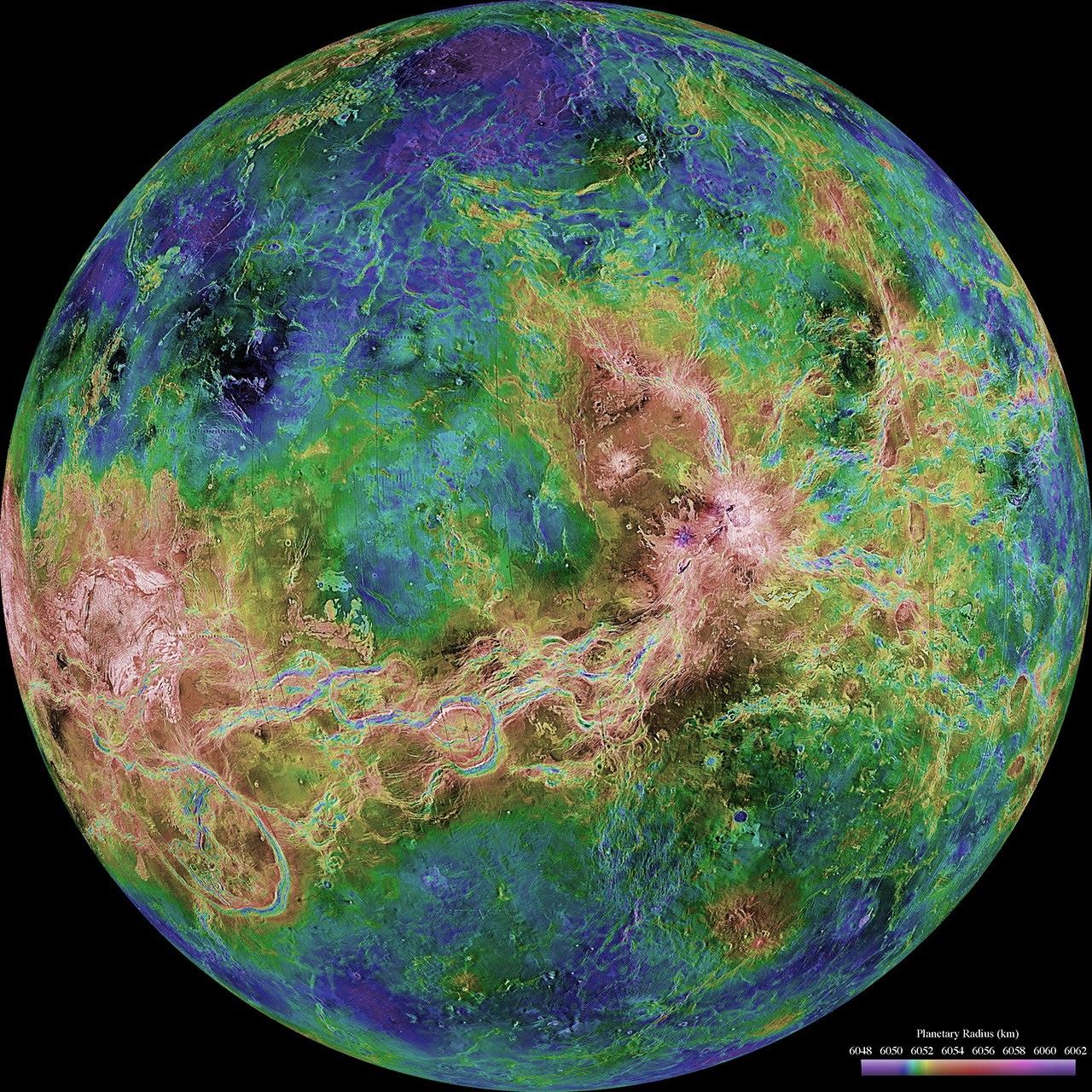
Venus is wrapped in permanent, unbroken cloud. Nobody can watch its surface rotate with a telescope. The rotation period was measured using radar: starting in the early 1960s, first with the American Mariner 2 flyby and ground-based radar at Goldstone, California, and refined by later missions including the Soviet Venera probes and NASA's Magellan orbiter in the 1990s. Radar waves bounce off the solid surface, pass back through the clouds, and reveal the ground turning underneath, even though nobody can see it.
Even now, the number is not perfectly settled. Different measurements taken decades apart have found Venus's rotation to be very slightly inconsistent, off by minutes, which some scientists think means the planet's spin rate actually shifts slightly over time, possibly because its thick atmosphere shifts momentum back and forth with the solid planet underneath it.
Why it matters
Venus is often called Earth's twin because it is close to the same size and made of similar rock. The comparison stops there. Its backwards, near year long day is one of several reasons Venus turned out so different from Earth, alongside its runaway greenhouse atmosphere that pushes surface temperatures to about 465 degrees Celsius, hot enough on every part of the planet, day or night, to melt lead.
That surface temperature barely changes between the Venusian day and night side despite the day lasting months, which is itself a clue: it shows that Venus's thick atmosphere, not sunlight, is what actually controls its surface temperature. A slow, backwards spin turns out to be a detail that reveals something about how an entire planet's climate can be dictated by its air rather than its Sun.