A robot has been climbing a mountain on Mars for 12 years
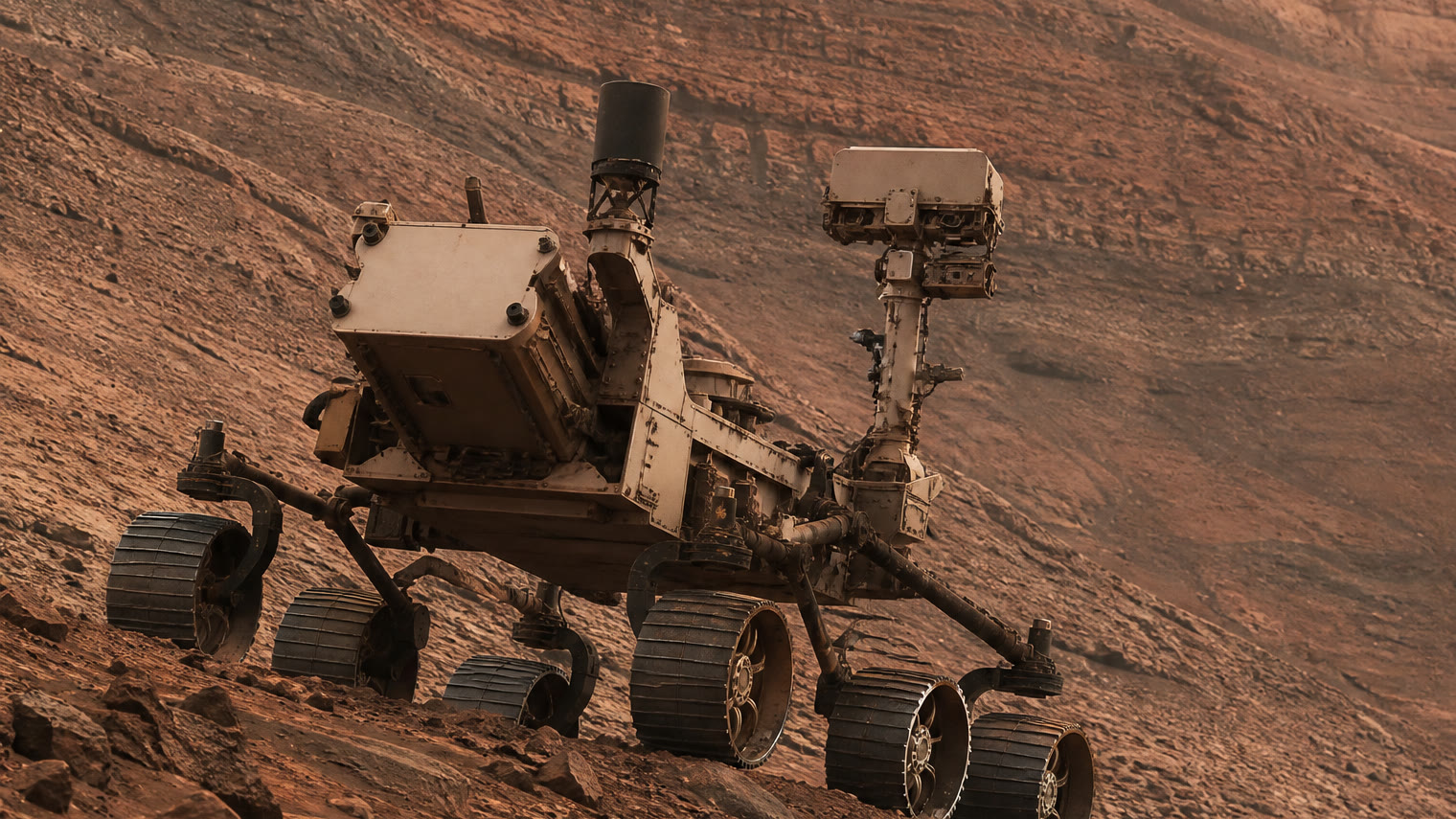
Illustration generated with AI for DomiVerseX
Far from home, a lonely machine keeps creeping up a dusty slope, one wheel turn at a time. It has passed a big round number on the way, and the reason it keeps going is not the one most people would guess.
This article contains affiliate links. If you buy through them, we may earn a small commission at no extra cost to you.
Mars is one of our neighbor planets, and there is a machine on it that has been doing the same slow job for a very long time. Its name is Curiosity. It landed on 6 August 2012, inside a giant hole in the ground called Gale Crater.
In the middle of that crater stands a mountain. It is called Mount Sharp, and it is about 5 kilometers tall. Picture 15 Eiffel Towers stacked on top of each other, and you are close.
In September 2014, Curiosity reached the bottom of that mountain. Then the robot started to climb. It has been climbing ever since.
If a baby had been born the week Curiosity reached the mountain, that child would now be about 12 years old and getting ready for middle school. The whole time that child was learning to walk, talk, read and ride a bike, a machine on another planet was inching uphill.
Why does this matter to you? Most things you own are old after five years. Your phone slows down, your sneakers fall apart. This robot has been working on a cold, dusty planet for longer than that, twice over, and nobody can drive out to fix it.
The long drive to the bottom of the hill
Curiosity did not land on the mountain. It landed on the flat crater floor, which looks a bit like a rusty desert with a wall of hills far away on every side.
From the landing to the foot of Mount Sharp took about two years. To be exact, NASA announced on 11 September 2014 that the rover had arrived. That is 766 days after it touched down, more than two full school years of driving before the real climb even began.
Even the starting point changed along the way. In 2014 the team chose a new place to start up the mountain, an area called Pahrump Hills, instead of the one first planned, called Murray Buttes. In NASA's 2014 announcement, John Grotzinger put it like this: "It has been a long but historic journey to this Martian mountain."
Why does this matter to you? Big plans change. Even a robot on Mars, with a team of experts behind it, had to switch its route when it got close and saw the ground for real.
One kilometer up
On 26 August 2026, NASA announced that Curiosity had reached 1 kilometer of elevation gain. NASA describes it as the height gained on the rover's journey from Gale Crater up the slope of Mount Sharp. NASA called it "the pinnacle, so far" of the mission, which by then was 14 years old.
One kilometer is about three Eiffel Towers stacked up. In feet, it is about 3,281.
That is the only number NASA has given. It is a round number, so the best way to say it is exactly that: one kilometer.
Now here is a number that we worked out ourselves. If you spread that kilometer evenly over every day from September 2014 to late August 2026, it comes to about 23 centimeters of height per day. That is an average, not a NASA figure. Real climbing is never that even. But on average, every single day, it rose a little more than the width of a sheet of printer paper.
Over a whole year, those small steps add up to about 84 meters. That is about the height of a building with 25 floors, climbed every year, year after year.
Why does this matter to you? Small steps work. Nobody would be impressed by 23 centimeters. Twelve years of them lifted a robot as high as three Eiffel Towers.
The view back down
To mark the moment, NASA shared a giant panorama. It was made from 323 pictures taken by a camera on the rover called Mastcam, on 1 and 2 August 2026. If you looked at each picture for 10 seconds, it would take you almost an hour to see them all.
The pictures were taken from a valley that the team nicknamed Valle Grande. The view looks back down the mountain to the crater floor and to the northern rim of the crater, far away, through a dusty summer sky.
NASA adjusted the colors so the scene looks the way it would to a human eye under the light we have on Earth. So when you look at it, you see roughly what you would see if you stood next to the rover.
Enjoying this story?
Get a short teaser by email whenever we publish something new. No spam.
Those two days had numbers too. They were sol 4,972 and sol 4,973. A sol is a day on Mars, and according to NASA's Astronomy Picture of the Day, it is about 40 minutes longer than a day on Earth. Over one week, that is more than four and a half extra hours. And nearly 5,000 sols on Mars come to close to 14 years here.
Why does this matter to you? Nobody has ever stood on Mars and looked down from that mountain. This picture is the closest any of us can get.
The twist: the top was never the goal
Here is the part the short video leaves out.
Mount Sharp is about 5 kilometers tall. Curiosity has climbed 1 kilometer. After 12 years, it is only about one fifth of the way up.
Think of a building with five floors. After 12 years of climbing, Curiosity has reached the top of the first floor.
If it kept the same average pace, the remaining 4 kilometers would take it close to 50 more years. That is a whole grown up life, from leaving school to getting old.
So is the mission a failure? Not at all. Reaching the summit was never the plan. The rock of Mount Sharp is stacked in layers, and the layers on the way up are the point. Every step higher puts the rover next to a different layer, and each new layer is something new to study.
It is a bit like reading a very tall stack of old letters, one by one, from the bottom. You do not need to reach the top letter for the reading to be worth it.
Why does this matter to you? Sometimes the most useful trip is not about the finish line. It is about what you see on the way.
A selfie from the middle of the climb
On 3 October 2026, NASA's Astronomy Picture of the Day showed a selfie of Curiosity. It is not a new picture. According to that page, it was taken on a ridge called Vera Rubin Ridge on sol 1,943, which was 23 January 2018.
That page also says the selfie was stitched together from 61 separate photos taken by a camera on the rover called MAHLI. Sixty one photos is about as many faces as you would find in two school class pictures, all pieced together into one image of a robot posing on a mountain.
By the time it took that picture, the robot had already been on Mars for more than five years. It still had more than eight years of climbing ahead before the kilometer mark.
Why does this matter to you? A machine built to explore has also been, for more than a decade, a kind of patient photographer. Every year it keeps working, it can send home more views of a place no person has visited.
How high will it get?
Nobody knows how this story ends.
NASA's own words were "the pinnacle, so far". Those last two words matter. They suggest the team does not see this as the end of the climb.
But no machine lasts forever. One day Curiosity's power or its wheels will give out, and the robot will stop where it stands. It might be a little higher than 1 kilometer. It might be a lot higher. As Space.com showed with the same panorama, the view from where it stands is already enormous.
So here is the question that nobody on Earth can answer yet: how high will Curiosity get before its power or its wheels finally give out?
Sources
- NASA's Mars Curiosity Rover Arrives at Martian Mountain, NASA
- Curiosity Reaches 1-Kilometer Elevation Gain, NASA Science
- APOD 2026 October 3, Selfie at Vera Rubin Ridge, NASA Science
- Curiosity climbs to new heights on Mars, Space photo of the day for Aug. 28, 2026, Space.com
- Mars Curiosity Reaches 1-Kilometer Elevation Gain, Astrobiology