The Coldest Place in the Universe
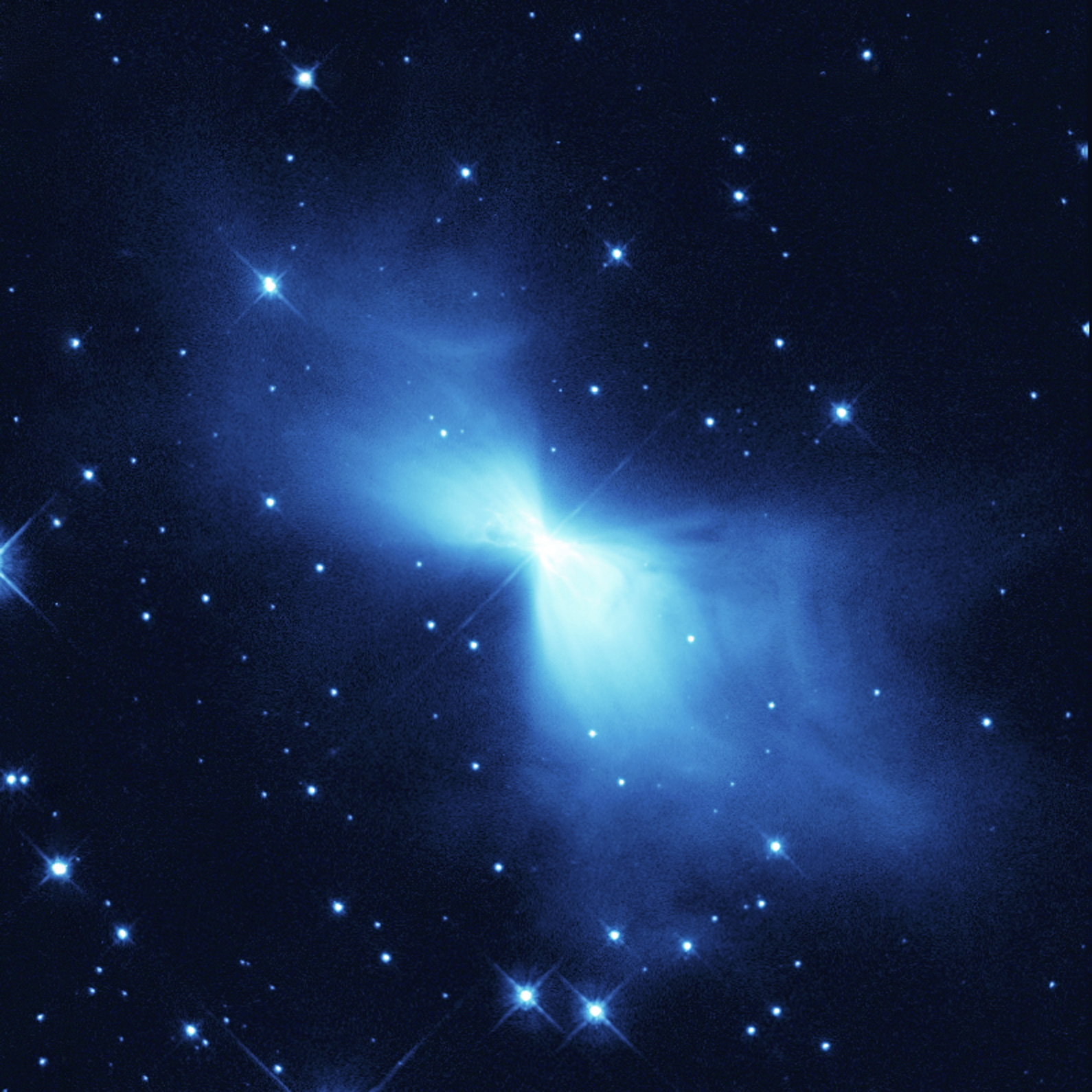
Credit: ESA/NASA, Hubble Space Telescope
Two nebulae, the same shape, the same cause, and temperatures at opposite ends of what the universe allows. One is a degree above absolute zero. The other is lit by a star hotter than 250,000 degrees.
This article contains affiliate links. If you buy through them, we may earn a small commission at no extra cost to you.
Two objects in our galaxy look like the same thing and behave like opposites.
Both are dying Sun-like stars. Both have thrown their outer layers into space in two opposing directions, producing a shape people describe as a butterfly, an hourglass, or a bow tie. Both got that shape for the same reason. And yet one of them is the coldest place ever found in the universe, while the other is heated by one of the hottest stars ever measured.
They are not a strange coincidence. They are the same process photographed at two different moments.
Why both look like butterflies
When a star of roughly one to eight solar masses runs out of nuclear fuel, it swells, becomes unstable, and begins shedding its outer layers. If nothing interfered, the discarded material would drift outward as a round shell, and many planetary nebulae do look roughly spherical.
Something does interfere. Both of these objects have a dense ring of gas and dust circling the star at its equator, a doughnut-shaped torus seen edge-on from Earth as a dark band across the middle. That torus blocks the outflow sideways. The only escape routes left are up and down, along the star's poles. Material funnels into two opposing lobes, and the result looks like wings.
The dark bar across the waist is not a gap in the nebula. It is the thing doing the shaping.
The one that runs cold
About 5,000 light-years away in Centaurus sits the Boomerang Nebula, at roughly 1 kelvin. That is about minus 272 degrees Celsius, one degree above absolute zero.
That number is stranger than it sounds. Space is not at absolute zero. It glows faintly everywhere at about 2.7 kelvin, the cooled-down afterglow of the Big Bang, and that radiation warms everything it touches. It sets a floor. The Boomerang is below the floor.
It manages this the way an aerosol can gets cold in your hand. When gas expands fast enough that no heat can flow in from outside, it spends energy it cannot replace, and its temperature drops. Physicists call it adiabatic cooling, and every refrigerator on Earth runs on a version of it.
The Boomerang's central star is doing this on a scale no laboratory can match. It is driving gas outward at roughly 500,000 kilometres per hour and has been doing so for about 1,500 years, losing something like one-thousandth of a solar mass every year. That is ten to a hundred times faster than comparable dying stars. The outflow is fast enough and thin enough that the expanding gas cools faster than the cosmic microwave background can warm it back up. The nebula is not sitting at the temperature of space. It is refrigerating itself, and winning.
Measuring this required a trick. You cannot send a thermometer 5,000 light-years. In 1995, Raghvendra Sahai and Lars-Ake Nyman pointed the 15-metre Swedish-ESO Submillimetre Telescope in Chile at the nebula and looked at its carbon monoxide molecules. A cloud only absorbs radiation passing through it if the cloud is colder than the source. The Boomerang's gas was absorbing the cosmic microwave background, coming out dimmer on the far side. That is not an inference. It is a direct statement that this gas is colder than the leftover heat of the Big Bang.
There is one more twist. In 2013, ALMA mapped the cold gas directly instead of the light reflecting off dust, and found the famous bow-tie shape only in the inner regions. Further out, the nebula is broad and rounded. The hourglass turns out to be a lighting effect: the dust ring lets starlight escape in only two narrow directions, and those beams illuminate an hourglass across a cloud that is nothing of the sort. For thirty years astronomers had been looking at a shadow and calling it a shape.
The butterfly that runs hot
Enjoying this story?
Get a short teaser by email whenever we publish something new. No spam.
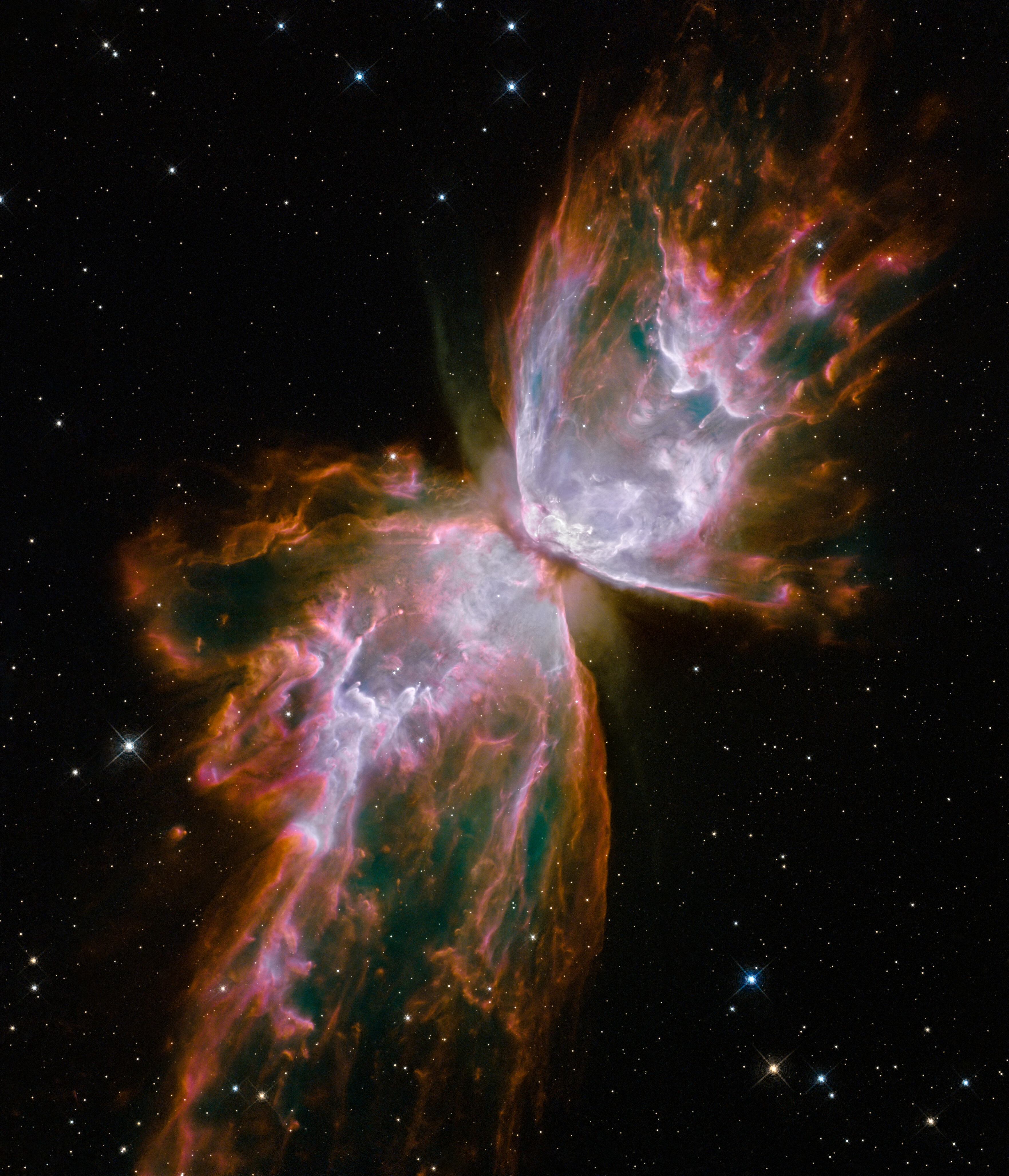
About 3,400 to 3,800 light-years away in Scorpius sits NGC 6302, the Butterfly Nebula. Its wings stretch roughly three light-years, and it is one of the best-studied planetary nebulae in the galaxy.
At its centre is a white dwarf of about two-thirds the Sun's mass, the exposed core of a star that may once have been five times heavier than the Sun. It has a surface temperature above 250,000 degrees Celsius, making it one of the hottest stars known. It was not directly identified until 2009, when Hubble's newly installed Wide Field Camera 3 finally picked it out, because the same dust torus that shapes the nebula also hides the star.
That star is the reason the Butterfly glows in colour. Its ultraviolet radiation ionises the surrounding gas, heating it to around 20,000 degrees Celsius and making it emit light. The orange and red come from nitrogen and sulphur, the blue from hydrogen. Sharp white edges inside the wings are shock fronts, places where fast gas ejected recently is slamming into slower gas thrown off earlier.
The same story, two chapters
Here is the part worth sitting with.
The Boomerang is a pre-planetary nebula. Its central star has not finished shedding its envelope and is not yet hot enough to ionise the gas around it. Nothing there is glowing under its own power. What we see is starlight bouncing off dust, which is why it looks so pale.
NGC 6302 is further along the same road. Its envelope has been expelled, its scorching core is exposed, and that core is now lighting up the material it threw away.
So the difference between one degree above absolute zero and a quarter of a million degrees is not a difference in kind. It is a difference in timing. The cold comes from the throwing. The heat comes from what is left behind once the throwing is done. The Boomerang is what an object like the Butterfly looked like earlier, before the core was uncovered.
This is also why the Boomerang will not stay a record-holder. The 2013 ALMA observations already found its outer fringes beginning to warm. When the central star finishes its work, the wind stops, the expansion slows, and the background radiation gets its way. The nebula will drift up to about 2.7 kelvin like everything else, then disperse.
We happen to be alive during the few thousand years in which it is anomalous.
Why this matters for us
In roughly five billion years our own Sun will exhaust its hydrogen, swell into a red giant, and begin discarding its outer layers. Whether the Solar System's remains end up looking like a sphere, a bow tie or a butterfly depends on details we are still working out, and objects like these are how we work them out. Extreme cases test theories hardest. A model of stellar mass loss that cannot produce a nebula as cold as the Boomerang is a model with a problem.
There is also something worth noticing about how the coldest measurement was made. The cosmic microwave background is normally the object of study, the fossil record of the early universe. Here it was used as a backlight, a uniform lamp placed behind the thing astronomers actually wanted to measure. The oldest light in existence became a thermometer for a star's death throes.
And then there is the plain fact of it. A dying star, using nothing more exotic than expanding gas, cooled a patch of space below the temperature the Big Bang left behind. No laboratory on Earth went colder until physicists deliberately engineered it with lasers and magnetic traps. The universe got there first, by accident, on its way to putting a star out.
Sources
- NASA JPL, Boomerang Nebula Boasts the Coolest Spot in the Universe (1997)
- NASA JPL, Ghostly Specter Haunts the 'Coldest Place in the Universe' (2013)
- ESA/Hubble, The Boomerang Nebula: the coolest place in the Universe?
- NRAO, ALMA Reveals Ghostly Shape of Coldest Place in the Universe (2013)
- ESA/Hubble, Butterfly emerges from stellar demise in planetary nebula NGC 6302
- NOIRLab, Gemini South Celebrates 25th Anniversary With a Snapshot of the Butterfly Nebula