One of the Biggest Stars Ever Found
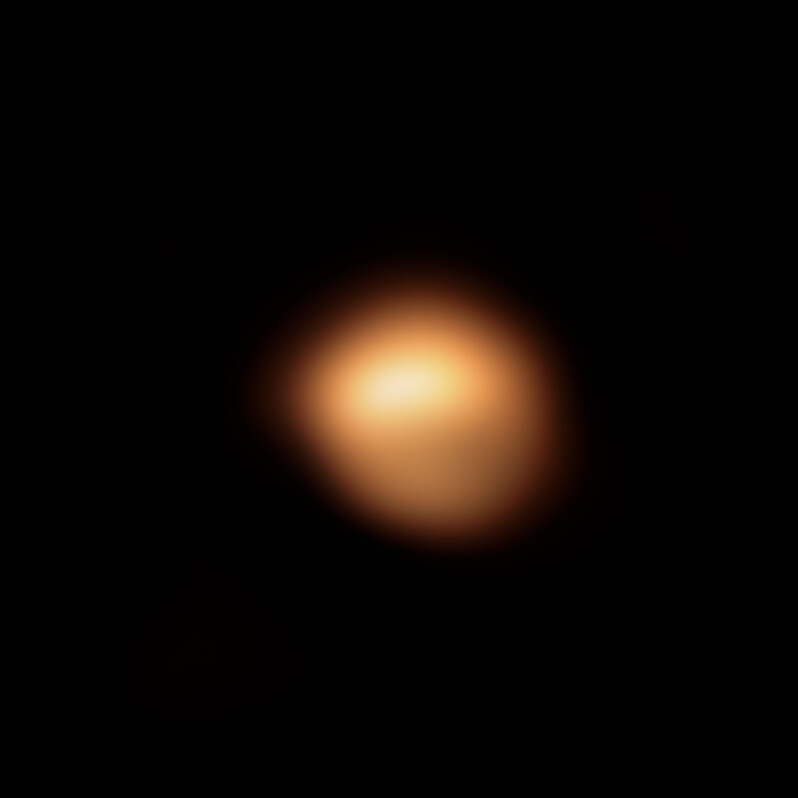
Credit: ESO/M. Montargès et al. (CC BY 4.0)
Nearly ten billion Suns could fit inside this star, and astronomers still argue about exactly how big it is.
This article contains affiliate links. If you buy through them, we may earn a small commission at no extra cost to you.
Nineteen thousand light-years away burns Stephenson 2-18. If its published size is right, nearly ten billion Suns would fit inside it. Astronomers still argue about the exact number, and the story of why reveals something about how hard it actually is to measure something you can never visit.
A record that keeps moving
Stephenson 2-18 is not the first star to hold the biggest known title. For years, that title belonged to UY Scuti, thought to be about 1,700 times wider than the Sun. Then the Gaia space telescope, launched to measure the precise positions and distances of over a billion stars, produced a new distance estimate for UY Scuti: closer to Earth than previously assumed.
That single correction changed everything about its size. A star's apparent brightness depends on both how much light it actually produces and how far away it is. If a star turns out to be closer than assumed, less of its true brightness is needed to explain what we see from here, which usually means the star is smaller than assumed too. After Gaia's correction, UY Scuti's estimated size dropped to somewhere between about 750 and 900 solar radii, still enormous, but roughly half of what was once claimed.
How you measure a star you can never visit
Nobody can wrap a tape measure around a star trillions of kilometers away. Astronomers instead combine three numbers: how bright the star appears from Earth, how hot its surface is, found by analyzing its spectrum of light, and how far away it sits. Those three numbers, run through the physics of how hot objects radiate light, produce an estimated radius.
The distance is the number that causes the most trouble. A small error in distance produces a much larger error in the calculated size, because brightness falls off with the square of distance. That is exactly the error that inflated UY Scuti's original estimate, and it is why the biggest star record is really a leaderboard that gets rewritten every time distance measurements improve, not a fixed fact waiting to be confirmed.
Stephenson 2-18, and the limit it seems to break
Enjoying this story?
Get a short teaser by email whenever we publish something new. No spam.
Stephenson 2-18 sits in the constellation Scutum and is classified as a red supergiant, one of a class of stars sometimes called hypergiants when they approach the extreme end of the size range: a star that has swelled to enormous size in the final stages before it exhausts its fuel. Published estimates put its radius at around 2,150 times the Sun's, based on its distance and luminosity as measured in survey data.
That number is the center of a real scientific dispute. Stellar models predict red supergiants should not be able to exceed roughly 1,500 solar radii, a limit set by the physics of how much a star's own outward-pushing radiation and pulsations can support before it becomes unstable and sheds mass faster than it can hold together. Stephenson 2-18's published size sits comfortably past that predicted ceiling.
There is no settled resolution yet. Some researchers think the published size estimate is simply too high, likely because of the same kind of distance or brightness uncertainty that affected UY Scuti; Stephenson 2-18's distance is less precisely measured than closer, better-studied stars. Others think the theoretical upper limit itself may need revising, since it depends on assumptions about how these stars lose mass that are still being refined. Until a more precise distance is available, probably from a future Gaia data release or a dedicated follow-up observation, the honest answer is that nobody knows for certain which explanation is correct.
Why this keeps being worth checking
Every time a star's measured size changes, it is a live demonstration of the scientific method working exactly as intended: a new instrument produces a better distance, the better distance produces a better size, and a previously confident number gets revised in public. That is not a flaw in astronomy. It is what separates a science that updates itself from a fixed record book.
It also matters beyond bragging rights. The theoretical limit on how large a star can grow is tied directly to models of how stars live, lose mass, and eventually die, models used across essentially all of stellar astrophysics. If a real star turns out to reliably exceed that limit, the models need to change. If Stephenson 2-18's size turns out to be a measurement error once corrected, the limit holds. Either outcome teaches astronomers something they did not know for certain before, which is the actual reason a handful of astronomers keep arguing about a star nobody will ever get close to.
Sources
- Arroyo-Torres et al. 2013, The atmospheric structure and fundamental parameters of the red supergiants AH Scorpii, UY Scuti, and KW Sagittarii, A&A 554, A76
- Beasor et al. 2020, Theoretical investigation of the Humphreys-Davidson limit at high and low metallicity, A&A 635, A175
- Space.com, What is the biggest star in the universe?