Something From Outside Our Solar System Just Passed Within Reach of Mars, and Scientists Still Can't Agree on What It Is
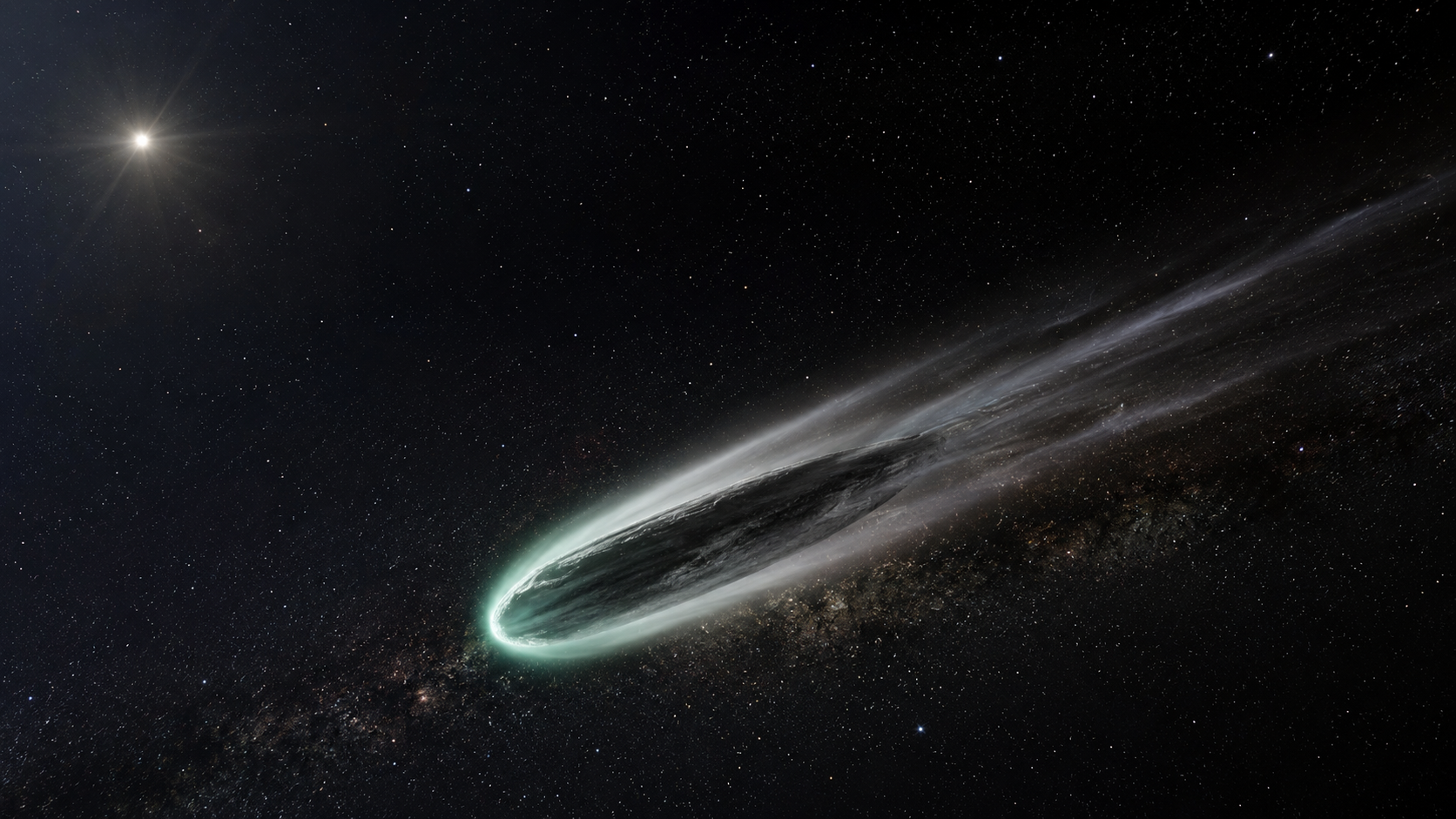
Illustration by Domi Verse X
A Harvard astrophysicist says the interstellar object now leaving our solar system might not be a rock. Almost every other scientist disagrees, and nobody can fully explain why it's behaving the way it is.
This article contains affiliate links. If you buy through them, we may earn a small commission at no extra cost to you.
One of the most respected astrophysicists in the world just said something most scientists refuse to say out loud: that an object flying through our solar system right now might not be a rock. It's called 3I/ATLAS, and it came from somewhere no comet has ever come from before, another star system entirely. Almost everyone disagrees with him. But nobody can fully explain why it's behaving the way it is.
Astronomers call it 3I/ATLAS, only the third interstellar object ever confirmed passing through our solar system, after 'Oumuamua in 2017 and Borisov in 2019. This time, though, the argument over what it actually is has gone further, and stayed louder, longer than it did for either of the first two.
What Is 3I/ATLAS?
3I/ATLAS was discovered on July 1, 2025, by the ATLAS survey telescope network, the same system built to catch dangerous near Earth asteroids before they catch us. The "3I" in its name simply means it is the third confirmed interstellar object, and "ATLAS" credits the telescope that found it.
Unlike anything born in our solar system, 3I/ATLAS never orbited the Sun. It arrived from the direction of the constellation Sagittarius at roughly 137,000 miles per hour, a speed so extreme that the Sun's gravity could never hold onto it. It swept through on a hyperbolic trajectory, meaning it is a one time visitor. Once it leaves, it is gone for good.
NASA and the European Space Agency both classify it as a comet: an icy nucleus surrounded by a coma, the bright cloud of gas and dust that forms as ice warms and vaporizes near the Sun. Hubble Space Telescope observations from August 2025 put its nucleus somewhere between 440 meters and 5.6 kilometers across, a wide range because a bright coma makes it hard to measure the solid core underneath.
The Numbers That Made It Famous
3I/ATLAS reached perihelion, its closest point to the Sun, on October 30, 2025, passing about 130 million miles away, just outside the orbit of Mars. For a few days around that point it disappeared behind the Sun from Earth's point of view, then reappeared on October 31 for astronomers to keep watching.
From there its path curved it toward Jupiter, with its closest approach to the giant planet expected around March 2026. That flyby is also the reason Harvard astrophysicist Avi Loeb proposed something unusual: redirecting NASA's aging Juno spacecraft, already in Jupiter's neighborhood, to attempt a closer look as 3I/ATLAS passed by.
New research published in 2025 and 2026 also found something genuinely unusual about how the comet releases water. A study using data from the SOHO spacecraft's SWAN instrument, along with other observations, described a water production pattern that behaves differently from typical solar system comets, one more piece of evidence that interstellar visitors don't necessarily play by the same rules as the comets born in our own backyard.
Most of what scientists know about 3I/ATLAS comes from professional observatories, but ordinary backyard comets pass close enough to Earth most years to see with modest equipment. A beginner-friendly refractor like the Celestron Inspire 100AZ has become a popular pick for exactly this kind of comet-watching, since it sets up quickly and doesn't require any prior astronomy experience to get a usable view.
A Comparison Straight Out of Science Fiction
As 3I/ATLAS moved through the solar system, Loeb kept reaching for one specific comparison to describe it: Arthur C. Clarke's 1973 novel "Rendezvous with Rama," in which a giant, perfectly cylindrical alien spacecraft passes silently through the solar system, brushes close to the Sun, and continues on without ever slowing down or explaining itself. Loeb has titled several of his own public updates on the object "Rendezvous with 3I/ATLAS," drawing a direct, deliberate line between the fictional scenario and the real comet now leaving our solar system for good.
It's a striking image: a visitor that arrives without warning, moves too fast and too precisely to be pinned down, and disappears again before anyone can prove exactly what it was. But that comparison is Loeb's own framing, not a conclusion from NASA, ESA, or any peer reviewed study, and it says more about how he chooses to interpret the data than about what the data actually shows. Nothing observed so far, including by Loeb himself, has produced direct evidence of engineering, propulsion, or structure. What exists is a set of statistical oddities that Loeb reads as suspicious, and that most other astronomers read as ordinary comet behavior playing out in an unfamiliar way, because the comet itself came from somewhere ordinary rules were never written for.
Enjoying this story?
Get a short teaser by email whenever we publish something new. No spam.
The Alien Probe Claim
This is where the story became impossible to ignore. Avi Loeb, a Harvard professor and one of the most publicly outspoken scientists working today, has spent the past year arguing that 3I/ATLAS deserves serious consideration as a potential piece of extraterrestrial technology, not just a comet.
Loeb has pointed to a list of what he calls anomalies: an unusual orbital alignment that brings the object unusually close to Mars, Venus and Jupiter, a nickel to iron ratio he says doesn't match typical comets, polarization readings, an anti-tail pointing toward the Sun instead of away from it, and a brightening pattern he argues is faster than a simple ice ball should produce. By mid-2026 Loeb had expanded this into a running list of over 20 items, which he has continued publishing and updating as new data comes in. He has publicly urged NASA to release additional imagery of the object and has floated the idea that it could represent a reconnaissance mission, comparing the scenario to a "1 in 4" chance of some kind of technological origin in his own public statements.
It is worth being clear about what Loeb is not saying. He has not claimed 3I/ATLAS is confirmed to be artificial. His argument is that the possibility is scientifically worth investigating rather than dismissing outright, and that the object's unusual traits deserve closer scrutiny than a routine comet would get. Readers who want Loeb's full case in his own words, going back to his first interstellar-object controversy over 'Oumuamua in 2017, can find it laid out in his book Extraterrestrial: The First Sign of Intelligent Life Beyond Earth.
What Mainstream Scientists Say
The response from the rest of the astronomical community has been close to unanimous, and unusually blunt for a scientific disagreement. NASA's own public materials on 3I/ATLAS describe it purely as a natural comet and do not engage with the artificial object claims at all.
Jason Wright, an astronomy professor at Penn State who has spent years studying the search for extraterrestrial technology, published a detailed point by point rebuttal of Loeb's anomaly list. His central argument is that comets are simply unpredictable by nature. Every comet behaves a little differently, and an interstellar one, shaped by a different star system entirely, should be expected to look stranger than anything native to our solar system, not because it's artificial, but because it never had to follow our local rules.
Wright walked through many of Loeb's specific claims. The orbital alignment Loeb flagged as improbable, Wright argued, is a case of calculating the odds after the fact rather than predicting them in advance, a well known statistical trap. The anti-tail and jet features Loeb cited as unusual are documented phenomena that astronomers have understood in other comets for decades. The unusual nickel and water readings fall within the range of what is already known about comet chemistry, since there is no single fixed ratio that all comets are required to share. Even the object's rapid brightening, Wright noted, is expected physics: 3I/ATLAS is approaching the Sun faster than a typical solar system comet, giving it less time to heat gradually at each distance, which naturally produces a steeper brightening curve.
Wright's blunt conclusion was that no planetary scientists give Loeb's technological explanation serious credence, not out of closed mindedness, but because the natural explanations already account for what's being observed.
Where Is It Now?
As of mid-2026, 3I/ATLAS has already made its closest pass by Jupiter and is now fading as it continues its one way trip back out of the solar system, never to return. Loeb continues to track and publish updates on the object even as its brightness drops, and some recent reporting suggests his own position has softened somewhat, with outlets describing him as increasingly open to the idea that the object is, in his words, most likely natural, even as he keeps a running list of items he considers worth explaining. And whatever it turns out to be, both NASA and ESA have been clear on one point: at its closest approach to Earth, on December 19, 2025, it stayed about 270 million kilometers away, and it "posed no threat to Earth."
Whatever its true nature, 3I/ATLAS has already done something rare: it turned a technical astronomy story into a genuine public argument, one playing out in real time between a Harvard professor willing to say the unthinkable out loud and a scientific community insisting the ordinary explanation still fits the evidence.
Sources
- NASA Science: 3I/ATLAS Facts and FAQs
- ESA: Comet 3I/ATLAS frequently asked questions
- Jason Wright (Penn State), AstroWright: Loeb's 3I/ATLAS "Anomalies" Explained
- Avi Loeb, Medium: 3I/ATLAS Is Fading Away, Leaving Us to Ponder Over Its 22 Mysterious Anomalies
- Avi Loeb, Medium: Intercepting 3I/ATLAS at Its Closest Approach to Jupiter with the Rejuvenated Juno Spacecraft
- IOPscience: Water Production Rates of the Interstellar Object 3I/ATLAS
- NewsNation: Harvard professor now agrees 3I/ATLAS "most likely natural"
- Avi Loeb, Medium: Rendezvous with 3I/ATLAS