
Only One Company on the Planet Knows How to Build This Machine
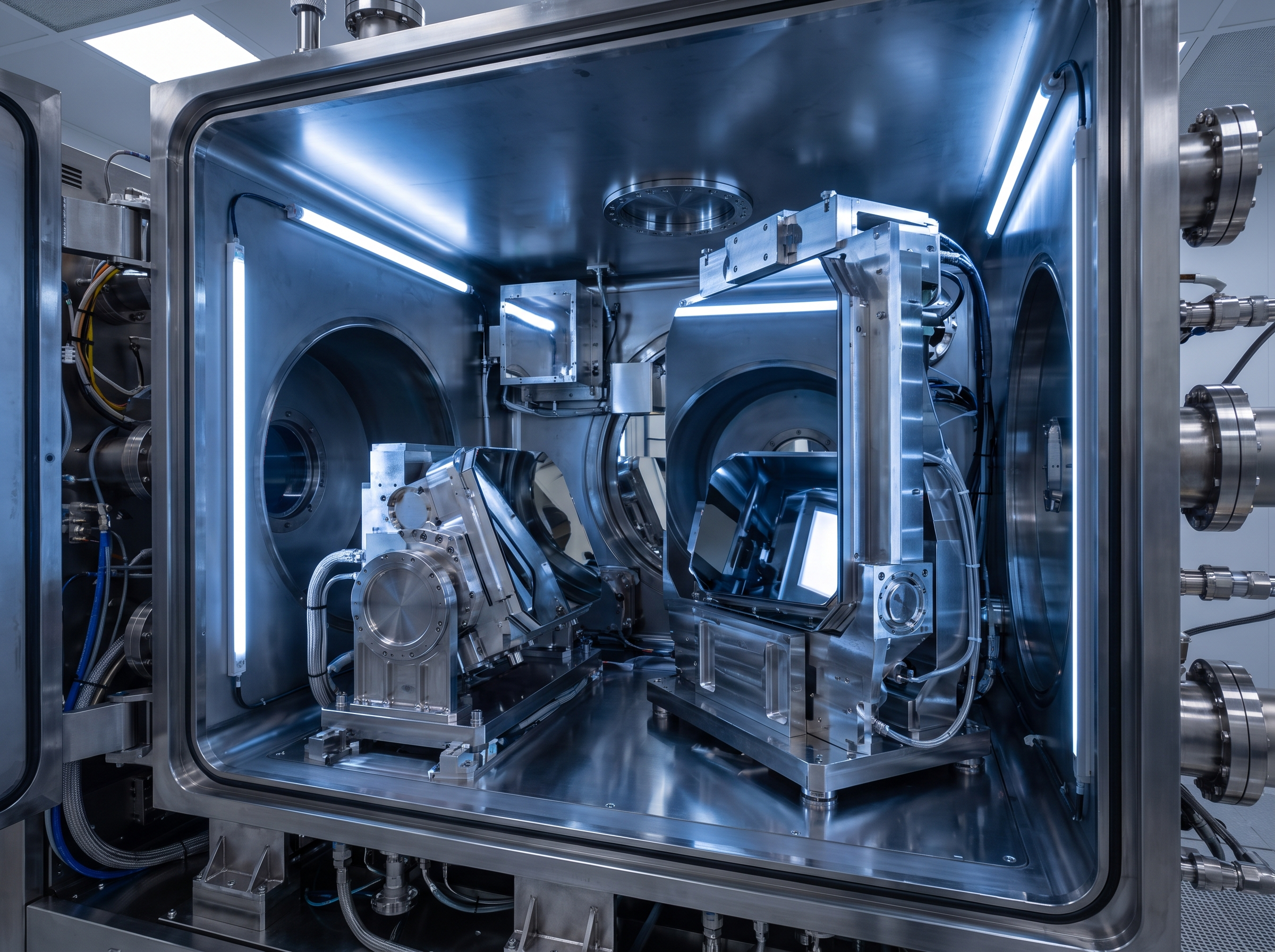
AI-generated illustration
Every leading-edge chip on Earth is printed with light made by blasting 50,000 droplets of molten tin every second. Here is how the machine works, and why nobody else builds it.
This article contains affiliate links. If you buy through them, we may earn a small commission at no extra cost to you.
Every advanced chip made in the last several years, in every phone and laptop and data centre on Earth, was printed by a machine built by one company in the Netherlands.
That company is ASML. Nobody else makes an extreme ultraviolet lithography system. Not a competitor with less market share. Nobody.
Why the light had to change
Chipmaking is printing. You shine light through a patterned mask onto a silicon wafer coated in photoresist, and the light defines the circuit.
The limit is wavelength. You cannot reliably print features much smaller than the light you are printing with. For years the industry used deep ultraviolet at 193 nanometres and got below that limit through increasingly baroque multi-patterning tricks, exposing the same wafer several times with offset masks to build one fine pattern out of several coarse ones.
Below roughly 10 nanometres, that approach became unmanageable. The industry needed shorter light.
It settled on 13.5 nanometres, chosen from a range between 4 and 40 as the practical sweet spot for generating usable extreme ultraviolet from tin plasma.
The problem with that light
Extreme ultraviolet at 13.5 nm is absorbed by almost everything, including air.
That single fact reshapes the entire machine. The light cannot travel through a normal atmosphere, so the whole optical path has to sit inside a high vacuum. It cannot be focused through lenses, because it would be absorbed by the glass, so the optics are mirrors, coated in dozens of alternating layers engineered to reflect a wavelength that materials do not naturally reflect.
There is also no lamp or laser that simply emits it at useful power. It has to be manufactured, continuously, from scratch.
How the light is made
Enjoying this story?
Get a short teaser by email whenever we publish something new. No spam.
This is the part that sounds invented.
A generator fires droplets of molten tin into a vacuum chamber at a rate of 50,000 per second. Each droplet is about 25 micrometres across, roughly a third the width of a human hair, travelling at around 70 metres per second.
Each droplet is hit twice by a high-power carbon dioxide laser. The first pulse flattens it into a pancake. The second, far more powerful, vaporises it into a plasma at roughly 40 times the temperature of the Sun's surface. That plasma emits a burst of light at 13.5 nm.
Then the next droplet arrives, 20 millionths of a second later, and it happens again. 100,000 laser pulses per second, continuously, for as long as the machine is printing chips. A good popular book on the semiconductor industry will tell you how this became a monopoly; the physics above is why it stayed one.
The number that is about to change
ASML has demonstrated a pre-production source running at 1,000 watts, up from 600. The route to that power is more tin: doubling the droplet rate to 100,000 per second and going from two laser pulses per droplet to three, which is 300,000 pulses per second.
The target is mass production readiness by 2030, at 330 wafers per hour against roughly 220 for current systems. ASML has said it sees a clear path to 1,500 watts and no fundamental barrier at 2,000.
The caveat this article needs
The monopoly is a fact about 2026, not a law of nature.
ASML's position rests on a supply chain nobody has replicated: Zeiss for the optics, Trumpf for the drive lasers, and several decades of accumulated engineering that came out of a multinational research effort rather than one company's laboratory. That is extremely hard to duplicate. It is not impossible, and there are well-funded national programmes explicitly trying.
So the accurate framing is this. As of 2026, one company builds the machine that every leading-edge chip depends on, and a single site in the Netherlands is a genuine chokepoint in the global economy. If you are reading this years from now, that sentence is the one to check first.