Nobody Understood Why the Workers Were Dying Until the Bridge Was Almost Done
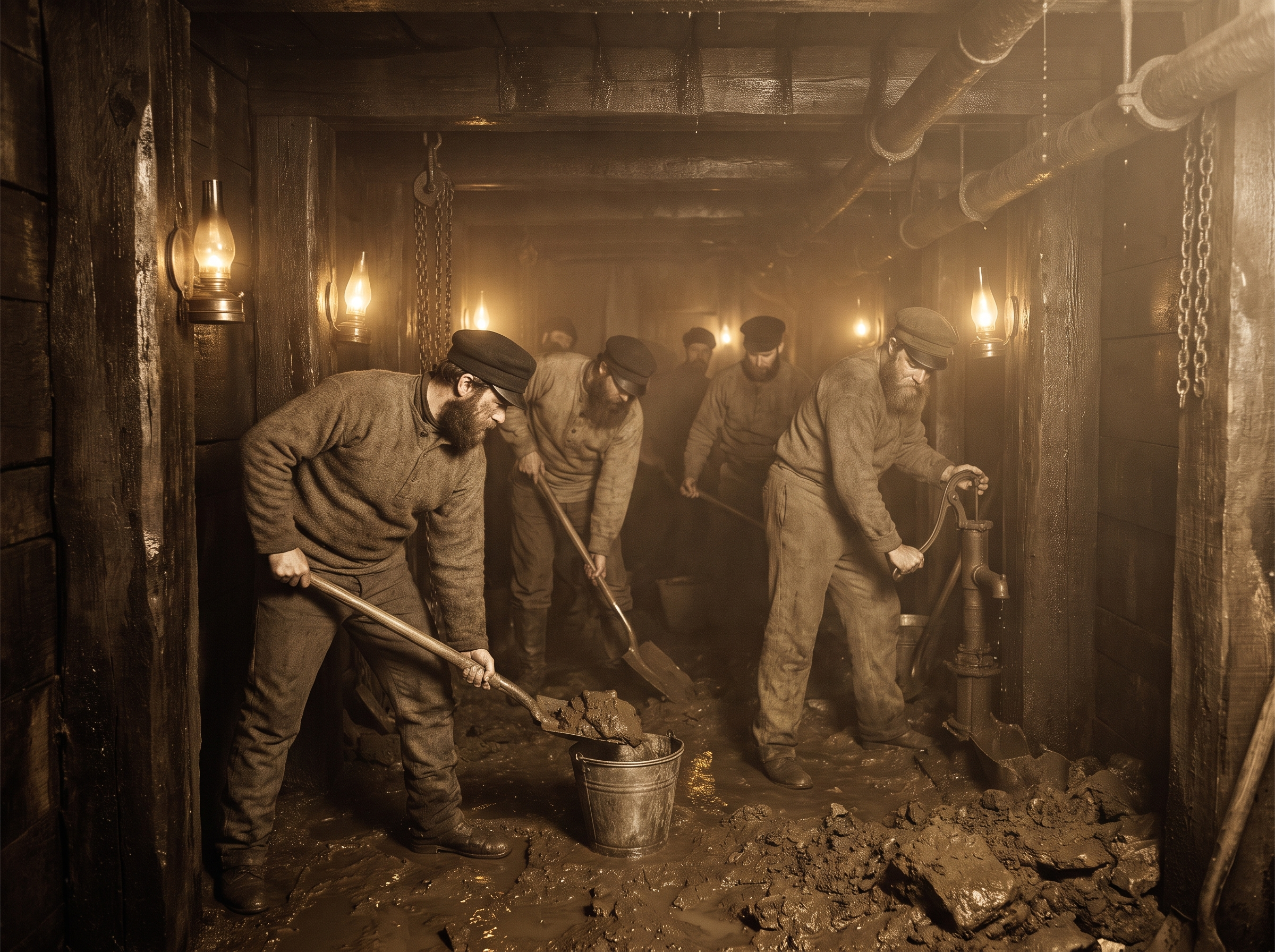
AI-generated illustration
Men dug the Brooklyn Bridge foundations in pressurised boxes under the river, and coming back up crippled them. One of the victims was the chief engineer.
This article contains affiliate links. If you buy through them, we may earn a small commission at no extra cost to you.
To stand a bridge tower in a riverbed you first have to reach the riverbed. In 1870 the way to do that was a caisson: an enormous upturned timber box, open at the bottom, pumped full of compressed air to hold the water out while men dug beneath it.
The Brooklyn caisson went down in January 1870. The New York one followed in September 1871. Inside, the temperature sat around 27°C, the light came from lamps, and the master mechanic on site described half-naked men working in dim uncertain light in terms borrowed directly from Dante.
The digging was not what killed them. Coming back up was.
The thing nobody had a name for
Men who left the caisson and returned to normal pressure started collapsing. The symptoms arrived within minutes to hours: crushing joint pain, cramps, dizziness, paralysis. Workers described the headache as being shot and the limb pain as having the flesh stripped from the bone.
The first cases appeared once the digging passed about fifteen metres. At eighteen metres men began suffering paralysis. The deeper the caissons went, the worse it got.
They called it the bends, because the pain doubled men over. Physicians called it caisson disease and argued about the cause. Was it the cold? The exertion? The foul air?
The actual mechanism is dissolved gas. Under pressure, nitrogen dissolves into the blood and tissues. Come up slowly and it leaves harmlessly through the lungs. Come up fast and it comes out of solution where it sits, forming bubbles in joints, in the spinal cord, in the brain.
Who paid for it
Death counts vary by source. The American Society of Civil Engineers puts it at 20 men killed during construction. New York City archival material places the figure at roughly 27. Those totals include falls, fires and explosions as well as caisson disease.
The number of men crippled rather than killed was far higher. The Museum of the City of New York puts it at over one hundred men killed or severely debilitated by caisson disease alone.
One of them was the chief engineer.
The Roeblings
Enjoying this story?
Get a short teaser by email whenever we publish something new. No spam.
John Augustus Roebling designed the bridge and never saw a stone of it laid. In June 1869, surveying tower positions near the Fulton Ferry, a docking boat crushed his foot against a piling. He refused conventional treatment in favour of hydrotherapy. Tetanus set in and he was dead within a month.
The job passed to his 32-year-old son, Washington.
Washington Roebling made a decision that reads as either principled or reckless depending on the day: to keep morale up, he stayed in the caissons longer than his own workers. In December 1870 a fire took hold in the timber ceiling of the Brooklyn caisson, hidden and fed by the compressed air, and he spent a harrowing night down there fighting it. He came up with the bends and partially recovered.
In early 1872 he went down again in the New York caisson, worked twelve straight hours, and came up too fast. This time he did not recover. He never returned to the site.
Emily
Washington Roebling directed the remaining eleven years of construction from a window overlooking the river.
His wife Emily Warren Roebling learned the mathematics and the engineering, carried his instructions to the site, managed the contractors, handled the politics, and when there was a move to replace him as chief engineer she lobbied successfully to keep him in the post.
The bridge opened on 24 May 1883. Washington watched from his window as Emily accompanied President Chester Arthur across it.
When the understanding actually arrived
The title of this piece needs a correction, and here it is.
The bridge's own physician, Andrew Smith, named caisson disease in 1873 and correctly connected it to the speed of decompression. That was during construction, not after it. So the men were not working in total ignorance for the full thirteen years.
What did not exist until much later was a working physiological model and a safe procedure built on it. That came from John Scott Haldane's decompression tables, published in 1908, a quarter of a century after the bridge opened. Smith knew what was happening. Nobody yet knew how to reliably prevent it.
The distinction matters because the Brooklyn Bridge is usually told as a story of heroic ignorance. It is closer to a story of partial knowledge arriving too slowly to help the people it was about.